

178 5 “Sphere to tangential plane”: polar (normal) aspect
5-242 Case 2: equatorial plane of reference
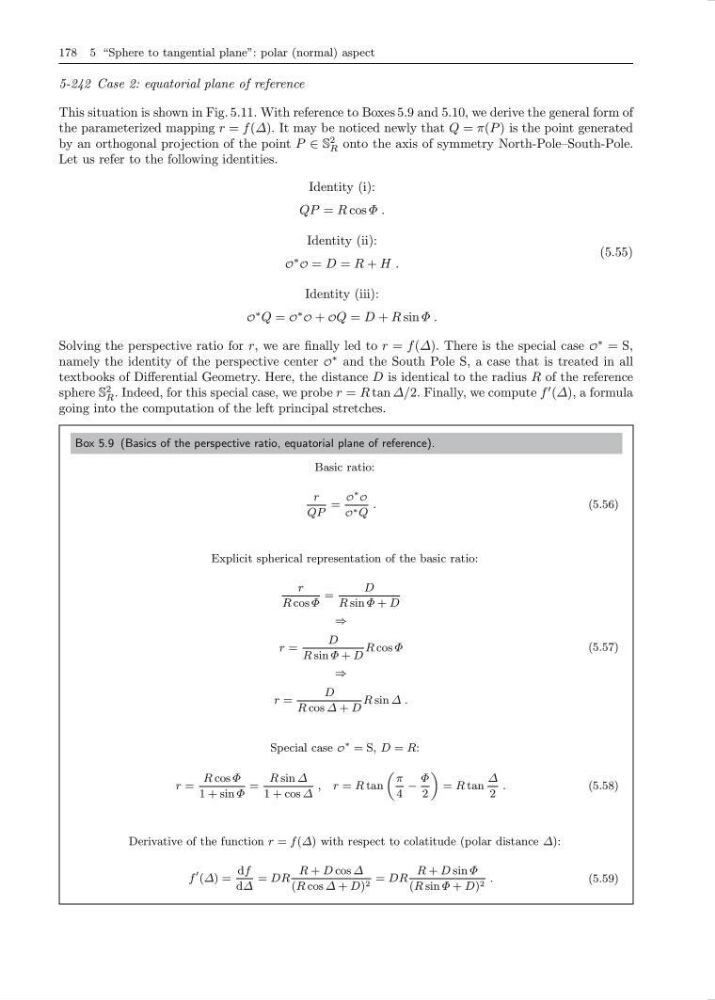
This situation is shown in Fig. 5.11. With reference to Boxes 5.9 and 5.10, we derive the general form of
the parameterized mapping r = f (∆). It may be noticed newly that Q = π(P ) is the point generated
by an orthogonal projection of the point P ∈ S
2
R onto the axis of symmetry North-Pole–South-Pole.
Let us refer to the following identities.
Identity (i):
QP = R cos Φ .
Identity (ii):
O
∗ O = D = R + H .
Identity (iii):
O
∗ Q = O
∗ O + OQ = D + R sin Φ .
(5.55)
Solving the perspective ratio for r, we are finally led to r = f (∆). There is the special case O
∗ = S,
namely the identity of the perspective center O
∗ and the South Pole S, a case that is treated in all
textbooks of Differential Geometry. Here, the distance D is identical to the radius R of the reference
sphere S
2
R . Indeed, for this special case, we probe r = R tan ∆/2. Finally, we compute f
(∆), a formula
going into the computation of the left principal stretches.
Box 5.9 (Basics of the perspective ratio, equatorial plane of reference).
Basic ratio:
r
QP
=
O
∗ O
O ∗ Q
.
(5.56)
Explicit spherical representation of the basic ratio:
r
R cos Φ
=
D
R sin Φ + D
⇒
r =
D
R sin Φ + D
R cos Φ
⇒
r =
D
R cos ∆ + D
R sin ∆ .
(5.57)
Special case O
∗ = S, D = R:
r =
R cos Φ
1 + sin Φ
=
R sin ∆
1 + cos ∆
, r = R tan
„
π
4
−
Φ
2
«
= R tan
∆
2
.
(5.58)
Derivative of the function r = f (∆) with respect to colatitude (polar distance ∆):
f
(∆) =
df
d∆
= DR
R + D cos ∆
(R cos ∆ + D) 2 = DR
R + D sin Φ
(R sin Φ + D) 2 .
(5.59)
5-242 Case 2: equatorial plane of reference
This situation is shown in Fig. 5.11. With reference to Boxes 5.9 and 5.10, we derive the general form of
the parameterized mapping r = f (∆). It may be noticed newly that Q = π(P ) is the point generated
by an orthogonal projection of the point P ∈ S
2
R onto the axis of symmetry North-Pole–South-Pole.
Let us refer to the following identities.
Identity (i):
QP = R cos Φ .
Identity (ii):
O
∗ O = D = R + H .
Identity (iii):
O
∗ Q = O
∗ O + OQ = D + R sin Φ .
(5.55)
Solving the perspective ratio for r, we are finally led to r = f (∆). There is the special case O
∗ = S,
namely the identity of the perspective center O
∗ and the South Pole S, a case that is treated in all
textbooks of Differential Geometry. Here, the distance D is identical to the radius R of the reference
sphere S
2
R . Indeed, for this special case, we probe r = R tan ∆/2. Finally, we compute f
(∆), a formula
going into the computation of the left principal stretches.
Box 5.9 (Basics of the perspective ratio, equatorial plane of reference).
Basic ratio:
r
QP
=
O
∗ O
O ∗ Q
.
(5.56)
Explicit spherical representation of the basic ratio:
r
R cos Φ
=
D
R sin Φ + D
⇒
r =
D
R sin Φ + D
R cos Φ
⇒
r =
D
R cos ∆ + D
R sin ∆ .
(5.57)
Special case O
∗ = S, D = R:
r =
R cos Φ
1 + sin Φ
=
R sin ∆
1 + cos ∆
, r = R tan
„
π
4
−
Φ
2
«
= R tan
∆
2
.
(5.58)
Derivative of the function r = f (∆) with respect to colatitude (polar distance ∆):
f
(∆) =
df
d∆
= DR
R + D cos ∆
(R cos ∆ + D) 2 = DR
R + D sin Φ
(R sin Φ + D) 2 .
(5.59)