

5-2 Special mapping equations 167
N arc
` π
2
− Φ
´
T N S
2
R
P
p
O
Φ
∆ =
π
2
− Φ
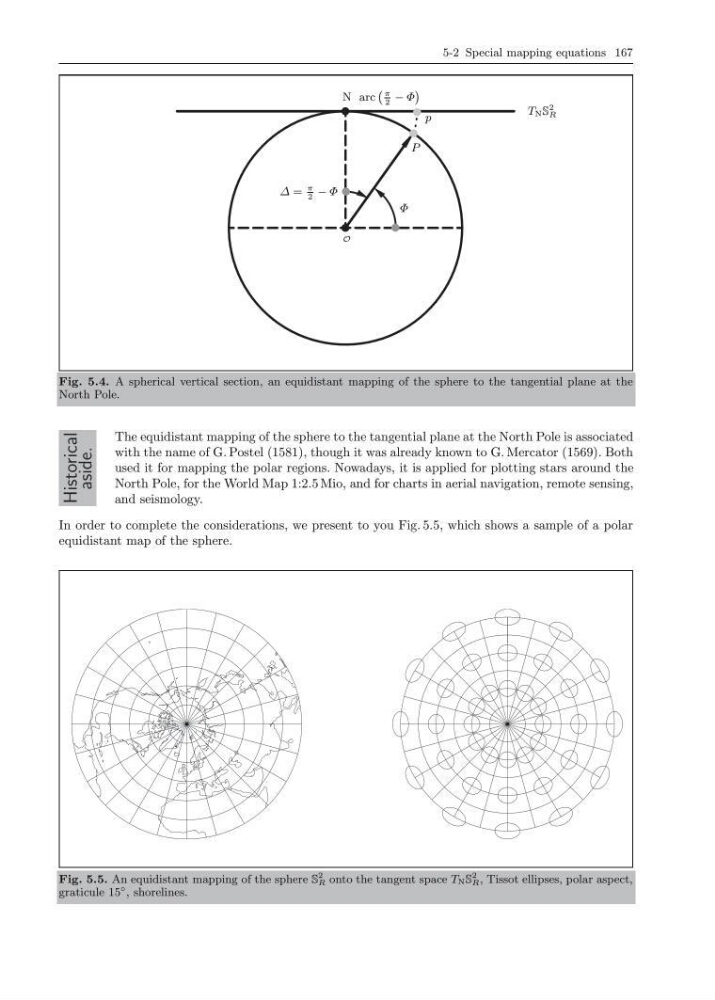
Fig. 5.4. A spherical vertical section, an equidistant mapping of the sphere to the tangential plane at the
North Pole.
Historical
aside.
The equidistant mapping of the sphere to the tangential plane at the North Pole is associated
with the name of G. Postel (1581), though it was already known to G. Mercator (1569). Both
used it for mapping the polar regions. Nowadays, it is applied for plotting stars around the
North Pole, for the World Map 1:2.5 Mio, and for charts in aerial navigation, remote sensing,
and seismology.
In order to complete the considerations, we present to you Fig. 5.5, which shows a sample of a polar
equidistant map of the sphere.
Fig. 5.5. An equidistant mapping of the sphere S
2
R onto the tangent space T N S
2
R , Tissot ellipses, polar aspect,
graticule 15
◦ , shorelines.
N arc
` π
2
− Φ
´
T N S
2
R
P
p
O
Φ
∆ =
π
2
− Φ
Fig. 5.4. A spherical vertical section, an equidistant mapping of the sphere to the tangential plane at the
North Pole.
Historical
aside.
The equidistant mapping of the sphere to the tangential plane at the North Pole is associated
with the name of G. Postel (1581), though it was already known to G. Mercator (1569). Both
used it for mapping the polar regions. Nowadays, it is applied for plotting stars around the
North Pole, for the World Map 1:2.5 Mio, and for charts in aerial navigation, remote sensing,
and seismology.
In order to complete the considerations, we present to you Fig. 5.5, which shows a sample of a polar
equidistant map of the sphere.
Fig. 5.5. An equidistant mapping of the sphere S
2
R onto the tangent space T N S
2
R , Tissot ellipses, polar aspect,
graticule 15
◦ , shorelines.