

3-4 The oblique frame of reference of the ellipsoid-of-revolution 143
3-4 The oblique frame of reference of the ellipsoid-of-revolution
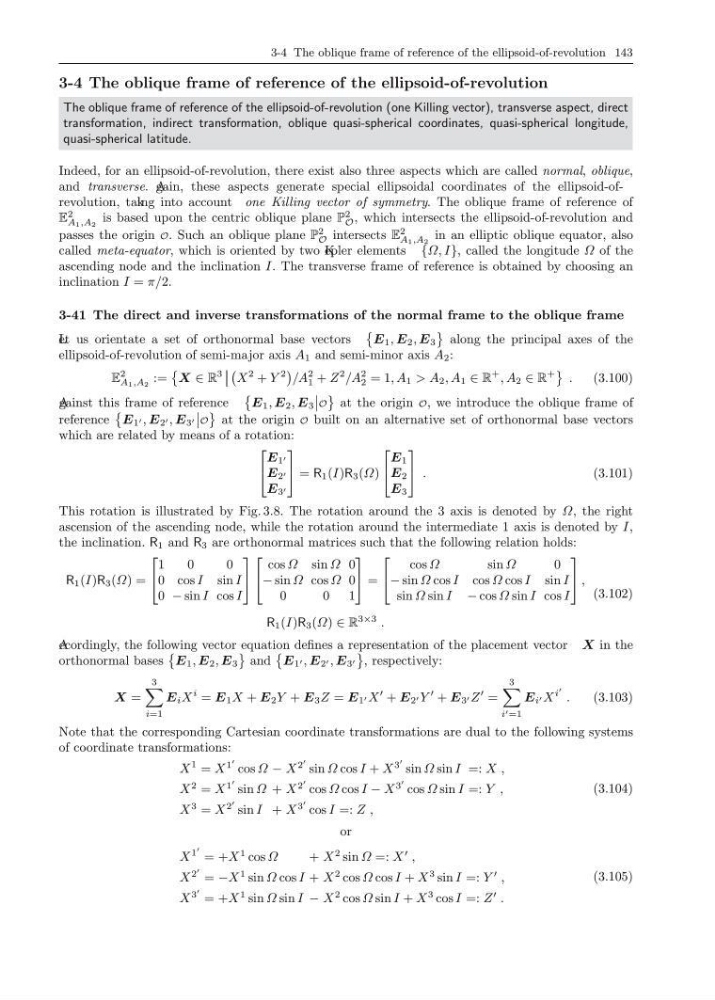
The oblique frame of reference of the ellipsoid-of-revolution (one Killing vector), transverse aspect, direct
transformation, indirect transformation, oblique quasi-spherical coordinates, quasi-spherical longitude,
quasi-spherical latitude.
Indeed, for an ellipsoid-of-revolution, there exist also three aspects which are called normal, oblique,
and transverse. A gain, these aspects generate special ellipsoidal coordinates of the ellipsoid-ofrevolution, tak ing into account one Killing vector of symmetry. The oblique frame of reference of
E
2
A 1 ,A 2
is based upon the centric oblique plane P
2
O , which intersects the ellipsoid-of-revolution and
passes the origin O. Such an oblique plane P
2
O intersects E
2
A 1 ,A 2
in an elliptic oblique equator, also
called meta-equator, which is oriented by two K epler elements {Ω, I}, called the longitude Ω of the
ascending node and the inclination I. The transverse frame of reference is obtained by choosing an
inclination I = π/2.
3-41 The direct and inverse transformations of the normal frame to the oblique frame
L et us orientate a set of orthonormal base vectors
E 1 , E 2 , E 3
along the principal axes of the
ellipsoid-of-revolution of semi-major axis A 1 and semi-minor axis A 2 :
E
2
A 1 ,A 2 :=
X ∈ R
3
X
2 + Y
2
/A
2
1 + Z
2 /A
2
2 = 1, A 1 > A 2 , A 1 ∈ R
+ , A 2 ∈ R
+
.
(3.100)
A gainst this frame of reference
E 1 , E 2 , E 3
O
at the origin O, we introduce the oblique frame of
reference
E 1 , E 2 , E 3
O
at the origin O built on an alternative set of orthonormal base vectors
which are related by means of a rotation:
⎡
⎣
E 1
E 2
E 3
⎤
⎦ = R 1 (I)R 3 (Ω)
⎡
⎣
E 1
E 2
E 3
⎤
⎦ .
(3.101)
This rotation is illustrated by Fig. 3.8. The rotation around the 3 axis is denoted by Ω, the right
ascension of the ascending node, while the rotation around the intermediate 1 axis is denoted by I,
the inclination. R 1 and R 3 are orthonormal matrices such that the following relation holds:
R 1 (I)R 3 (Ω) =
⎡
⎣
1
0
0
0 cosI sin I
0 − sin I cos I
⎤
⎦
⎡
⎣
cos Ω sin Ω 0
− sin Ω cos Ω 0
0
0 1
⎤
⎦ =
⎡
⎣
cos Ω
sin Ω
0
− sin Ω cos I cos Ω cos I sin I
sin Ω sin I − cos Ω sin I cos I
⎤
⎦ ,
R 1 (I)R 3 (Ω) ∈ R
3×3 .
(3.102)
A ccordingly, the following vector equation defines a representation of the placement vector X in the
orthonormal bases
E 1 , E 2 , E 3
and
E 1 , E 2 , E 3
, respectively:
X =
3
i=1
E i X
i = E 1 X + E 2 Y + E 3 Z = E 1 X
+ E 2 Y
+ E 3 Z
=
3
i =1
E i X
i
.
(3.103)
Note that the corresponding Cartesian coordinate transformations are dual to the following systems
of coordinate transformations:
X
1 = X
1
cos Ω − X
2
sin Ω cos I + X
3
sin Ω sin I =: X ,
X
2 = X
1
sin Ω + X
2
cos Ω cos I − X
3
cos Ω sin I =: Y ,
X
3 = X
2
sin I + X
3
cos I =: Z ,
(3.104)
or
X
1
= +X
1 cos Ω
+ X
2 sin Ω =: X
,
X
2
= −X
1 sin Ω cos I + X
2 cos Ω cos I + X
3 sin I =: Y
,
X
3
= +X
1 sin Ω sin I − X
2 cos Ω sin I + X
3 cos I =: Z
.
(3.105)
3-4 The oblique frame of reference of the ellipsoid-of-revolution
The oblique frame of reference of the ellipsoid-of-revolution (one Killing vector), transverse aspect, direct
transformation, indirect transformation, oblique quasi-spherical coordinates, quasi-spherical longitude,
quasi-spherical latitude.
Indeed, for an ellipsoid-of-revolution, there exist also three aspects which are called normal, oblique,
and transverse. A gain, these aspects generate special ellipsoidal coordinates of the ellipsoid-ofrevolution, tak ing into account one Killing vector of symmetry. The oblique frame of reference of
E
2
A 1 ,A 2
is based upon the centric oblique plane P
2
O , which intersects the ellipsoid-of-revolution and
passes the origin O. Such an oblique plane P
2
O intersects E
2
A 1 ,A 2
in an elliptic oblique equator, also
called meta-equator, which is oriented by two K epler elements {Ω, I}, called the longitude Ω of the
ascending node and the inclination I. The transverse frame of reference is obtained by choosing an
inclination I = π/2.
3-41 The direct and inverse transformations of the normal frame to the oblique frame
L et us orientate a set of orthonormal base vectors
E 1 , E 2 , E 3
along the principal axes of the
ellipsoid-of-revolution of semi-major axis A 1 and semi-minor axis A 2 :
E
2
A 1 ,A 2 :=
X ∈ R
3
X
2 + Y
2
/A
2
1 + Z
2 /A
2
2 = 1, A 1 > A 2 , A 1 ∈ R
+ , A 2 ∈ R
+
.
(3.100)
A gainst this frame of reference
E 1 , E 2 , E 3
O
at the origin O, we introduce the oblique frame of
reference
E 1 , E 2 , E 3
O
at the origin O built on an alternative set of orthonormal base vectors
which are related by means of a rotation:
⎡
⎣
E 1
E 2
E 3
⎤
⎦ = R 1 (I)R 3 (Ω)
⎡
⎣
E 1
E 2
E 3
⎤
⎦ .
(3.101)
This rotation is illustrated by Fig. 3.8. The rotation around the 3 axis is denoted by Ω, the right
ascension of the ascending node, while the rotation around the intermediate 1 axis is denoted by I,
the inclination. R 1 and R 3 are orthonormal matrices such that the following relation holds:
R 1 (I)R 3 (Ω) =
⎡
⎣
1
0
0
0 cosI sin I
0 − sin I cos I
⎤
⎦
⎡
⎣
cos Ω sin Ω 0
− sin Ω cos Ω 0
0
0 1
⎤
⎦ =
⎡
⎣
cos Ω
sin Ω
0
− sin Ω cos I cos Ω cos I sin I
sin Ω sin I − cos Ω sin I cos I
⎤
⎦ ,
R 1 (I)R 3 (Ω) ∈ R
3×3 .
(3.102)
A ccordingly, the following vector equation defines a representation of the placement vector X in the
orthonormal bases
E 1 , E 2 , E 3
and
E 1 , E 2 , E 3
, respectively:
X =
3
i=1
E i X
i = E 1 X + E 2 Y + E 3 Z = E 1 X
+ E 2 Y
+ E 3 Z
=
3
i =1
E i X
i
.
(3.103)
Note that the corresponding Cartesian coordinate transformations are dual to the following systems
of coordinate transformations:
X
1 = X
1
cos Ω − X
2
sin Ω cos I + X
3
sin Ω sin I =: X ,
X
2 = X
1
sin Ω + X
2
cos Ω cos I − X
3
cos Ω sin I =: Y ,
X
3 = X
2
sin I + X
3
cos I =: Z ,
(3.104)
or
X
1
= +X
1 cos Ω
+ X
2 sin Ω =: X
,
X
2
= −X
1 sin Ω cos I + X
2 cos Ω cos I + X
3 sin I =: Y
,
X
3
= +X
1 sin Ω sin I − X
2 cos Ω sin I + X
3 cos I =: Z
.
(3.105)