

120 3 Coordinates
x
y
z
S
2
r
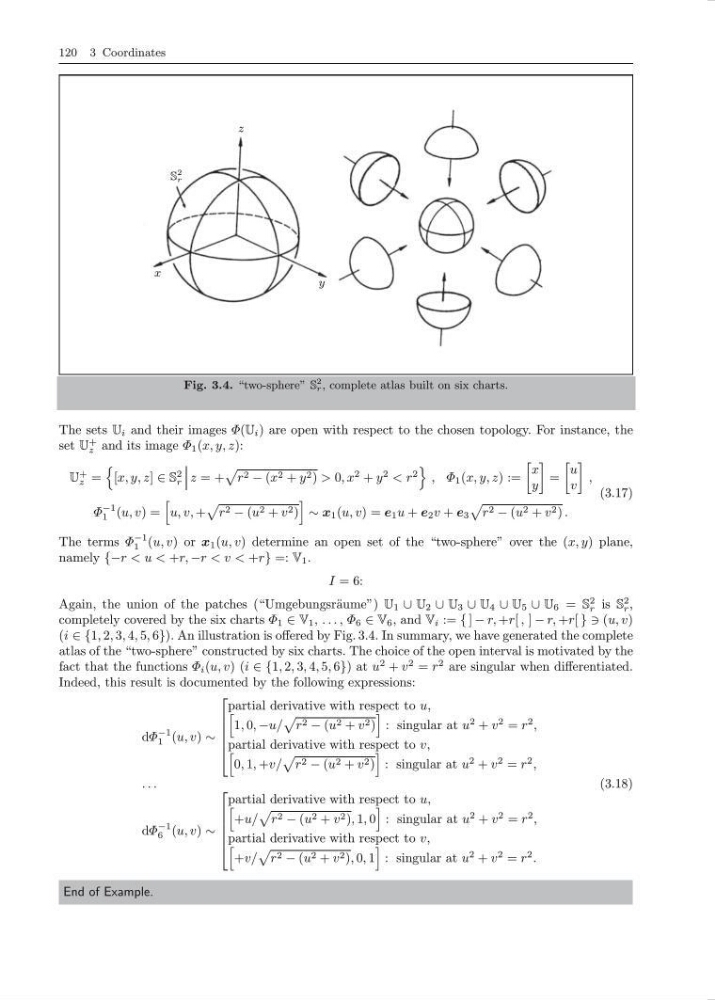
Fig. 3.4. “two-sphere” S
2
r , complete atlas built on six charts.
The sets U i and their images Φ(U i ) are open with respect to the chosen topology. For instance, the
set U
+
z and its image Φ 1 (x, y, z):
U
+
z =
[x, y, z] ∈ S
2
r z = +
r 2 − (x 2 + y 2 ) > 0, x
2 + y
2 < r
2
, Φ 1 (x, y, z) :=
x
y
=
u
v
,
Φ
−1
1 (u, v) =
u, v, +
r 2 − (u 2 + v 2 )
∼ x 1 (u, v) = e 1 u + e 2 v + e 3
r 2 − (u 2 + v 2 ) .
(3.17)
The terms Φ
−1
1 (u, v) or x 1 (u, v) determine an open set of the “two-sphere” over the (x, y) plane,
namely {−r < u < +r, −r < v < +r} =: V 1 .
I = 6:
Again, the union of the patches (“Umgebungsr¨ aume”) U 1 ∪ U 2 ∪ U 3 ∪ U 4 ∪ U 5 ∪ U 6 = S
2
r is S
2
r ,
completely covered by the six charts Φ 1 ∈ V 1 , . . . , Φ 6 ∈ V 6 , and V i := { ] − r, +r[ , ] − r, +r[ } } (u, v)
(i ∈ {1, 2, 3, 4, 5, 6}). An illustration is offered by Fig. 3.4. In summary, we have generated the complete
atlas of the “two-sphere” constructed by six charts. The choice of the open interval is motivated by the
fact that the functions Φ i (u, v) (i ∈ {1, 2, 3, 4, 5, 6}) at u
2 + v
2 = r
2 are singular when differentiated.
Indeed, this result is documented by the following expressions:
dΦ
−1
1 (u, v) ∼
⎡
⎢
⎢
⎢
⎢
⎣
partial derivative with respect to u,
1, 0, −u/
r 2 − (u 2 + v 2 )
: singular at u
2 + v
2 = r
2 ,
partial derivative with respect to v,
0, 1, +v/
r 2 − (u 2 + v 2 )
: singular at u
2 + v
2 = r
2 ,
. . .
dΦ
−1
6 (u, v) ∼
⎡
⎢
⎢
⎢
⎢
⎣
partial derivative with respect to u,
+u/
r 2 − (u 2 + v 2 ), 1, 0
: singular at u
2 + v
2 = r
2 ,
partial derivative with respect to v,
+v/
r 2 − (u 2 + v 2 ), 0, 1
: singular at u
2 + v
2 = r
2 .
(3.18)
End of Example.
x
y
z
S
2
r
Fig. 3.4. “two-sphere” S
2
r , complete atlas built on six charts.
The sets U i and their images Φ(U i ) are open with respect to the chosen topology. For instance, the
set U
+
z and its image Φ 1 (x, y, z):
U
+
z =
[x, y, z] ∈ S
2
r z = +
r 2 − (x 2 + y 2 ) > 0, x
2 + y
2 < r
2
, Φ 1 (x, y, z) :=
x
y
=
u
v
,
Φ
−1
1 (u, v) =
u, v, +
r 2 − (u 2 + v 2 )
∼ x 1 (u, v) = e 1 u + e 2 v + e 3
r 2 − (u 2 + v 2 ) .
(3.17)
The terms Φ
−1
1 (u, v) or x 1 (u, v) determine an open set of the “two-sphere” over the (x, y) plane,
namely {−r < u < +r, −r < v < +r} =: V 1 .
I = 6:
Again, the union of the patches (“Umgebungsr¨ aume”) U 1 ∪ U 2 ∪ U 3 ∪ U 4 ∪ U 5 ∪ U 6 = S
2
r is S
2
r ,
completely covered by the six charts Φ 1 ∈ V 1 , . . . , Φ 6 ∈ V 6 , and V i := { ] − r, +r[ , ] − r, +r[ } } (u, v)
(i ∈ {1, 2, 3, 4, 5, 6}). An illustration is offered by Fig. 3.4. In summary, we have generated the complete
atlas of the “two-sphere” constructed by six charts. The choice of the open interval is motivated by the
fact that the functions Φ i (u, v) (i ∈ {1, 2, 3, 4, 5, 6}) at u
2 + v
2 = r
2 are singular when differentiated.
Indeed, this result is documented by the following expressions:
dΦ
−1
1 (u, v) ∼
⎡
⎢
⎢
⎢
⎢
⎣
partial derivative with respect to u,
1, 0, −u/
r 2 − (u 2 + v 2 )
: singular at u
2 + v
2 = r
2 ,
partial derivative with respect to v,
0, 1, +v/
r 2 − (u 2 + v 2 )
: singular at u
2 + v
2 = r
2 ,
. . .
dΦ
−1
6 (u, v) ∼
⎡
⎢
⎢
⎢
⎢
⎣
partial derivative with respect to u,
+u/
r 2 − (u 2 + v 2 ), 1, 0
: singular at u
2 + v
2 = r
2 ,
partial derivative with respect to v,
+v/
r 2 − (u 2 + v 2 ), 0, 1
: singular at u
2 + v
2 = r
2 .
(3.18)
End of Example.