

114 3 Coordinates
Question.
Question: “Why has the notion of the manifold and the chart, U → φ(U), been axiomatically
introduced?” Answer: “The answer to our fundamental question is based on the “mathematical observation” that not all higher-dimensional curved surfaces can be embedded or
immersed in a higher-dimensional Euclidean space. Or we do not know whether such an
embedding or immersion exists.”
For instance, since the twenties of the 20th century, we know that spacetime is a four-dimensional
pseudo-Riemann manifold of signature “+ + +−” equipped with a pseudo-Riemann metric, Riemann
curvature, zero Cartan torsion. But how to embed or immerse such a four-dimensional spacetime
manifold in a pseudo-Euclidean space? In case we know nothing, we better work “intrinsically” with
the manifold, neglecting the problem of embedding or immersion. Indeed, this is the majority vote
procedure when dealing with spacetime. And, in addition, it would not be too helpful to think in
terms of the following theorem: any analytical four-dimensional pseudo-Riemann manifold (analytical
spacetime) can be immersed in a ten-dimensional pseudo-Euclidean space. Another example is the
projective space P
n , and this projective space cannot be embedded or immersed in an Euclidean space
as the ambient space. Anyway, let us continue to explain continuity and homeomorphism, a situation
similar to art, where many “. . . isms” exist. At least, the mathematical builders of the world are more
careful in defining their“. . . isms”, like conformeomorphism or areomorphism.
Definition 3.2 (Continuity, homeomorphism).
Let X and Y be two topological spaces and f : X → Y a mapping. f is called sequence continuous or
continous in x ∈ X if f to x convergent sequences are continuously mapped to f (x) convergent series.
f is called sequence continuous or just continuous if f is continuous in any point x of X. f is called a
topological map or a homeomorphism if f is continuous, bijective, and f
−1 is continous as well.
End of Definition.
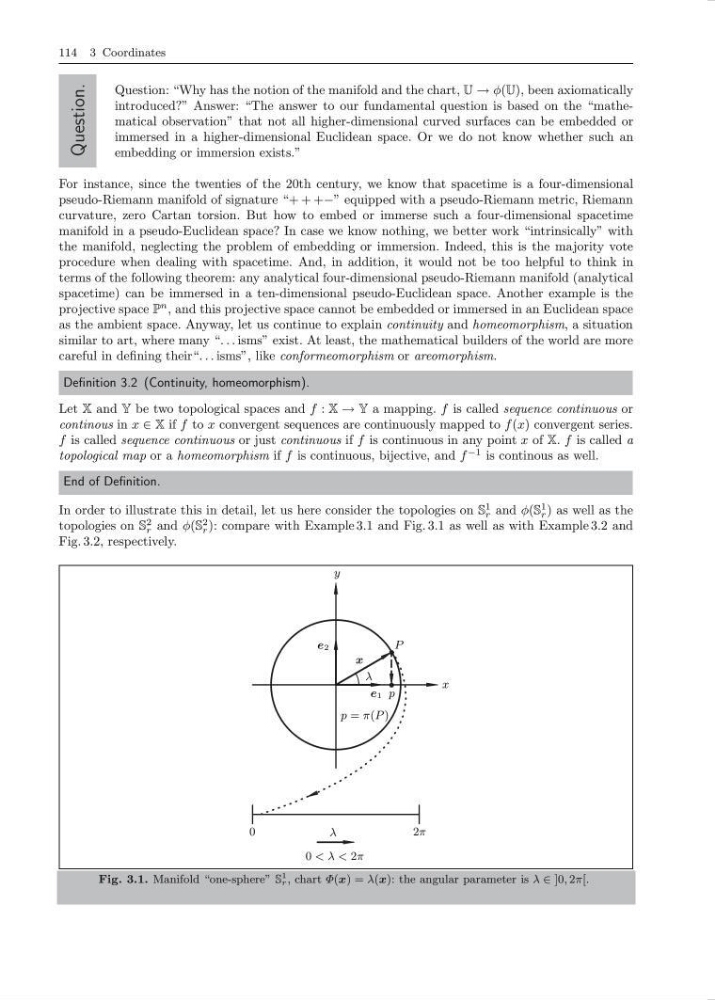
In order to illustrate this in detail, let us here consider the topologies on S
1
r and φ(S
1
r ) as well as the
topologies on S
2
r and φ(S
2
r ): compare with Example 3.1 and Fig. 3.1 as well as with Example 3.2 and
Fig. 3.2, respectively.
x
y
x
e1
e2
λ
p
p = π(P )
P
0
λ
2π
0 < λ < 2π
Fig. 3.1. Manifold “one-sphere” S
1
r , chart Φ(x) = λ(x): the angular parameter is λ ∈ ]0, 2π[.
Question.
Question: “Why has the notion of the manifold and the chart, U → φ(U), been axiomatically
introduced?” Answer: “The answer to our fundamental question is based on the “mathematical observation” that not all higher-dimensional curved surfaces can be embedded or
immersed in a higher-dimensional Euclidean space. Or we do not know whether such an
embedding or immersion exists.”
For instance, since the twenties of the 20th century, we know that spacetime is a four-dimensional
pseudo-Riemann manifold of signature “+ + +−” equipped with a pseudo-Riemann metric, Riemann
curvature, zero Cartan torsion. But how to embed or immerse such a four-dimensional spacetime
manifold in a pseudo-Euclidean space? In case we know nothing, we better work “intrinsically” with
the manifold, neglecting the problem of embedding or immersion. Indeed, this is the majority vote
procedure when dealing with spacetime. And, in addition, it would not be too helpful to think in
terms of the following theorem: any analytical four-dimensional pseudo-Riemann manifold (analytical
spacetime) can be immersed in a ten-dimensional pseudo-Euclidean space. Another example is the
projective space P
n , and this projective space cannot be embedded or immersed in an Euclidean space
as the ambient space. Anyway, let us continue to explain continuity and homeomorphism, a situation
similar to art, where many “. . . isms” exist. At least, the mathematical builders of the world are more
careful in defining their“. . . isms”, like conformeomorphism or areomorphism.
Definition 3.2 (Continuity, homeomorphism).
Let X and Y be two topological spaces and f : X → Y a mapping. f is called sequence continuous or
continous in x ∈ X if f to x convergent sequences are continuously mapped to f (x) convergent series.
f is called sequence continuous or just continuous if f is continuous in any point x of X. f is called a
topological map or a homeomorphism if f is continuous, bijective, and f
−1 is continous as well.
End of Definition.
In order to illustrate this in detail, let us here consider the topologies on S
1
r and φ(S
1
r ) as well as the
topologies on S
2
r and φ(S
2
r ): compare with Example 3.1 and Fig. 3.1 as well as with Example 3.2 and
Fig. 3.2, respectively.
x
y
x
e1
e2
λ
p
p = π(P )
P
0
λ
2π
0 < λ < 2π
Fig. 3.1. Manifold “one-sphere” S
1
r , chart Φ(x) = λ(x): the angular parameter is λ ∈ ]0, 2π[.