

2-6 Polar decomposition and simultaneous diagonalization of three matrices 111
2-5 Canonical criteria for conformal, equiareal, and other mappings
Canonical criteria for conformal, equiareal, and isometric mappings as well as equidistant mappings
M
2
l → {R
2 , δ µν }, Hilbert invariants.
Question.
Question: “How can we generalize those canonical criteria for a conformal, an equiareal, or
an isometric mapping M
2
l → M
2
r := {R
2 , δ µν } = E
2 if we restrict the right two-dimensional
Riemann manifold to be two-dimensional Euclidean?” Answer: “Let us refer to Box 1.46 and
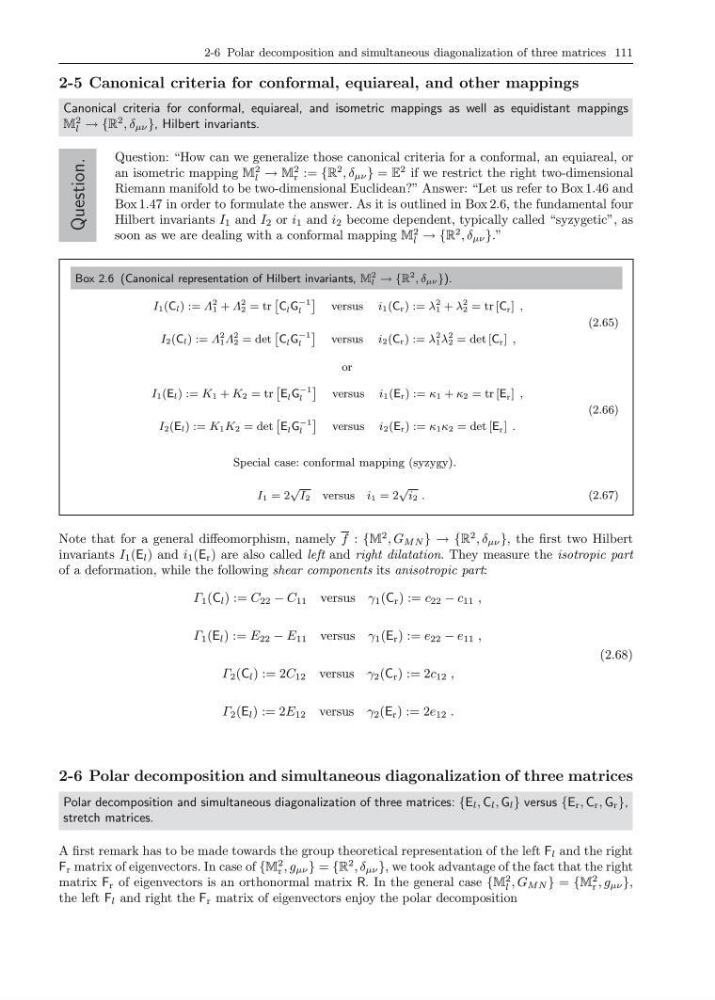
Box 1.47 in order to formulate the answer. As it is outlined in Box 2.6, the fundamental four
Hilbert invariants I 1 and I 2 or i 1 and i 2 become dependent, typically called “syzygetic”, as
soon as we are dealing with a conformal mapping M
2
l → {R
2 , δ µν }.”
Box 2.6 (Canonical representation of Hilbert invariants, M
2
l → {R
2 , δ µν }).
I 1 (C l ) := Λ
2
1 + Λ
2
2 = tr
ˆ
C l G
−1
l
˜
versus i 1 (C r ) := λ
2
1 + λ
2
2 = tr [C r ] ,
I 2 (C l ) := Λ
2
1 Λ
2
2 = det
ˆ
C l G
−1
l
˜
versus i 2 (C r ) := λ
2
1 λ
2
2 = det [C r ] ,
(2.65)
or
I 1 (E l ) := K 1 + K 2 = tr
ˆ
E l G
−1
l
˜
versus i 1 (E r ) := κ 1 + κ 2 = tr [E r ] ,
I 2 (E l ) := K 1 K 2 = det
ˆ
E l G
−1
l
˜
versus i 2 (E r ) := κ 1 κ 2 = det [E r ] .
(2.66)
Special case: conformal mapping (syzygy).
I 1 = 2
√
I 2 versus i 1 = 2
√
i 2 .
(2.67)
Note that for a general diffeomorphism, namely f : {M
2 , G MN } → {R
2 , δ µν }, the first two Hilbert
invariants I 1 (E l ) and i 1 (E r ) are also called left and right dilatation. They measure the isotropic part
of a deformation, while the following shear components its anisotropic part:
Γ 1 (C l ) := C 22 − C 11 versus γ 1 (C r ) := c 22 − c 11 ,
Γ 1 (E l ) := E 22 − E 11 versus γ 1 (E r ) := e 22 − e 11 ,
Γ 2 (C l ) := 2C 12 versus γ 2 (C r ) := 2c 12 ,
Γ 2 (E l ) := 2E 12 versus γ 2 (E r ) := 2e 12 .
(2.68)
2-6 Polar decomposition and simultaneous diagonalization of three matrices
Polar decomposition and simultaneous diagonalization of three matrices: {E l , C l , G l } versus {E r , C r , G r },
stretch matrices.
A first remark has to be made towards the group theoretical representation of the left F l and the right
F r matrix of eigenvectors. In case of {M
2
r , g µν } = {R
2 , δ µν }, we took advantage of the fact that the right
matrix F r of eigenvectors is an orthonormal matrix R. In the general case {M
2
l , G MN } = {M
2
r , g µν },
the left F l and right the F r matrix of eigenvectors enjoy the polar decomposition
2-5 Canonical criteria for conformal, equiareal, and other mappings
Canonical criteria for conformal, equiareal, and isometric mappings as well as equidistant mappings
M
2
l → {R
2 , δ µν }, Hilbert invariants.
Question.
Question: “How can we generalize those canonical criteria for a conformal, an equiareal, or
an isometric mapping M
2
l → M
2
r := {R
2 , δ µν } = E
2 if we restrict the right two-dimensional
Riemann manifold to be two-dimensional Euclidean?” Answer: “Let us refer to Box 1.46 and
Box 1.47 in order to formulate the answer. As it is outlined in Box 2.6, the fundamental four
Hilbert invariants I 1 and I 2 or i 1 and i 2 become dependent, typically called “syzygetic”, as
soon as we are dealing with a conformal mapping M
2
l → {R
2 , δ µν }.”
Box 2.6 (Canonical representation of Hilbert invariants, M
2
l → {R
2 , δ µν }).
I 1 (C l ) := Λ
2
1 + Λ
2
2 = tr
ˆ
C l G
−1
l
˜
versus i 1 (C r ) := λ
2
1 + λ
2
2 = tr [C r ] ,
I 2 (C l ) := Λ
2
1 Λ
2
2 = det
ˆ
C l G
−1
l
˜
versus i 2 (C r ) := λ
2
1 λ
2
2 = det [C r ] ,
(2.65)
or
I 1 (E l ) := K 1 + K 2 = tr
ˆ
E l G
−1
l
˜
versus i 1 (E r ) := κ 1 + κ 2 = tr [E r ] ,
I 2 (E l ) := K 1 K 2 = det
ˆ
E l G
−1
l
˜
versus i 2 (E r ) := κ 1 κ 2 = det [E r ] .
(2.66)
Special case: conformal mapping (syzygy).
I 1 = 2
√
I 2 versus i 1 = 2
√
i 2 .
(2.67)
Note that for a general diffeomorphism, namely f : {M
2 , G MN } → {R
2 , δ µν }, the first two Hilbert
invariants I 1 (E l ) and i 1 (E r ) are also called left and right dilatation. They measure the isotropic part
of a deformation, while the following shear components its anisotropic part:
Γ 1 (C l ) := C 22 − C 11 versus γ 1 (C r ) := c 22 − c 11 ,
Γ 1 (E l ) := E 22 − E 11 versus γ 1 (E r ) := e 22 − e 11 ,
Γ 2 (C l ) := 2C 12 versus γ 2 (C r ) := 2c 12 ,
Γ 2 (E l ) := 2E 12 versus γ 2 (E r ) := 2e 12 .
(2.68)
2-6 Polar decomposition and simultaneous diagonalization of three matrices
Polar decomposition and simultaneous diagonalization of three matrices: {E l , C l , G l } versus {E r , C r , G r },
stretch matrices.
A first remark has to be made towards the group theoretical representation of the left F l and the right
F r matrix of eigenvectors. In case of {M
2
r , g µν } = {R
2 , δ µν }, we took advantage of the fact that the right
matrix F r of eigenvectors is an orthonormal matrix R. In the general case {M
2
l , G MN } = {M
2
r , g µν },
the left F l and right the F r matrix of eigenvectors enjoy the polar decomposition