

92
1 From Riemann manifolds to Riemann manifolds
1-15 Exercise: the Armadillo double projection
Exercise: the Armadillo double projection. First: sphere to torus. Second: torus to plane. The oblique
orthogonal projection.
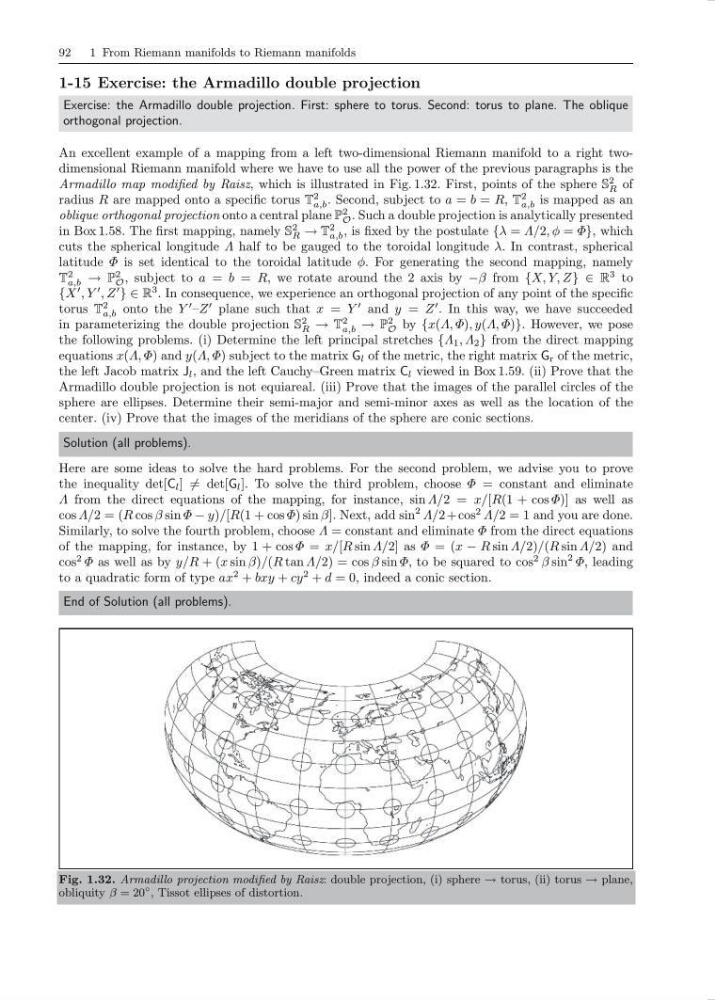
An excellent example of a mapping from a left two-dimensional Riemann manifold to a right twodimensional Riemann manifold where we have to use all the power of the previous paragraphs is the
Armadillo map modified by Raisz, which is illustrated in Fig. 1.32. First, points of the sphere S
2
R of
radius R are mapped onto a specific torus T
2
a,b . Second, subject to a = b = R, T
2
a,b is mapped as an
oblique orthogonal projection onto a central plane P
2
O . Such a double projection is analytically presented
in Box 1.58. The first mapping, namely S
2
R → T
2
a,b , is fixed by the postulate {λ = Λ/2, φ = Φ}, which
cuts the spherical longitude Λ half to be gauged to the toroidal longitude λ. In contrast, spherical
latitude Φ is set identical to the toroidal latitude φ. For generating the second mapping, namely
T
2
a,b → P
2
O , subject to a = b = R, we rotate around the 2 axis by −β from {X, Y, Z} ∈ R
3 to
{X
, Y
, Z
} ∈ R
3 . In consequence, we experience an orthogonal projection of any point of the specific
torus T
2
a,b onto the Y
–Z
plane such that x = Y
and y = Z
. In this way, we have succeeded
in parameterizing the double projection S
2
R → T
2
a,b → P
2
O by {x(Λ, Φ), y(Λ, Φ)}. However, we pose
the following problems. (i) Determine the left principal stretches {Λ 1 , Λ 2 } from the direct mapping
equations x(Λ, Φ) and y(Λ, Φ) subject to the matrix G l of the metric, the right matrix G r of the metric,
the left Jacob matrix J l , and the left Cauchy–Green matrix C l viewed in Box 1.59. (ii) Prove that the
Armadillo double projection is not equiareal. (iii) Prove that the images of the parallel circles of the
sphere are ellipses. Determine their semi-major and semi-minor axes as well as the location of the
center. (iv) Prove that the images of the meridians of the sphere are conic sections.
Solution (all problems).
Here are some ideas to solve the hard problems. For the second problem, we advise you to prove
the inequality det[C l ] = det[G l ]. To solve the third problem, choose Φ = constant and eliminate
Λ from the direct equations of the mapping, for instance, sin Λ/2 = x/[R(1 + cos Φ)] as well as
cos Λ/2 = (R cos β sin Φ − y)/[R(1 + cos Φ) sin β]. Next, add sin
2 Λ/2 + cos
2 Λ/2 = 1 and you are done.
Similarly, to solve the fourth problem, choose Λ = constant and eliminate Φ from the direct equations
of the mapping, for instance, by 1 + cos Φ = x/[R sin Λ/2] as Φ = (x − R sin Λ/2)/(R sin Λ/2) and
cos
2 Φ as well as by y/R + (x sin β)/(R tan Λ/2) = cos β sin Φ, to be squared to cos
2 β sin
2 Φ, leading
to a quadratic form of type ax
2 + bxy + cy
2 + d = 0, indeed a conic section.
End of Solution (all problems).
Fig. 1.32. Armadillo projection modified by Raisz: double projection, (i) sphere → torus, (ii) torus → plane,
obliquity β = 20
◦ , Tissot ellipses of distortion.
1 From Riemann manifolds to Riemann manifolds
1-15 Exercise: the Armadillo double projection
Exercise: the Armadillo double projection. First: sphere to torus. Second: torus to plane. The oblique
orthogonal projection.
An excellent example of a mapping from a left two-dimensional Riemann manifold to a right twodimensional Riemann manifold where we have to use all the power of the previous paragraphs is the
Armadillo map modified by Raisz, which is illustrated in Fig. 1.32. First, points of the sphere S
2
R of
radius R are mapped onto a specific torus T
2
a,b . Second, subject to a = b = R, T
2
a,b is mapped as an
oblique orthogonal projection onto a central plane P
2
O . Such a double projection is analytically presented
in Box 1.58. The first mapping, namely S
2
R → T
2
a,b , is fixed by the postulate {λ = Λ/2, φ = Φ}, which
cuts the spherical longitude Λ half to be gauged to the toroidal longitude λ. In contrast, spherical
latitude Φ is set identical to the toroidal latitude φ. For generating the second mapping, namely
T
2
a,b → P
2
O , subject to a = b = R, we rotate around the 2 axis by −β from {X, Y, Z} ∈ R
3 to
{X
, Y
, Z
} ∈ R
3 . In consequence, we experience an orthogonal projection of any point of the specific
torus T
2
a,b onto the Y
–Z
plane such that x = Y
and y = Z
. In this way, we have succeeded
in parameterizing the double projection S
2
R → T
2
a,b → P
2
O by {x(Λ, Φ), y(Λ, Φ)}. However, we pose
the following problems. (i) Determine the left principal stretches {Λ 1 , Λ 2 } from the direct mapping
equations x(Λ, Φ) and y(Λ, Φ) subject to the matrix G l of the metric, the right matrix G r of the metric,
the left Jacob matrix J l , and the left Cauchy–Green matrix C l viewed in Box 1.59. (ii) Prove that the
Armadillo double projection is not equiareal. (iii) Prove that the images of the parallel circles of the
sphere are ellipses. Determine their semi-major and semi-minor axes as well as the location of the
center. (iv) Prove that the images of the meridians of the sphere are conic sections.
Solution (all problems).
Here are some ideas to solve the hard problems. For the second problem, we advise you to prove
the inequality det[C l ] = det[G l ]. To solve the third problem, choose Φ = constant and eliminate
Λ from the direct equations of the mapping, for instance, sin Λ/2 = x/[R(1 + cos Φ)] as well as
cos Λ/2 = (R cos β sin Φ − y)/[R(1 + cos Φ) sin β]. Next, add sin
2 Λ/2 + cos
2 Λ/2 = 1 and you are done.
Similarly, to solve the fourth problem, choose Λ = constant and eliminate Φ from the direct equations
of the mapping, for instance, by 1 + cos Φ = x/[R sin Λ/2] as Φ = (x − R sin Λ/2)/(R sin Λ/2) and
cos
2 Φ as well as by y/R + (x sin β)/(R tan Λ/2) = cos β sin Φ, to be squared to cos
2 β sin
2 Φ, leading
to a quadratic form of type ax
2 + bxy + cy
2 + d = 0, indeed a conic section.
End of Solution (all problems).
Fig. 1.32. Armadillo projection modified by Raisz: double projection, (i) sphere → torus, (ii) torus → plane,
obliquity β = 20
◦ , Tissot ellipses of distortion.