

154
Le logiciel R - Maˆ ıtriser le langage
Attention
Il peut arriver que cet alias ne fonctionne pas, et il est alors n´ ecessaire
d’utiliser la fonction help() avec des guillemets.
?function
# Ne fonctionne pas.
help(function)
# Renvoie une erreur.
help("function") # Appel correct.
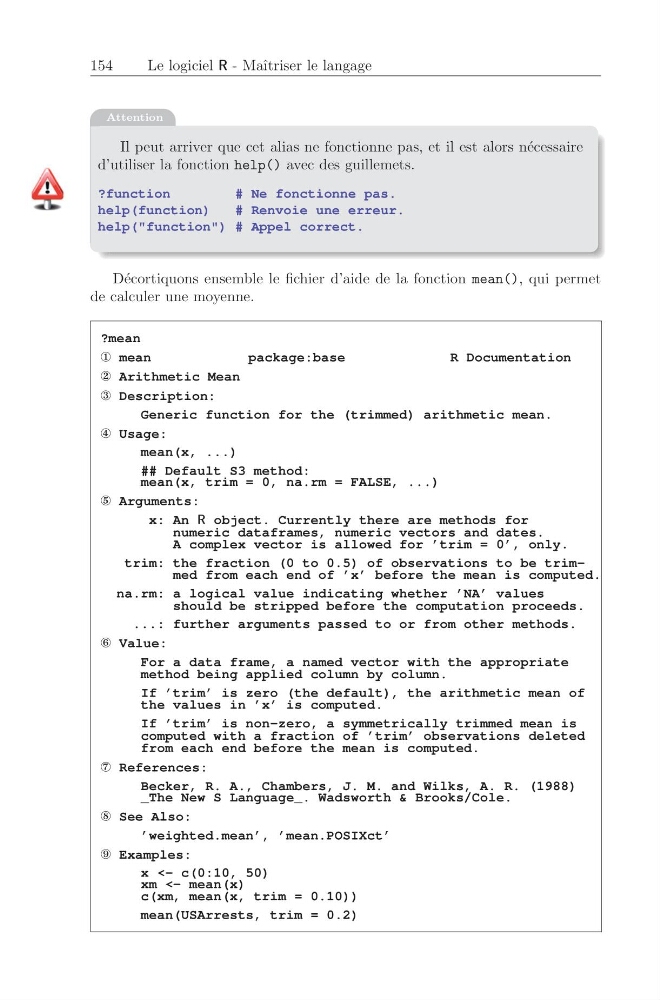
D´ ecortiquons ensemble le fichier d’aide de la fonction mean(), qui permet
de calculer une moyenne.
?mean
x mean
package:base
R Documentation
y Arithmetic Mean
z Description:
Generic function for the (trimmed) arithmetic mean.
{ Usage:
mean(x, ...)
## Default S3 method:
mean(x, trim = 0, na.rm = FALSE, ...)
| Arguments:
x: An R object. Currently there are methods for
numeric dataframes, numeric vectors and dates.
A complex vector is allowed for ’trim = 0’, only.
trim: the fraction (0 to 0.5) of observations to be trimmed from each end of ’x’ before the mean is computed.
na.rm: a logical value indicating whether ’NA’ values
should be stripped before the computation proceeds.
...: further arguments passed to or from other methods.
} Value:
For a data frame, a named vector with the appropriate
method being applied column by column.
If ’trim’ is zero (the default), the arithmetic mean of
the values in ’x’ is computed.
If ’trim’ is non-zero, a symmetrically trimmed mean is
computed with a fraction of ’trim’ observations deleted
from each end before the mean is computed.
~ References:
Becker, R. A., Chambers, J. M. and Wilks, A. R. (1988)
_The New S Language_. Wadsworth & Brooks/Cole.
See Also:
’weighted.mean’, ’mean.POSIXct’
Examples:
x <- c(0:10, 50)
xm <- mean(x)
c(xm, mean(x, trim = 0.10))
mean(USArrests, trim = 0.2)
Le logiciel R - Maˆ ıtriser le langage
Attention
Il peut arriver que cet alias ne fonctionne pas, et il est alors n´ ecessaire
d’utiliser la fonction help() avec des guillemets.
?function
# Ne fonctionne pas.
help(function)
# Renvoie une erreur.
help("function") # Appel correct.
D´ ecortiquons ensemble le fichier d’aide de la fonction mean(), qui permet
de calculer une moyenne.
?mean
x mean
package:base
R Documentation
y Arithmetic Mean
z Description:
Generic function for the (trimmed) arithmetic mean.
{ Usage:
mean(x, ...)
## Default S3 method:
mean(x, trim = 0, na.rm = FALSE, ...)
| Arguments:
x: An R object. Currently there are methods for
numeric dataframes, numeric vectors and dates.
A complex vector is allowed for ’trim = 0’, only.
trim: the fraction (0 to 0.5) of observations to be trimmed from each end of ’x’ before the mean is computed.
na.rm: a logical value indicating whether ’NA’ values
should be stripped before the computation proceeds.
...: further arguments passed to or from other methods.
} Value:
For a data frame, a named vector with the appropriate
method being applied column by column.
If ’trim’ is zero (the default), the arithmetic mean of
the values in ’x’ is computed.
If ’trim’ is non-zero, a symmetrically trimmed mean is
computed with a fraction of ’trim’ observations deleted
from each end before the mean is computed.
~ References:
Becker, R. A., Chambers, J. M. and Wilks, A. R. (1988)
_The New S Language_. Wadsworth & Brooks/Cole.
See Also:
’weighted.mean’, ’mean.POSIXct’
Examples:
x <- c(0:10, 50)
xm <- mean(x)
c(xm, mean(x, trim = 0.10))
mean(USArrests, trim = 0.2)