

3.2. Some Canonical Problems Having Analytic Solutions
71
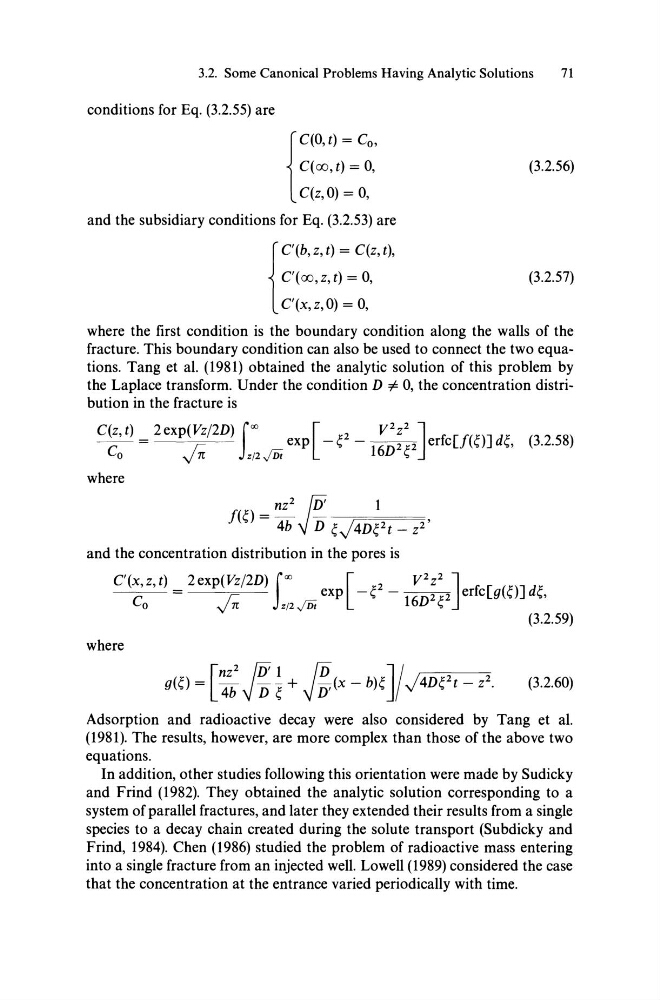
conditions for Eq. (3.2.55) are
{
C(O, t) = Co,
C(oo,t) = 0,
C(z,O) = 0,
and the subsidiary conditions for Eq. (3.2.53) are
{
C:(b,z,t) = C(z,t),
C (oo,z,t) = 0,
C'(x,z,O) = 0,
(3.2.56)
(3.2.57)
where the first condition is the boundary condition along the walls of the
fracture. This boundary condition can also be used to connect the two equations. Tang et al. (1981) obtained the analytic solution of this problem by
the Laplace transform. Under the condition D -=I- 0, the concentration distribution in the fracture is
C(z, t) = 2 eX P y'/ 2 D) foo exp [_ e2 _ V
2 :
2 2J erfc[f(e)] de, (3.2.58)
Co
11:
JZ/2JDi
16D e
where
nz 2 (iY
1
!(e) = 4b VD eJ4De2t _ Z2'
and the concentration distribution in the pores is
C'(x, z, t) = 2 exp(Vz/2D) 1
00
[_;:2 _ V 2 Z2 J rfi [ (;:)] d;:
C
I:
exp."
16D2 ;:2 e c g ."
.",
o
V 11:
z/2JDi
."
(3.2.59)
where
(3.2.60)
Adsorption and radioactive decay were also considered by Tang et al.
(1981). The results, however, are more complex than those ofthe above two
equations.
In addition, other studies following this orientation were made by Sudicky
and Frind (1982). They obtained the analytic solution corresponding to a
system of parallel fractures, and later they extended their results from a single
species to a decay chain created during the solute transport (Subdicky and
Frind, 1984). ehen (1986) studied the problem of radioactive mass entering
into a single fracture from an injected weIl. Lowell (1989) considered the case
that the concentration at the entrance varied periodically with time.
71
conditions for Eq. (3.2.55) are
{
C(O, t) = Co,
C(oo,t) = 0,
C(z,O) = 0,
and the subsidiary conditions for Eq. (3.2.53) are
{
C:(b,z,t) = C(z,t),
C (oo,z,t) = 0,
C'(x,z,O) = 0,
(3.2.56)
(3.2.57)
where the first condition is the boundary condition along the walls of the
fracture. This boundary condition can also be used to connect the two equations. Tang et al. (1981) obtained the analytic solution of this problem by
the Laplace transform. Under the condition D -=I- 0, the concentration distribution in the fracture is
C(z, t) = 2 eX P y'/ 2 D) foo exp [_ e2 _ V
2 :
2 2J erfc[f(e)] de, (3.2.58)
Co
11:
JZ/2JDi
16D e
where
nz 2 (iY
1
!(e) = 4b VD eJ4De2t _ Z2'
and the concentration distribution in the pores is
C'(x, z, t) = 2 exp(Vz/2D) 1
00
[_;:2 _ V 2 Z2 J rfi [ (;:)] d;:
C
I:
exp."
16D2 ;:2 e c g ."
.",
o
V 11:
z/2JDi
."
(3.2.59)
where
(3.2.60)
Adsorption and radioactive decay were also considered by Tang et al.
(1981). The results, however, are more complex than those ofthe above two
equations.
In addition, other studies following this orientation were made by Sudicky
and Frind (1982). They obtained the analytic solution corresponding to a
system of parallel fractures, and later they extended their results from a single
species to a decay chain created during the solute transport (Subdicky and
Frind, 1984). ehen (1986) studied the problem of radioactive mass entering
into a single fracture from an injected weIl. Lowell (1989) considered the case
that the concentration at the entrance varied periodically with time.