

36
2. Hydrodynamic Dispersion in Porous Media
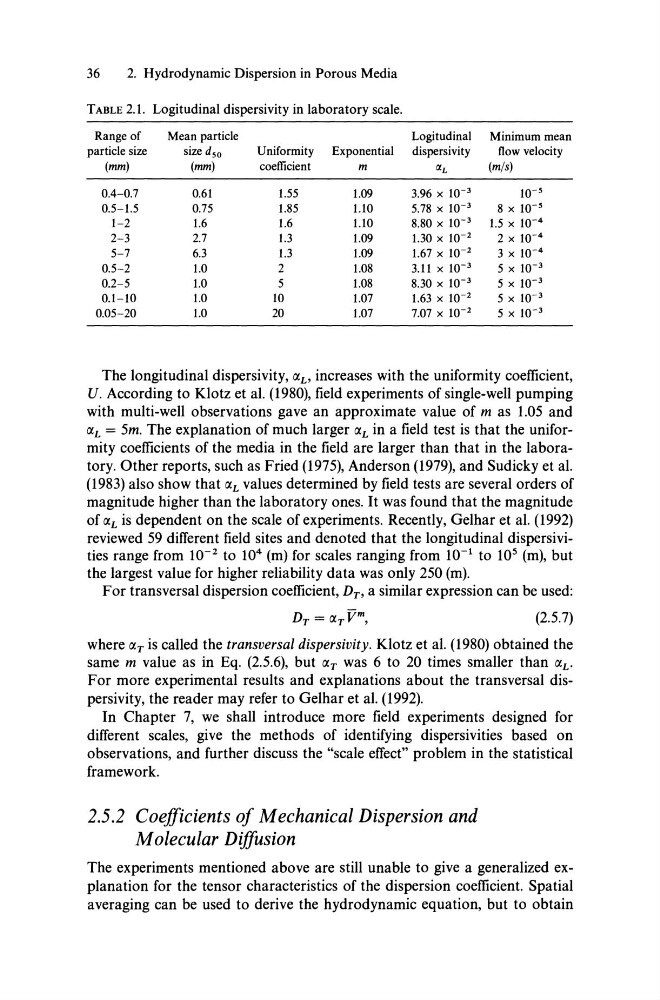
TABLE 2.1. Logitudinal dispersivity in laboratory scale.
Range of
Mean partic1e
Logitudinal
Minimum mean
partic1e size
size dso
Uniformity
Exponential
dispersivity
flow velocity
(mm)
(mm)
coefficient
m
IlL
(m/s)
0.4-0.7
0.61
1.55
1.09
3.96 x 10- 3
10- s
0.5-1.5
0.75
1.85
1.10
5.78 x 10- 3
8 x 10- 5
1-2
1.6
1.6
1.10
8.80 x 10- 3 1.5 X 10- 4
2-3
2.7
1.3
1.09
1.30 x 10- 2
2 X 10- 4
5-7
6.3
1.3
1.09
1.67 x 10- 2
3 X 10- 4
0.5-2
1.0
2
1.08
3.11 x 10- 3
5 X 10- 3
0.2-5
1.0
5
1.08
8.30 x 10- 3
5 X 10- 3
0.1-10
1.0
10
1.07
1.63 x 10- 2
5 X 10- 3
0.05-20
1.0
20
1.07
7.07 x 10- 2
5 X 10- 3
The longitudinal dispersivity, (XL' increases with the uniformity coefficient,
U. According to Klotz et aL (1980), field experiments of single-weIl pumping
with multi-weIl observations gave an approximate value of m as 1.05 and
(XL = 5m. The explanation of much larger (XL in a field test is that the uniformity coefficients of the media in the field are larger than that in the laboratory. Other reports, such as Fried (1975), Anderson (1979), and Sudicky et aL
(1983) also show that (XL values determined by field tests are several orders of
magnitude higher than the laboratory ones. It was found that the magnitude
of (XL is dependent on the scale of experiments. Recently, Gelhar et aL (1992)
reviewed 59 different field sites and denoted that the longitudinal dispersivities range from 10- 2 to 10 4 (m) for scales ranging from 10- 1 to 10 5 (m), but
the largest value for higher reliability data was only 250 (m).
For transversal dispersion coefficient, D T , a similar expression can be used:
(2.5.7)
where (XT is called the transversal dispersivity. Klotz et aL (1980) obtained the
same m value as in Eq. (2.5.6), but (XT was 6 to 20 times smaller than (XL'
For more experimental results and explanations about the transversal dispersivity, the reader may refer to Gelhar et aL (1992).
In Chapter 7, we shall introduce more field experiments designed for
different scales, give the methods of identifying dispersivities based on
observations, and further discuss the "scale effect" problem in the statistical
framework.
2.5.2 Coefficients of Mechanical Dispersion and
M olecular Diffusion
The experiments mentioned above are still unable to give a generalized explanation for the tensor characteristics of the dispersion coefficient. Spatial
averaging can be used to derive the hydrodynamic equation, but to obtain
2. Hydrodynamic Dispersion in Porous Media
TABLE 2.1. Logitudinal dispersivity in laboratory scale.
Range of
Mean partic1e
Logitudinal
Minimum mean
partic1e size
size dso
Uniformity
Exponential
dispersivity
flow velocity
(mm)
(mm)
coefficient
m
IlL
(m/s)
0.4-0.7
0.61
1.55
1.09
3.96 x 10- 3
10- s
0.5-1.5
0.75
1.85
1.10
5.78 x 10- 3
8 x 10- 5
1-2
1.6
1.6
1.10
8.80 x 10- 3 1.5 X 10- 4
2-3
2.7
1.3
1.09
1.30 x 10- 2
2 X 10- 4
5-7
6.3
1.3
1.09
1.67 x 10- 2
3 X 10- 4
0.5-2
1.0
2
1.08
3.11 x 10- 3
5 X 10- 3
0.2-5
1.0
5
1.08
8.30 x 10- 3
5 X 10- 3
0.1-10
1.0
10
1.07
1.63 x 10- 2
5 X 10- 3
0.05-20
1.0
20
1.07
7.07 x 10- 2
5 X 10- 3
The longitudinal dispersivity, (XL' increases with the uniformity coefficient,
U. According to Klotz et aL (1980), field experiments of single-weIl pumping
with multi-weIl observations gave an approximate value of m as 1.05 and
(XL = 5m. The explanation of much larger (XL in a field test is that the uniformity coefficients of the media in the field are larger than that in the laboratory. Other reports, such as Fried (1975), Anderson (1979), and Sudicky et aL
(1983) also show that (XL values determined by field tests are several orders of
magnitude higher than the laboratory ones. It was found that the magnitude
of (XL is dependent on the scale of experiments. Recently, Gelhar et aL (1992)
reviewed 59 different field sites and denoted that the longitudinal dispersivities range from 10- 2 to 10 4 (m) for scales ranging from 10- 1 to 10 5 (m), but
the largest value for higher reliability data was only 250 (m).
For transversal dispersion coefficient, D T , a similar expression can be used:
(2.5.7)
where (XT is called the transversal dispersivity. Klotz et aL (1980) obtained the
same m value as in Eq. (2.5.6), but (XT was 6 to 20 times smaller than (XL'
For more experimental results and explanations about the transversal dispersivity, the reader may refer to Gelhar et aL (1992).
In Chapter 7, we shall introduce more field experiments designed for
different scales, give the methods of identifying dispersivities based on
observations, and further discuss the "scale effect" problem in the statistical
framework.
2.5.2 Coefficients of Mechanical Dispersion and
M olecular Diffusion
The experiments mentioned above are still unable to give a generalized explanation for the tensor characteristics of the dispersion coefficient. Spatial
averaging can be used to derive the hydrodynamic equation, but to obtain