

8.3. Groundwater Quality Management Models
291
data when the transmissivity is regarded as a random field. Andricevic and
Kitanidis (1990) used the stochastic dual control method to improve the
estimation of parameters during the remediation of aquifer pollution, and
thereby, raising the reliability of management.
Using the concept of Management Equivalence Identifiability presented
by Sun and Yeh (1990b), we can find another way to estimate the uncertainty
of the optimal management decision. In the Hemet project (Yeh and Sun,
1994) mentioned in Section 8.3.4, we found that the uncertainties in hydraulic
and dispersion parameters only cause a small uncertainty in the management
solution (the relative error of the total operation cost is less then 1%), while
the uncertainties in boundary inflow, boundary outflow and precipitation
infiltration may cause significant uncertainty in the management solution
(the relative error of the total operation cost may be as large as 28%). An
efficient data collection strategy was then suggested for improving the reliability of the management model.
8.3.7 Economic and Political Models in
Groundwater Management
Models of this kind generally relate to a very large scale and a good many
variables. The considerations with regard to economy, policies, and even the
law, are directly represented by the models. For instance, in order to develop
the agricultural economy in a region, wh at policies shall we adopt to manage
the water resources (including the water rate, water law, water allocation, and
so on) so as to achieve the best agricultural economic development, and
at the same time, maintain the environment? According to the review by
Gorelick (1983), such models can be grouped into three types: the hydraulic
economic response models, the models of groundwater simulation linked
with economy management and the multilevel management models. Detailed
discussions of these models are beyond the scope of this book, so only a very
brief introduction is given below in this section.
Hydraulic Economic Response Models
Hydraulic economic response models are the direct extension of groundwater hydraulic management models, which include the agricultural economic
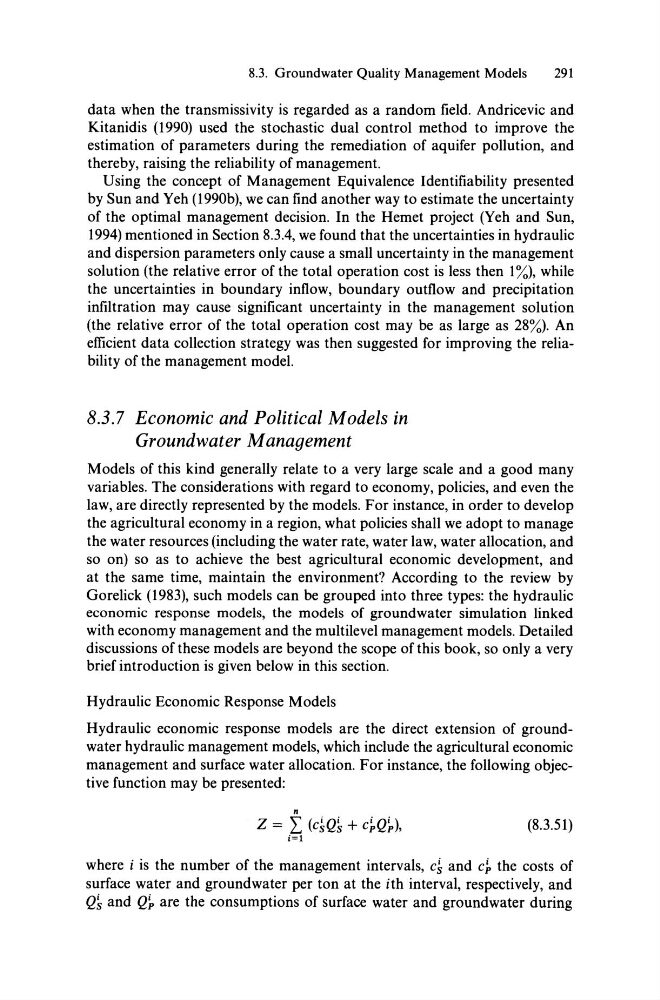
management and surface water allocation. For instance, the following objective function may be presented:
"
Z = L (c~Q~ + c~Q~),
(8.3.51)
;=1
where i is the number of the management intervals, c~ and c~ the costs of
surface water and groundwater per ton at the ith interval, respectively, and
Q~ and Q~ are the consumptions of surface water and groundwater during
291
data when the transmissivity is regarded as a random field. Andricevic and
Kitanidis (1990) used the stochastic dual control method to improve the
estimation of parameters during the remediation of aquifer pollution, and
thereby, raising the reliability of management.
Using the concept of Management Equivalence Identifiability presented
by Sun and Yeh (1990b), we can find another way to estimate the uncertainty
of the optimal management decision. In the Hemet project (Yeh and Sun,
1994) mentioned in Section 8.3.4, we found that the uncertainties in hydraulic
and dispersion parameters only cause a small uncertainty in the management
solution (the relative error of the total operation cost is less then 1%), while
the uncertainties in boundary inflow, boundary outflow and precipitation
infiltration may cause significant uncertainty in the management solution
(the relative error of the total operation cost may be as large as 28%). An
efficient data collection strategy was then suggested for improving the reliability of the management model.
8.3.7 Economic and Political Models in
Groundwater Management
Models of this kind generally relate to a very large scale and a good many
variables. The considerations with regard to economy, policies, and even the
law, are directly represented by the models. For instance, in order to develop
the agricultural economy in a region, wh at policies shall we adopt to manage
the water resources (including the water rate, water law, water allocation, and
so on) so as to achieve the best agricultural economic development, and
at the same time, maintain the environment? According to the review by
Gorelick (1983), such models can be grouped into three types: the hydraulic
economic response models, the models of groundwater simulation linked
with economy management and the multilevel management models. Detailed
discussions of these models are beyond the scope of this book, so only a very
brief introduction is given below in this section.
Hydraulic Economic Response Models
Hydraulic economic response models are the direct extension of groundwater hydraulic management models, which include the agricultural economic
management and surface water allocation. For instance, the following objective function may be presented:
"
Z = L (c~Q~ + c~Q~),
(8.3.51)
;=1
where i is the number of the management intervals, c~ and c~ the costs of
surface water and groundwater per ton at the ith interval, respectively, and
Q~ and Q~ are the consumptions of surface water and groundwater during