

270
8. Applications of Groundwater Quality Models
In the above equations, gs and gf are given by the flux boundary conditions
in the seawater and fresh water equations, respectively. After substituting
Eq. (8.2.30) into Eq. (8.2.32), the obtained equations can be arranged into
the following matrix form:
dH
[A]H + [B]Tt + F = 0,
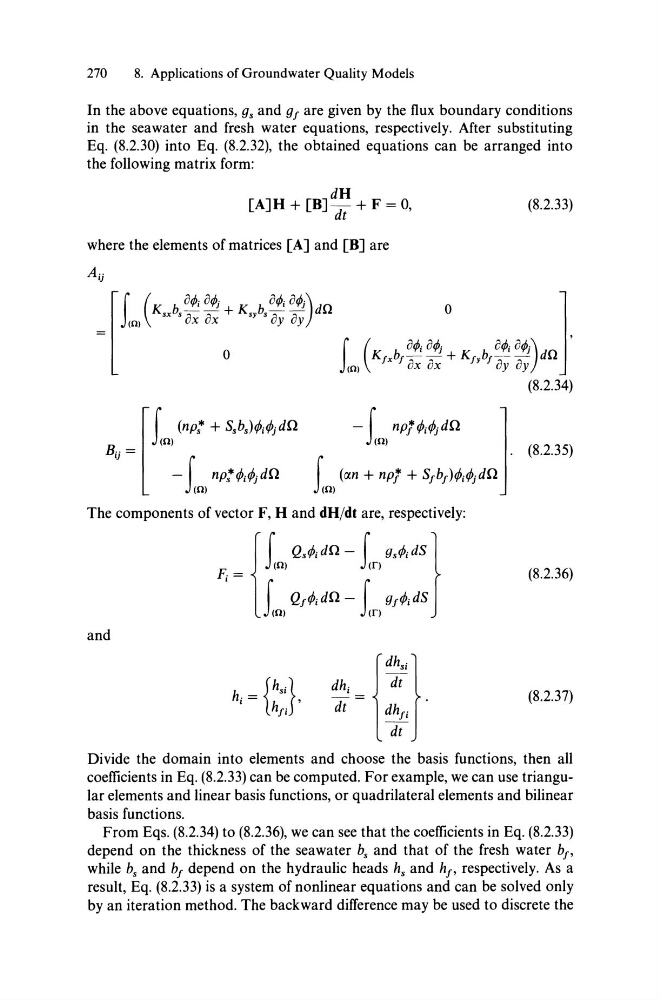
where the elements ofmatrices [A] and [B] are
- r npjt/lit/ljdn 1
JO)
r (an + npj + Sfbf)t/lit/ljdn .
J(O)
The components of vector F, Hand dH/dt are, respectively:
and
h. = {h. i }
I
h '
fi
j
dh
Si )
dh.
dt
d: ~ d:;, .
(8.2.33)
(8.2.35)
(8.2.36)
(8.2.37)
Divide the domain into elements and choose the basis functions, then all
coefficients in Eq. (8.2.33) can be computed. For example, we can use triangular elements and linear basis functions, or quadrilateral elements and bilinear
basis functions.
From Eqs. (8.2.34) to (8.2.36), we can see that the coefficients in Eq. (8.2.33)
depend on the thickness of the seawater b s and that of the fresh water b f ,
while b. and b f depend on the hydraulic heads h. and h f , respectively. As a
result, Eq. (8.2.33) is a system of nonlinear equations and can be solved only
by an iteration method. The back ward difference may be used to discrete the
8. Applications of Groundwater Quality Models
In the above equations, gs and gf are given by the flux boundary conditions
in the seawater and fresh water equations, respectively. After substituting
Eq. (8.2.30) into Eq. (8.2.32), the obtained equations can be arranged into
the following matrix form:
dH
[A]H + [B]Tt + F = 0,
where the elements ofmatrices [A] and [B] are
- r npjt/lit/ljdn 1
JO)
r (an + npj + Sfbf)t/lit/ljdn .
J(O)
The components of vector F, Hand dH/dt are, respectively:
and
h. = {h. i }
I
h '
fi
j
dh
Si )
dh.
dt
d: ~ d:;, .
(8.2.33)
(8.2.35)
(8.2.36)
(8.2.37)
Divide the domain into elements and choose the basis functions, then all
coefficients in Eq. (8.2.33) can be computed. For example, we can use triangular elements and linear basis functions, or quadrilateral elements and bilinear
basis functions.
From Eqs. (8.2.34) to (8.2.36), we can see that the coefficients in Eq. (8.2.33)
depend on the thickness of the seawater b s and that of the fresh water b f ,
while b. and b f depend on the hydraulic heads h. and h f , respectively. As a
result, Eq. (8.2.33) is a system of nonlinear equations and can be solved only
by an iteration method. The back ward difference may be used to discrete the