

8.2. Seawater Intrusion
267
where the hydraulic conductivity K. is assumed to be independent of the
depth. Equations (8.2.17a) and (8.2.l7b) are the two-dimensional equations
resulting from the vertical averaging of the seawater equations (8.2.1a) and
(8.2.1b), with the assumption ofEq. (8.2.15).
Using exactly the same derivation and assumption, the fresh water
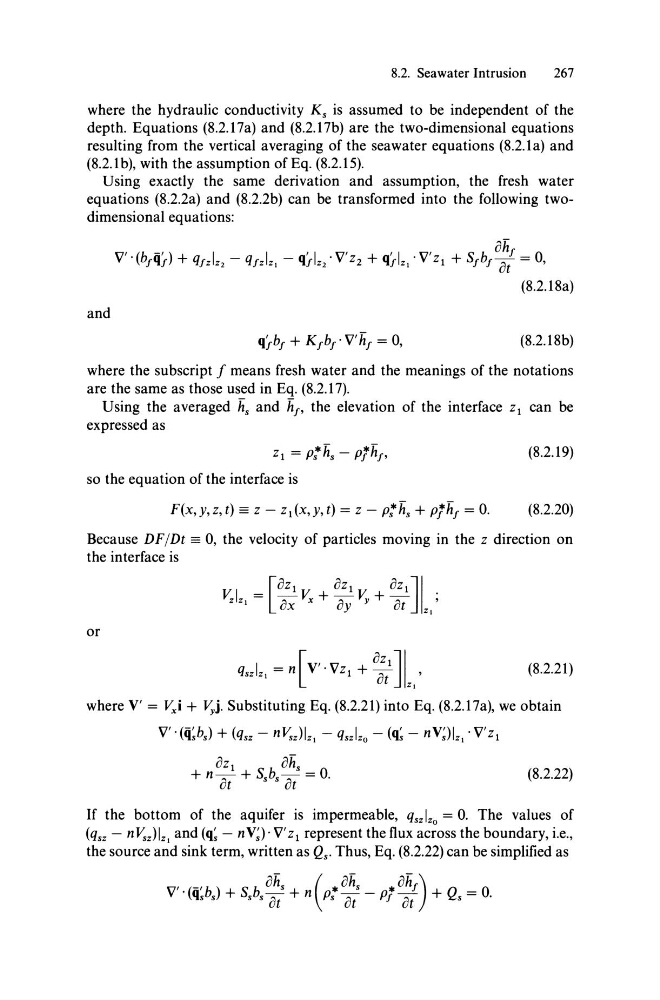
equations (8.2.2a) and (8.2.2b) can be transformed into the following twodimensional equations:
V'·(bfij') + qfz1z2 - qfz1zl - q,lz 2 ·V'Z2 + q,lz,·V'Zl + Sfb f 007 = 0,
(8.2.18a)
and
(8.2. 18b)
where the subscript f means fresh water and the meanings of the notations
are the same as those used in Eq. (8.2.17).
Using the averaged ii. and ii f , the elevation of the interface Zl can be
expressed as
Zl = p:iis - p!ii f ,
so the equation of the interface is
F(x,y,z,t) == Z - Zl(X,y,t) = Z - p:ii. + p!ii f = O.
(8.2.19)
(8.2.20)
Because DF/Dt == 0, the velocity of particles moving in the Z direction on
the interface is
or
q'ZIZI = n[ V'·Vzl + 0;t1Jlzl'
(8.2.21)
where V' = V) + v,j. Substituting Eq. (8.2.21) into Eq. (8.2. 17a), we obtain
V'·(ij~bs) + (qsz - nV.z)lz l - qszlzo - (q~ - nV;)lz l ·V'ZI
OZI
oiis
+ nTt + SAfit = O.
(8.2.22)
If the bottom of the aquifer is impermeable, qszlzo = O. The values of
(q.z - n V.z)lz l and (q~ - n V;)· V' Z 1 represent the flux across the boundary, Le.,
the source and sink term, written as Q •. Thus, Eq. (8.2.22) can be simplified as
V'. (-' b ) Sb oii.
(* oii s * oii f ) - 0
q. • + • sfit + n Ps fit - Pf Tt + Q. - .
267
where the hydraulic conductivity K. is assumed to be independent of the
depth. Equations (8.2.17a) and (8.2.l7b) are the two-dimensional equations
resulting from the vertical averaging of the seawater equations (8.2.1a) and
(8.2.1b), with the assumption ofEq. (8.2.15).
Using exactly the same derivation and assumption, the fresh water
equations (8.2.2a) and (8.2.2b) can be transformed into the following twodimensional equations:
V'·(bfij') + qfz1z2 - qfz1zl - q,lz 2 ·V'Z2 + q,lz,·V'Zl + Sfb f 007 = 0,
(8.2.18a)
and
(8.2. 18b)
where the subscript f means fresh water and the meanings of the notations
are the same as those used in Eq. (8.2.17).
Using the averaged ii. and ii f , the elevation of the interface Zl can be
expressed as
Zl = p:iis - p!ii f ,
so the equation of the interface is
F(x,y,z,t) == Z - Zl(X,y,t) = Z - p:ii. + p!ii f = O.
(8.2.19)
(8.2.20)
Because DF/Dt == 0, the velocity of particles moving in the Z direction on
the interface is
or
q'ZIZI = n[ V'·Vzl + 0;t1Jlzl'
(8.2.21)
where V' = V) + v,j. Substituting Eq. (8.2.21) into Eq. (8.2. 17a), we obtain
V'·(ij~bs) + (qsz - nV.z)lz l - qszlzo - (q~ - nV;)lz l ·V'ZI
OZI
oiis
+ nTt + SAfit = O.
(8.2.22)
If the bottom of the aquifer is impermeable, qszlzo = O. The values of
(q.z - n V.z)lz l and (q~ - n V;)· V' Z 1 represent the flux across the boundary, Le.,
the source and sink term, written as Q •. Thus, Eq. (8.2.22) can be simplified as
V'. (-' b ) Sb oii.
(* oii s * oii f ) - 0
q. • + • sfit + n Ps fit - Pf Tt + Q. - .