

8.2. Seawater Intrusion
265
Because the seawater region and the fresh water region have a common free
boundary, which is an unknown interface, governing equations (8.2.1) and
(8.2.2) cannot be solved individually. This case is very similar to the ca se of
an unknown water table that is between the unsaturated zone and the saturated zone. To solve Eqs. (8.2.1) and (8.2.2), the interface boundary condition
must be defined.
The interface is always formed by identical fluid molecules. Thus, we have
DF/Dt = O. From the relationship between the total derivative and partial
derivatives, we have the following equations:
and
eF
-+V'VF=O et s
(8.2.7a)
(8.2.7b)
where V s and V f are the porous velocities in seawater and fresh water, respectively. According to Eqs. (8.2.lb) and (8.2.2b), they satisfy
nVs = -KsVhs
(8.2.8a)
and
(8.2.8b)
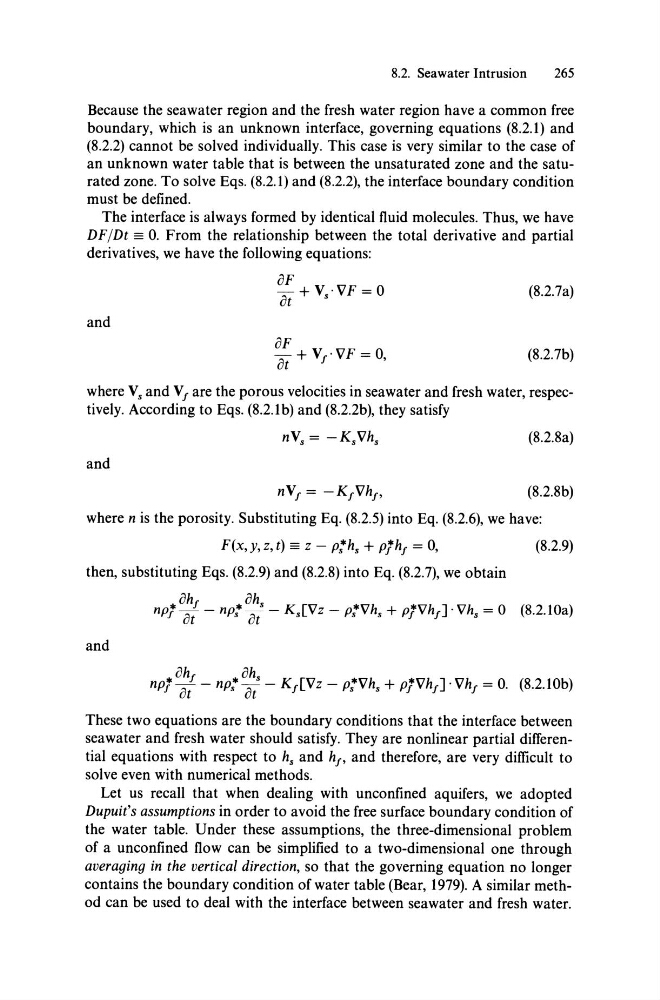
where n is the porosity. Substituting Eq. (8.2.5) into Eq. (8.2.6), we have:
F(x, y, Z, t) = Z - p:hs + plh f = 0,
(8.2.9)
then, substituting Eqs. (8.2.9) and (8.2.8) into Eq. (8.2.7), we obtain
* eh f
* eh s
[
* h
* h]' Vh - 0 (8 2 0 )
nPI Tl - nps 8t - K s Vz - Ps V s + PI V f
s -
. . 1 a
and
* eh f
* eh s
[
* h
* h] h
b
npf Tt - nps 8t - K f Vz - Ps V s + Pf V f . V f = O. (8.2.10 )
These two equations are the boundary conditions that the interface between
seawater and fresh water should satisfy. They are nonlinear partial differential equations with respect to h s and h f , and therefore, are very difficult to
solve even with numerical methods.
Let us recall that when dealing with unconfined aquifers, we adopted
Dupuit's assumptions in order to avoid the free surface boundary condition of
the water table. Under these assumptions, the three-dimensional problem
of a unconfined flow can be simplified to a two-dimensional one through
averaging in the vertical direction, so that the governing equation no longer
contains the boundary condition of water table (Bear, 1979). A similar method can be used to deal with the interface between seawater and fresh water.
265
Because the seawater region and the fresh water region have a common free
boundary, which is an unknown interface, governing equations (8.2.1) and
(8.2.2) cannot be solved individually. This case is very similar to the ca se of
an unknown water table that is between the unsaturated zone and the saturated zone. To solve Eqs. (8.2.1) and (8.2.2), the interface boundary condition
must be defined.
The interface is always formed by identical fluid molecules. Thus, we have
DF/Dt = O. From the relationship between the total derivative and partial
derivatives, we have the following equations:
and
eF
-+V'VF=O et s
(8.2.7a)
(8.2.7b)
where V s and V f are the porous velocities in seawater and fresh water, respectively. According to Eqs. (8.2.lb) and (8.2.2b), they satisfy
nVs = -KsVhs
(8.2.8a)
and
(8.2.8b)
where n is the porosity. Substituting Eq. (8.2.5) into Eq. (8.2.6), we have:
F(x, y, Z, t) = Z - p:hs + plh f = 0,
(8.2.9)
then, substituting Eqs. (8.2.9) and (8.2.8) into Eq. (8.2.7), we obtain
* eh f
* eh s
[
* h
* h]' Vh - 0 (8 2 0 )
nPI Tl - nps 8t - K s Vz - Ps V s + PI V f
s -
. . 1 a
and
* eh f
* eh s
[
* h
* h] h
b
npf Tt - nps 8t - K f Vz - Ps V s + Pf V f . V f = O. (8.2.10 )
These two equations are the boundary conditions that the interface between
seawater and fresh water should satisfy. They are nonlinear partial differential equations with respect to h s and h f , and therefore, are very difficult to
solve even with numerical methods.
Let us recall that when dealing with unconfined aquifers, we adopted
Dupuit's assumptions in order to avoid the free surface boundary condition of
the water table. Under these assumptions, the three-dimensional problem
of a unconfined flow can be simplified to a two-dimensional one through
averaging in the vertical direction, so that the governing equation no longer
contains the boundary condition of water table (Bear, 1979). A similar method can be used to deal with the interface between seawater and fresh water.