

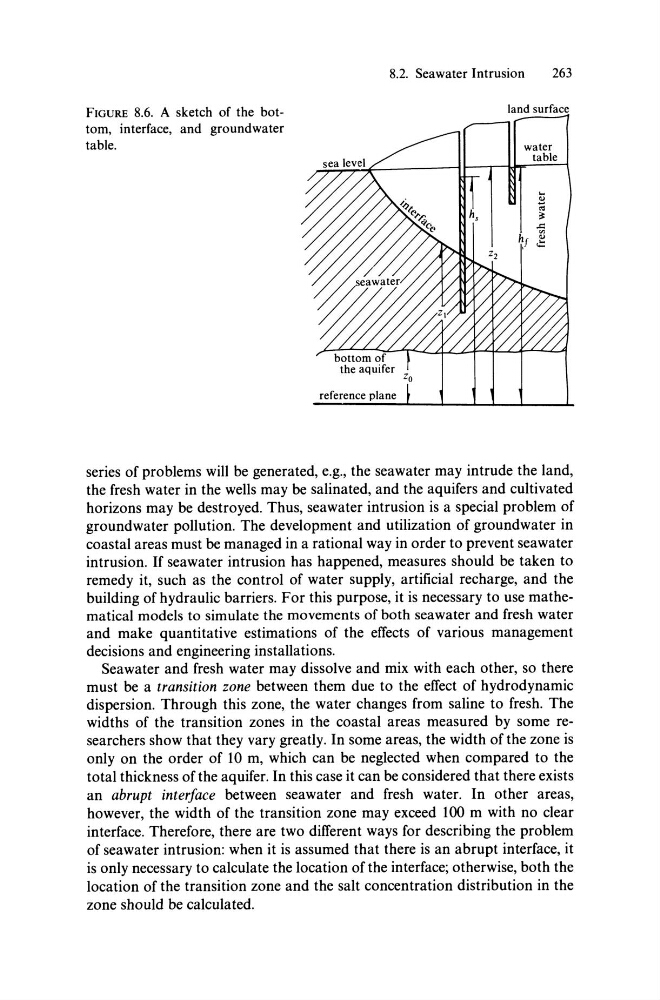
FIGURE 8.6. A sketch of the bottom, interface, and groundwater
table.
8.2. Seawater Intrusion
263
reference plane
land surface
water
tahle
series of problems will be genera ted, e.g., the seawater may intrude the land,
the fresh water in the wells may be salinated, and the aquifers and cultivated
horizons may be destroyed. Thus, seawater intrusion is a special problem of
groundwater pollution. The development and utilization of groundwater in
coastal areas must be managed in a rational way in order to prevent seawater
intrusion. If seawater intrusion has happened, measures should be taken to
remedy it, such as the control of water supply, artificial recharge, and the
building of hydraulic barriers. F or this purpose, it is necessary to use mathematical models to simulate the movements of both seawater and fresh water
and make quantitative estimations of the effects of various management
decisions and engineering installations.
Seawater and fresh water may dissolve and mix with each other, so there
must be a transition zone between them due to the effect of hydrodynamic
dispersion. Through this zone, the water changes from saline to fresh. The
widths of the transition zones in the coastal areas measured by some researchers show that they vary greatly. In some areas, the width of the zone is
only on the order of 10 m, which can be neglected when compared to the
total thickness of the aquifer. In this case it can be considered that there exists
an abrupt interface between seawater and fresh water. In other areas,
however, the width of the transition zone may exceed 100 m with no clear
interface. Therefore, there are two different ways for describing the problem
of seawater intrusion: when it is assumed that there is an abrupt interface, it
is only necessary to calculate the location of the interface; otherwise, both the
location of the transition zone and the salt concentration distribution in the
zone should be calculated.
table.
8.2. Seawater Intrusion
263
reference plane
land surface
water
tahle
series of problems will be genera ted, e.g., the seawater may intrude the land,
the fresh water in the wells may be salinated, and the aquifers and cultivated
horizons may be destroyed. Thus, seawater intrusion is a special problem of
groundwater pollution. The development and utilization of groundwater in
coastal areas must be managed in a rational way in order to prevent seawater
intrusion. If seawater intrusion has happened, measures should be taken to
remedy it, such as the control of water supply, artificial recharge, and the
building of hydraulic barriers. F or this purpose, it is necessary to use mathematical models to simulate the movements of both seawater and fresh water
and make quantitative estimations of the effects of various management
decisions and engineering installations.
Seawater and fresh water may dissolve and mix with each other, so there
must be a transition zone between them due to the effect of hydrodynamic
dispersion. Through this zone, the water changes from saline to fresh. The
widths of the transition zones in the coastal areas measured by some researchers show that they vary greatly. In some areas, the width of the zone is
only on the order of 10 m, which can be neglected when compared to the
total thickness of the aquifer. In this case it can be considered that there exists
an abrupt interface between seawater and fresh water. In other areas,
however, the width of the transition zone may exceed 100 m with no clear
interface. Therefore, there are two different ways for describing the problem
of seawater intrusion: when it is assumed that there is an abrupt interface, it
is only necessary to calculate the location of the interface; otherwise, both the
location of the transition zone and the salt concentration distribution in the
zone should be calculated.