

8.1. Simulation and Predietion ofGroundwater Pollution
261
porous block
fract~e~
• • • • •
• • • • •
• • • • • }{
f racture
(a)
(b)
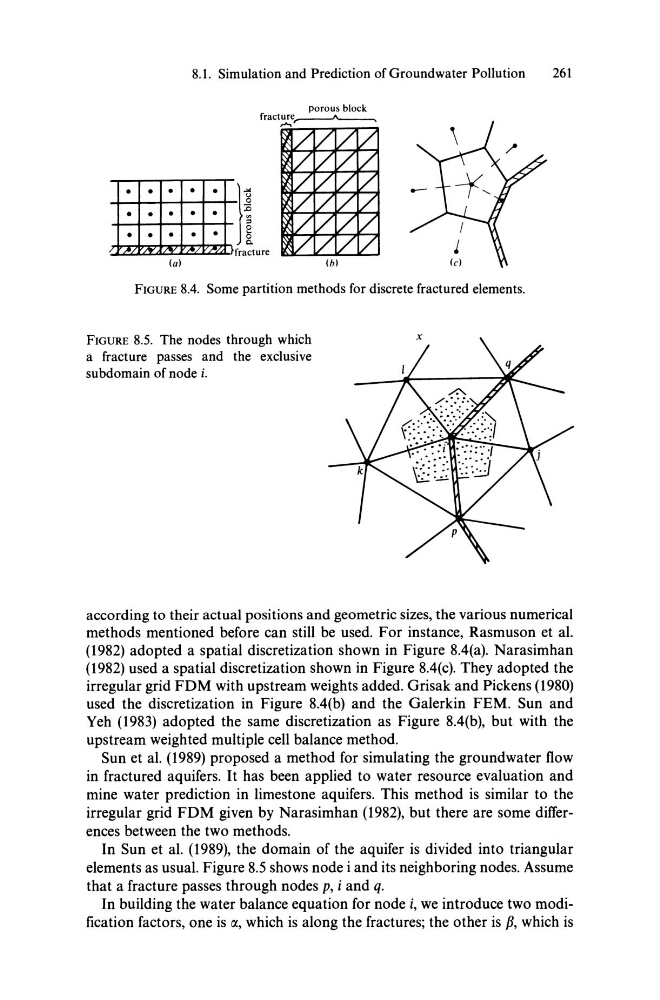
FIGURE 8.4. Some partition methods for diserete fraetured elements.
FIGURE 8.5. The nodes through whieh
a fraeture passes and the exclusive
subdomain of node i.
aeeording to their aetual positions and geometrie sizes, the various numerieal
methods mentioned before can still be used. For instance, Rasmuson et al.
(1982) adopted a spatial discretization shown in Figure 8.4(a). Narasimhan
(1982) used a spatial discretization shown in Figure 8.4(c). They adopted the
irregular grid FDM with upstream weights added. Grisak and Pickens (1980)
used the discretization in Figure 8.4(b) and the Galerkin FEM. Sun and
Yeh (1983) adopted the same discretization as Figure 8.4(b), but with the
upstream weighted multiple cell balance method.
Sun et al. (1989) proposed a method for simulating the groundwater flow
in fractured aquifers. It has been applied to water resource evaluation and
mine water prediction in limestone aquifers. This method is similar to the
irregular grid FDM given by Narasimhan (1982), but there are some differences between the two methods.
In Sun et al. (1989), the domain of the aquifer is divided into triangular
elements as usual. Figure 8.5 shows node i and its neighboring nodes. Assume
that a fracture passes through nodes p, i and q.
In building the water balance equation for node i, we introduce two modification factors, one is oe, which is along the fractures; the other is ß, which is
261
porous block
fract~e~
• • • • •
• • • • •
• • • • • }{
f racture
(a)
(b)
FIGURE 8.4. Some partition methods for diserete fraetured elements.
FIGURE 8.5. The nodes through whieh
a fraeture passes and the exclusive
subdomain of node i.
aeeording to their aetual positions and geometrie sizes, the various numerieal
methods mentioned before can still be used. For instance, Rasmuson et al.
(1982) adopted a spatial discretization shown in Figure 8.4(a). Narasimhan
(1982) used a spatial discretization shown in Figure 8.4(c). They adopted the
irregular grid FDM with upstream weights added. Grisak and Pickens (1980)
used the discretization in Figure 8.4(b) and the Galerkin FEM. Sun and
Yeh (1983) adopted the same discretization as Figure 8.4(b), but with the
upstream weighted multiple cell balance method.
Sun et al. (1989) proposed a method for simulating the groundwater flow
in fractured aquifers. It has been applied to water resource evaluation and
mine water prediction in limestone aquifers. This method is similar to the
irregular grid FDM given by Narasimhan (1982), but there are some differences between the two methods.
In Sun et al. (1989), the domain of the aquifer is divided into triangular
elements as usual. Figure 8.5 shows node i and its neighboring nodes. Assume
that a fracture passes through nodes p, i and q.
In building the water balance equation for node i, we introduce two modification factors, one is oe, which is along the fractures; the other is ß, which is