

8.1. Simulation and Prediction ofGroundwater Pollution
257
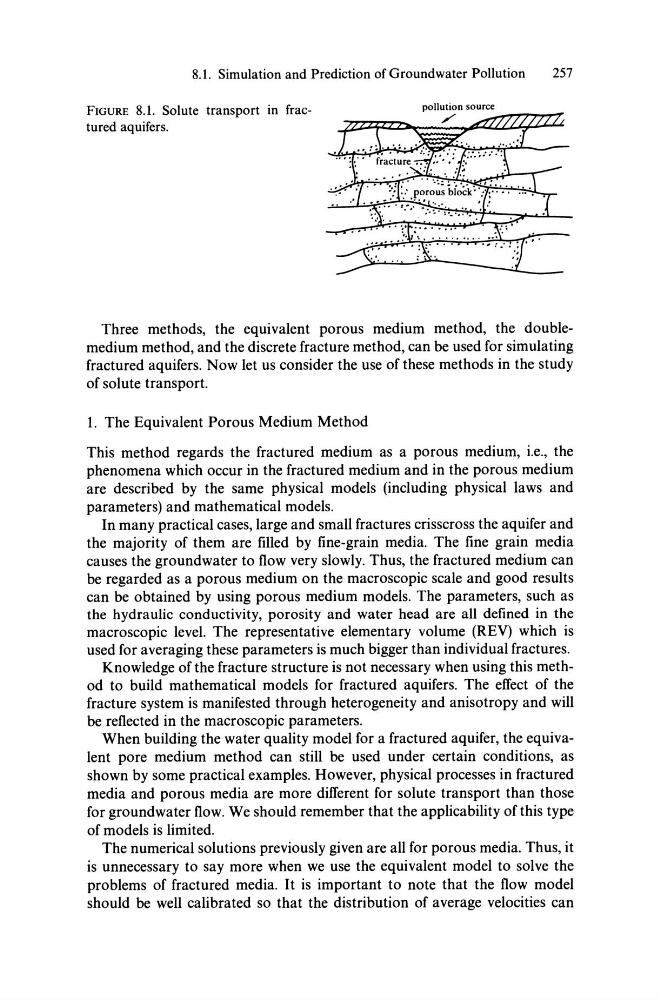
FIGURE 8.1. Solute transport in fractured aquifers.
pollution source
/ '
__ ....-.."7""1'~'?"
Three methods, the equivalent porous medium method, the doublemedium method, and the discrete fracture method, can be used for simulating
fractured aquifers. Now let us consider the use of these methods in the study
of solute transport.
1. The Equivalent Porous Medium Method
This method regards the fractured medium as a porous medium, i.e., the
phenomena which occur in the fractured medium and in the porous medium
are described by the same physical models (including physical laws and
parameters) and mathematical models.
In many practical ca ses, large and small fractures crisscross the aquifer and
the majority of them are filled by fine-grain media. The fine grain media
causes the groundwater to flow very slowly. Thus, the fractured medium can
be regarded as a porous medium on the macroscopic scale and good results
can be obtained by using porous medium models. The parameters, such as
the hydraulic conductivity, porosity and water head are all defined in the
macroscopic level. The representative elementary volume (REV) which is
used for averaging these parameters is much bigger than individual fractures.
Knowledge of the fracture structure is not necessary when using this method to build mathematical models for fractured aquifers. The effect of the
fracture system is manifested through heterogeneity and anisotropy and will
be reflected in the macroscopic parameters.
When building the water quality model for a fractured aquifer, the equivalent pore medium method can still be used under certain conditions, as
shown by some practical examples. However, physical processes in fractured
media and porous media are more different for solute transport than those
for groundwater flow. We should remember that the applicability ofthis type
of models is limited.
The numerical solutions previously given are all for porous media. Thus, it
is unnecessary to say more when we use the equivalent model to solve the
problems of fractured media. It is important to note that the flow model
should be weIl calibrated so that the distribution of average velocities can
257
FIGURE 8.1. Solute transport in fractured aquifers.
pollution source
/ '
__ ....-.."7""1'~'?"
Three methods, the equivalent porous medium method, the doublemedium method, and the discrete fracture method, can be used for simulating
fractured aquifers. Now let us consider the use of these methods in the study
of solute transport.
1. The Equivalent Porous Medium Method
This method regards the fractured medium as a porous medium, i.e., the
phenomena which occur in the fractured medium and in the porous medium
are described by the same physical models (including physical laws and
parameters) and mathematical models.
In many practical ca ses, large and small fractures crisscross the aquifer and
the majority of them are filled by fine-grain media. The fine grain media
causes the groundwater to flow very slowly. Thus, the fractured medium can
be regarded as a porous medium on the macroscopic scale and good results
can be obtained by using porous medium models. The parameters, such as
the hydraulic conductivity, porosity and water head are all defined in the
macroscopic level. The representative elementary volume (REV) which is
used for averaging these parameters is much bigger than individual fractures.
Knowledge of the fracture structure is not necessary when using this method to build mathematical models for fractured aquifers. The effect of the
fracture system is manifested through heterogeneity and anisotropy and will
be reflected in the macroscopic parameters.
When building the water quality model for a fractured aquifer, the equivalent pore medium method can still be used under certain conditions, as
shown by some practical examples. However, physical processes in fractured
media and porous media are more different for solute transport than those
for groundwater flow. We should remember that the applicability ofthis type
of models is limited.
The numerical solutions previously given are all for porous media. Thus, it
is unnecessary to say more when we use the equivalent model to solve the
problems of fractured media. It is important to note that the flow model
should be weIl calibrated so that the distribution of average velocities can