

7.4. Statistic Theory and Uncertainty Analysis
241
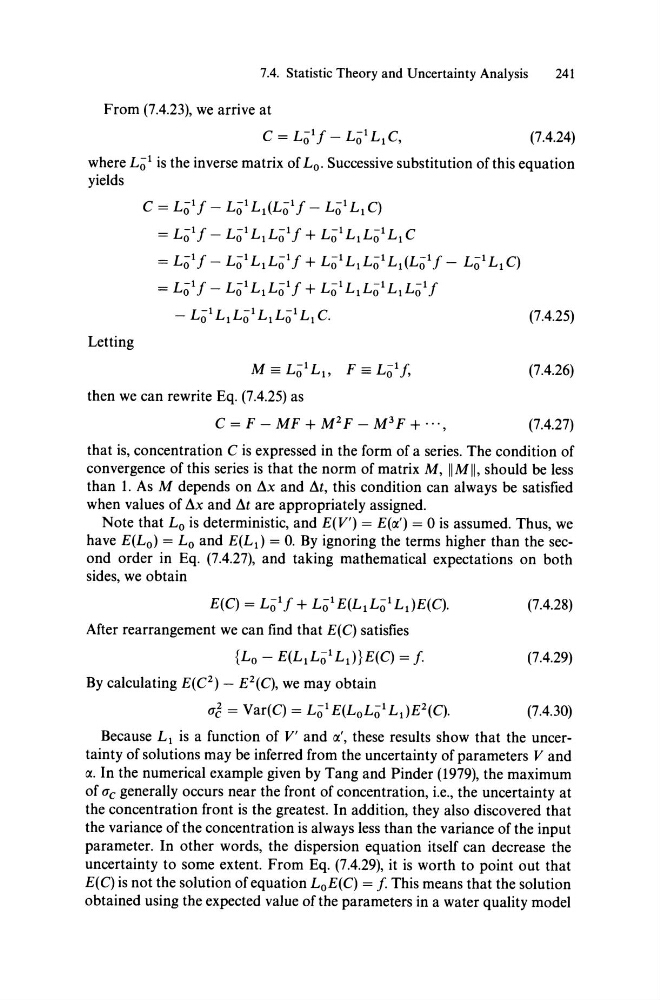
From (7.4.23), we arrive at
C = Lc/f - Lr;tL 1 C,
(7.4.24)
where L r / is the inverse matrix of L o . Successive substitution ofthis equation
yields
Letting
C = L Ö 1 f - L Ö 1 L 1 (L Ö 1 f - L Ö 1 L 1 C)
= L Ö 1 f - L Ö 1 L1Lö 1 f + L Ö 1 L1Lö 1 L 1 C
= L Ö 1 f - L Ö 1 L 1 L Ö 1 f + L Ö 1 L 1 L Ö 1 L 1 (L Ö 1 f - L Ö 1 L 1 C)
= L Ö 1 f - L Ö 1 L1Lö1f + L Ö 1 L1Lö 1 L1Lö1f
- L Ö 1 L 1 L Ö 1 L 1 L Ö 1 L 1 C.
M == L Ö 1 L 1, F == LÖ1j,
then we can rewrite Eq. (7.4.25) as
C = F - MF + M 2 F - M 3 F + ... ,
(7.4.25)
(7.4.26)
(7.4.27)
that is, concentration C is expressed in the form of aseries. The condition of
convergence of this se ries is that the norm of matrix M, IlMli, should be less
than 1. As M depends on ßx and ßt, this condition can always be satisfied
when values of ßx and ßt are appropriately assigned.
Note that L o is deterministic, and E(V') = E(a') = 0 is assumed. Thus, we
have E(L o ) = L o and E(Ld = O. By ignoring the terms higher than the second order in Eq. (7.4.27), and taking mathematical expectations on both
sides, we obtain
E(C) = LÖ1f + L Ö 1 E(L1Lö 1 L1)E(C).
After rearrangement we can find that E(C) satisfies
{Lo - E(L1Lö 1 Ld}E(C) = f.
By calculating E(C 2 ) - E 2 (C), we may obtain
(JE = Var(C) = L Ö 1 E(LoLö 1 LdE 2 (C).
(7.4.28)
(7.4.29)
(7.4.30)
Because L 1 is a function of V' and a', these results show that the uncertainty of solutions may be inferred from the uncertainty of parameters V and
a. In the numerical ex am pie given by Tang and Pinder (1979), the maximum
of (Je gene rally occurs near the front of concentration, i.e., the uncertainty at
the concentration front is the greatest. In addition, they also discovered that
the variance of the concentration is always less than the variance of the input
parameter. In other words, the dispersion equation itself can decrease the
uncertainty to some extent. From Eq. (7.4.29), it is worth to point out that
E( C) is not the solution of equation LoE(C) = f. This means that the solution
obtained using the expected value of the parameters in a water quality model
241
From (7.4.23), we arrive at
C = Lc/f - Lr;tL 1 C,
(7.4.24)
where L r / is the inverse matrix of L o . Successive substitution ofthis equation
yields
Letting
C = L Ö 1 f - L Ö 1 L 1 (L Ö 1 f - L Ö 1 L 1 C)
= L Ö 1 f - L Ö 1 L1Lö 1 f + L Ö 1 L1Lö 1 L 1 C
= L Ö 1 f - L Ö 1 L 1 L Ö 1 f + L Ö 1 L 1 L Ö 1 L 1 (L Ö 1 f - L Ö 1 L 1 C)
= L Ö 1 f - L Ö 1 L1Lö1f + L Ö 1 L1Lö 1 L1Lö1f
- L Ö 1 L 1 L Ö 1 L 1 L Ö 1 L 1 C.
M == L Ö 1 L 1, F == LÖ1j,
then we can rewrite Eq. (7.4.25) as
C = F - MF + M 2 F - M 3 F + ... ,
(7.4.25)
(7.4.26)
(7.4.27)
that is, concentration C is expressed in the form of aseries. The condition of
convergence of this se ries is that the norm of matrix M, IlMli, should be less
than 1. As M depends on ßx and ßt, this condition can always be satisfied
when values of ßx and ßt are appropriately assigned.
Note that L o is deterministic, and E(V') = E(a') = 0 is assumed. Thus, we
have E(L o ) = L o and E(Ld = O. By ignoring the terms higher than the second order in Eq. (7.4.27), and taking mathematical expectations on both
sides, we obtain
E(C) = LÖ1f + L Ö 1 E(L1Lö 1 L1)E(C).
After rearrangement we can find that E(C) satisfies
{Lo - E(L1Lö 1 Ld}E(C) = f.
By calculating E(C 2 ) - E 2 (C), we may obtain
(JE = Var(C) = L Ö 1 E(LoLö 1 LdE 2 (C).
(7.4.28)
(7.4.29)
(7.4.30)
Because L 1 is a function of V' and a', these results show that the uncertainty of solutions may be inferred from the uncertainty of parameters V and
a. In the numerical ex am pie given by Tang and Pinder (1979), the maximum
of (Je gene rally occurs near the front of concentration, i.e., the uncertainty at
the concentration front is the greatest. In addition, they also discovered that
the variance of the concentration is always less than the variance of the input
parameter. In other words, the dispersion equation itself can decrease the
uncertainty to some extent. From Eq. (7.4.29), it is worth to point out that
E( C) is not the solution of equation LoE(C) = f. This means that the solution
obtained using the expected value of the parameters in a water quality model