

7.2. Model Calibration and Parameter Estimation
215
scale of the test. In other words, the identified values of dispersivity depend
on the distance or time of tracer propagation (scale effect). This fact is
not consistent with the original physical meaning of dispersivity. Many
researchers attempted to explain this phenomenon from both theory and
field experiment. One explanation is that since the porous media in the field
are all inhomogeneous and anisotropic, the larger the experiment scale is, the
more opportunities there will be to meet the local heterogeneity. The macroscopic inhomogeneity and anisotropy can cause the real transport of the
solute to be much larger than the result calculated based on the mean velocity. Along this way, the statistical theory of mass transport in porous media
has been developed (Gelhar and Axness, 1983; Dagan, 1984; Dagan, 1989).
The second explanation is that the observations may be interpreted by an
incorrect model. There are two terms in the transport equation: advection
and dispersion. An incorrect model may regard the effect of advection as that
of dispersion.
Hutton and Lightfoot (1984) pointed out that when the dimension of a
mathematical model is lower than that of the corresponding physical model
of a test, unrealistic values of dispersivity may be obtained. For example, if
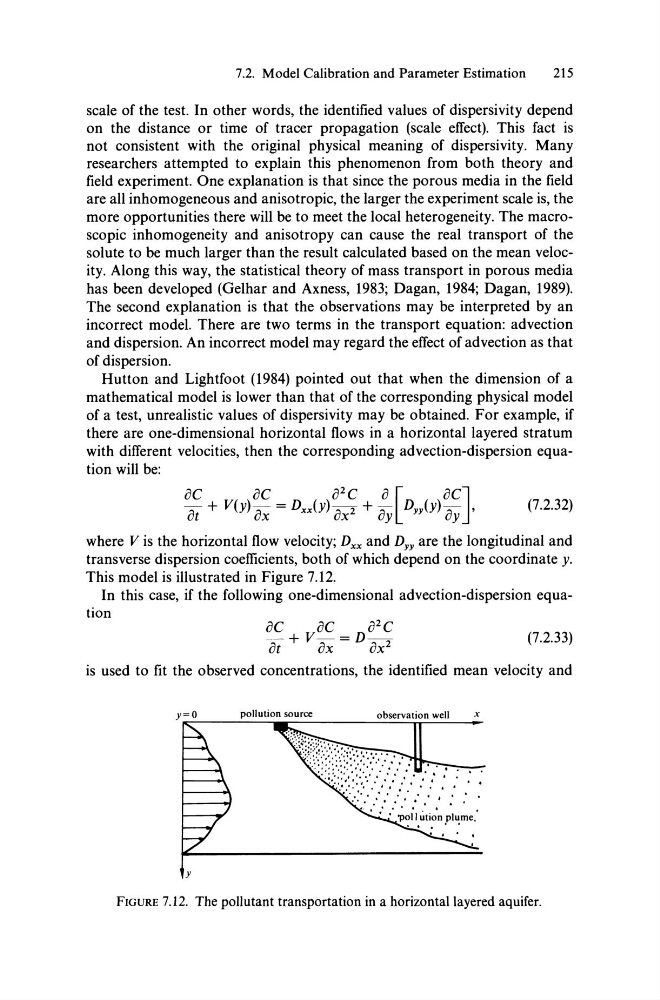
there are one-dimensional horizontal flows in a horizontallayered stratum
with different velocities, then the corresponding advection-dispersion equati on will be:
8C
8C
8 2 C
8 [
8C]
at + V(y) 8x = Dxx(Y) 8x2 + 8y Dyy(Y) 8y ,
(7.2.32)
where V is the horizontal flow velocity; Dxxand Dyy are the longitudinal and
trans verse dispersion coefficients, both of which depend on the coordinate y.
This model is illustrated in Figure 7.12.
In this case, if the following one-dimensional advection-dispersion equation
8C + V8C = D82C
8t
8x
8x 2
(7.2.33)
is used to fit the observed concentrations, the identified mean velocity and
pollution source
observation weil
x
...
. .
y
FIGURE 7.12. The pollutant transportation in a horizontallayered aquifer.
215
scale of the test. In other words, the identified values of dispersivity depend
on the distance or time of tracer propagation (scale effect). This fact is
not consistent with the original physical meaning of dispersivity. Many
researchers attempted to explain this phenomenon from both theory and
field experiment. One explanation is that since the porous media in the field
are all inhomogeneous and anisotropic, the larger the experiment scale is, the
more opportunities there will be to meet the local heterogeneity. The macroscopic inhomogeneity and anisotropy can cause the real transport of the
solute to be much larger than the result calculated based on the mean velocity. Along this way, the statistical theory of mass transport in porous media
has been developed (Gelhar and Axness, 1983; Dagan, 1984; Dagan, 1989).
The second explanation is that the observations may be interpreted by an
incorrect model. There are two terms in the transport equation: advection
and dispersion. An incorrect model may regard the effect of advection as that
of dispersion.
Hutton and Lightfoot (1984) pointed out that when the dimension of a
mathematical model is lower than that of the corresponding physical model
of a test, unrealistic values of dispersivity may be obtained. For example, if
there are one-dimensional horizontal flows in a horizontallayered stratum
with different velocities, then the corresponding advection-dispersion equati on will be:
8C
8C
8 2 C
8 [
8C]
at + V(y) 8x = Dxx(Y) 8x2 + 8y Dyy(Y) 8y ,
(7.2.32)
where V is the horizontal flow velocity; Dxxand Dyy are the longitudinal and
trans verse dispersion coefficients, both of which depend on the coordinate y.
This model is illustrated in Figure 7.12.
In this case, if the following one-dimensional advection-dispersion equation
8C + V8C = D82C
8t
8x
8x 2
(7.2.33)
is used to fit the observed concentrations, the identified mean velocity and
pollution source
observation weil
x
...
. .
y
FIGURE 7.12. The pollutant transportation in a horizontallayered aquifer.