

7
Mathematical Models of
Groundwater Quality
7.1 The Classification of Groundwater Quality Models
7.1.1 Hydrodynamic Dispersion Models
We have introduced the mechanism of hydrodynamic dispersion, derived
the hydrodynamic dispersion equations, and presented various methods for
solving this kind of equation in previous chapters. Let us now consider how
to construct and solve the general hydrodynamic dispersion models, or the
advection-dispersion models.
Hydrodynamic dispersion equations contain some parameters such as the
hydrodynamic dispersion coefficients, mean flow velocity, fluid density and
source/sink terms. We should first determine their values, and then solve for
the concentration distribution. Generally, the variation of solute concentrati on may affect the density and viscosity of the fluid, and conversely, the
changes of fluid density and viscosity may cause the state of the flow field to
change. In other words, the concentration distribution and the velocity distribution are interconnected. The concentration distribution is dependent on
the velocity distribution, and vice versa. They are both unknown functions.
Therefore, a single equation of hydrodynamic dispersion is not enough in the
general case. To solve the problem of groundwater quality in a saturated
zone, we need the following system of non-linear partial differential equations:
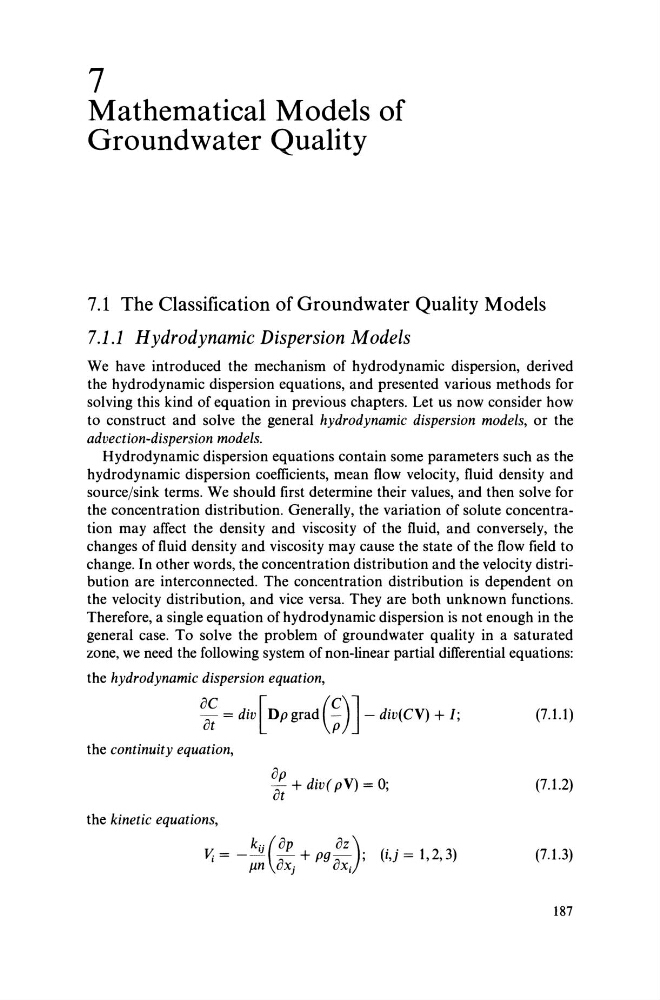
the hydrodynamic dispersion equation,
~~ = diV[ Dpgrad(~) ] - div(CV) + I;
(7.1.1)
the continuity equation,
Op
.
ot +dlV(pV)=O;
(7.1.2)
the kinetic equations,
Vi = -~ - + pg- ;
k . . (OP
oz)
J.ln OXj
OXi
(i,j = 1,2,3)
(7.1.3)
187
Mathematical Models of
Groundwater Quality
7.1 The Classification of Groundwater Quality Models
7.1.1 Hydrodynamic Dispersion Models
We have introduced the mechanism of hydrodynamic dispersion, derived
the hydrodynamic dispersion equations, and presented various methods for
solving this kind of equation in previous chapters. Let us now consider how
to construct and solve the general hydrodynamic dispersion models, or the
advection-dispersion models.
Hydrodynamic dispersion equations contain some parameters such as the
hydrodynamic dispersion coefficients, mean flow velocity, fluid density and
source/sink terms. We should first determine their values, and then solve for
the concentration distribution. Generally, the variation of solute concentrati on may affect the density and viscosity of the fluid, and conversely, the
changes of fluid density and viscosity may cause the state of the flow field to
change. In other words, the concentration distribution and the velocity distribution are interconnected. The concentration distribution is dependent on
the velocity distribution, and vice versa. They are both unknown functions.
Therefore, a single equation of hydrodynamic dispersion is not enough in the
general case. To solve the problem of groundwater quality in a saturated
zone, we need the following system of non-linear partial differential equations:
the hydrodynamic dispersion equation,
~~ = diV[ Dpgrad(~) ] - div(CV) + I;
(7.1.1)
the continuity equation,
Op
.
ot +dlV(pV)=O;
(7.1.2)
the kinetic equations,
Vi = -~ - + pg- ;
k . . (OP
oz)
J.ln OXj
OXi
(i,j = 1,2,3)
(7.1.3)
187