

6.4. The Modified Methods of Characteristics
183
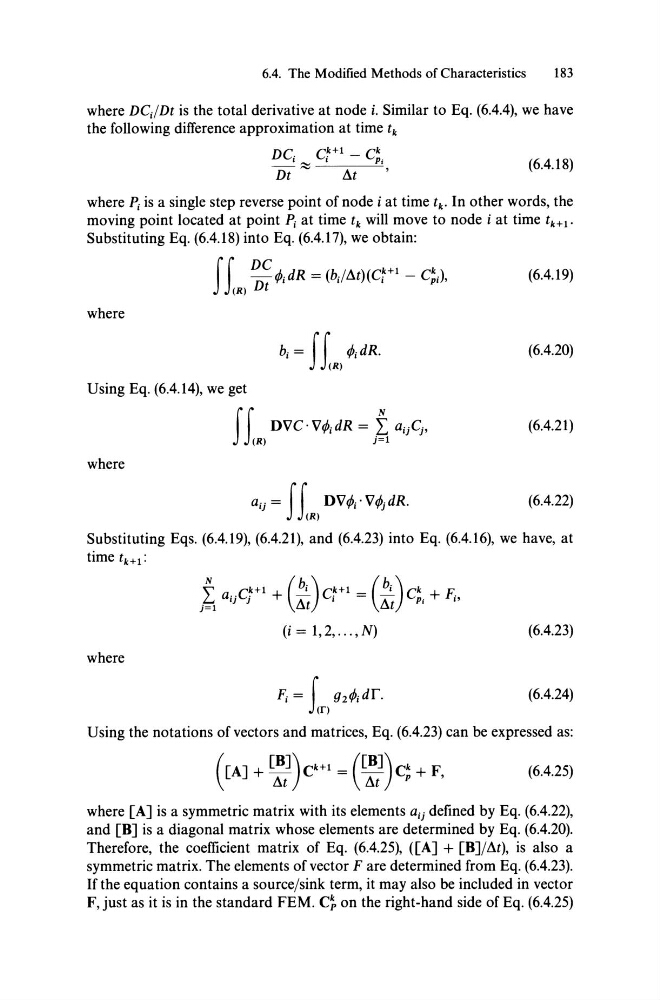
where DCJDt is the total derivative at node i. Similar to Eq. (6.4.4), we have
the following difTerenee approximation at time t k
DC. Ck+I - C k
'...........
I
Pi
Dt -
M
(6.4.18)
where Pi is a single step reverse point of node i at time t k • In other words, the
moving point loeated at point Pi at time tk will move to node i at time tk+I'
Substituting Eq. (6.4.18) into Eq. (6.4.17), we obtain:
f r DC
k+I
k
JeR) Dt rPi dR = (bJ M)( Ci - Cp;),
(6.4.19)
where
bi = fr rPidR.
J(R)
(6.4.20)
Using Eq. (6.4.14), we get
f r DVC'VrPi dR = f aijCj ,
J(R)
j;1
(6.4.21)
where
(6.4.22)
Substituting Eqs. (6.4.19), (6.4.21), and (6.4.23) into Eq. (6.4.16), we have, at
time tk + I :
~ a .. Ck+I + (bi)C~+1 = (bi)C k + F
jfi IJ J
At 1
At p;
I'
(i= 1,2,oo.,N)
(6.4.23)
where
Fi = r g2rPi dr.
J(n
(6.4.24)
Using the notations of veetors and matriees, Eq. (6.4.23) ean be expressed as:
( [A] + [B]) Ck+1 = ([B]) C k + F
M
M
p
,
(6.4.25)
where [A] is a symmetrie matrix with its elements aij defined by Eq. (6.4.22),
and [B] is a diagonal matrix whose elements are determined by Eq. (6.4.20).
Therefore, the eoeffieient matrix of Eq. (6.4.25), ([A] + [B]/At), is also a
symmetrie matrix. The elements of veetor F are determined from Eq. (6.4.23).
If the equation eontains a souree/sink term, it mayaiso be included in veetor
F, just as it is in the standard FEM. C~ on the right-hand side of Eq. (6.4.25)
183
where DCJDt is the total derivative at node i. Similar to Eq. (6.4.4), we have
the following difTerenee approximation at time t k
DC. Ck+I - C k
'...........
I
Pi
Dt -
M
(6.4.18)
where Pi is a single step reverse point of node i at time t k • In other words, the
moving point loeated at point Pi at time tk will move to node i at time tk+I'
Substituting Eq. (6.4.18) into Eq. (6.4.17), we obtain:
f r DC
k+I
k
JeR) Dt rPi dR = (bJ M)( Ci - Cp;),
(6.4.19)
where
bi = fr rPidR.
J(R)
(6.4.20)
Using Eq. (6.4.14), we get
f r DVC'VrPi dR = f aijCj ,
J(R)
j;1
(6.4.21)
where
(6.4.22)
Substituting Eqs. (6.4.19), (6.4.21), and (6.4.23) into Eq. (6.4.16), we have, at
time tk + I :
~ a .. Ck+I + (bi)C~+1 = (bi)C k + F
jfi IJ J
At 1
At p;
I'
(i= 1,2,oo.,N)
(6.4.23)
where
Fi = r g2rPi dr.
J(n
(6.4.24)
Using the notations of veetors and matriees, Eq. (6.4.23) ean be expressed as:
( [A] + [B]) Ck+1 = ([B]) C k + F
M
M
p
,
(6.4.25)
where [A] is a symmetrie matrix with its elements aij defined by Eq. (6.4.22),
and [B] is a diagonal matrix whose elements are determined by Eq. (6.4.20).
Therefore, the eoeffieient matrix of Eq. (6.4.25), ([A] + [B]/At), is also a
symmetrie matrix. The elements of veetor F are determined from Eq. (6.4.23).
If the equation eontains a souree/sink term, it mayaiso be included in veetor
F, just as it is in the standard FEM. C~ on the right-hand side of Eq. (6.4.25)