

176
6. Numerical Solutions of Advection-Dominated Problems
becomes
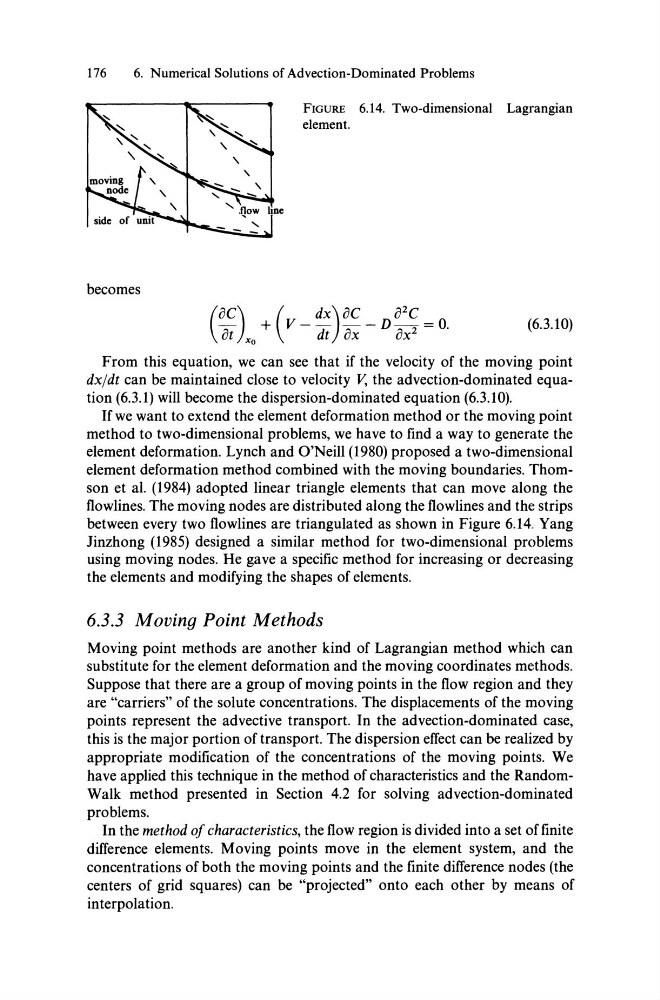
FIGURE 6.14. Two-dimensional Lagrangian
element.
( oe) + (v _ dx)oe _ D o2e = O.
ot Xo
dt ox
ox 2
(6.3.10)
From this equation, we can see that if the velocity of the moving point
dx/dt can be maintained dose to velocity V, the advection-dominated equation (6.3.1) will become the dispersion-dominated equation (6.3.10).
If we want to extend the element deformation method or the moving point
method to two-dimensional problems, we have to find a way to generate the
element deformation. Lynch and O'Neill (1980) proposed a two-dimensional
element deformation method combined with the moving boundaries. Thomson et al. (1984) adopted linear triangle elements that can move along the
flowlines. The moving nodes are distributed along the flowlines and the strips
between every two flowlines are triangulated as shown in Figure 6.14. Yang
Jinzhong (1985) designed a similar method for two-dimensional problems
using moving nodes. He gave a specific method for increasing or decreasing
the elements and modifying the shapes of elements.
6.3.3 Moving Point Methods
Moving point methods are another kind of Lagrangian method which can
substitute for the element deformation and the moving coordinates methods.
Suppose that there are a group of moving points in the flow region and they
are "carriers" of the solute concentrations. The displacements of the moving
points represent the advective transport. In the advection-dominated case,
this is the major portion of transport. The dispersion efTect can be realized by
appropriate modification of the concentrations of the moving points. We
have applied this technique in the method of characteristics and the RandomWalk method presented in Section 4.2 for solving advection-dominated
problems.
In the method of characteristics, the flow region is divided into a set of finite
difTerence elements. Moving points move in the element system, and the
concentrations of both the moving points and the finite difTerence nodes (the
centers of grid squares) can be "projected" onto each other by means of
interpolation.
6. Numerical Solutions of Advection-Dominated Problems
becomes
FIGURE 6.14. Two-dimensional Lagrangian
element.
( oe) + (v _ dx)oe _ D o2e = O.
ot Xo
dt ox
ox 2
(6.3.10)
From this equation, we can see that if the velocity of the moving point
dx/dt can be maintained dose to velocity V, the advection-dominated equation (6.3.1) will become the dispersion-dominated equation (6.3.10).
If we want to extend the element deformation method or the moving point
method to two-dimensional problems, we have to find a way to generate the
element deformation. Lynch and O'Neill (1980) proposed a two-dimensional
element deformation method combined with the moving boundaries. Thomson et al. (1984) adopted linear triangle elements that can move along the
flowlines. The moving nodes are distributed along the flowlines and the strips
between every two flowlines are triangulated as shown in Figure 6.14. Yang
Jinzhong (1985) designed a similar method for two-dimensional problems
using moving nodes. He gave a specific method for increasing or decreasing
the elements and modifying the shapes of elements.
6.3.3 Moving Point Methods
Moving point methods are another kind of Lagrangian method which can
substitute for the element deformation and the moving coordinates methods.
Suppose that there are a group of moving points in the flow region and they
are "carriers" of the solute concentrations. The displacements of the moving
points represent the advective transport. In the advection-dominated case,
this is the major portion of transport. The dispersion efTect can be realized by
appropriate modification of the concentrations of the moving points. We
have applied this technique in the method of characteristics and the RandomWalk method presented in Section 4.2 for solving advection-dominated
problems.
In the method of characteristics, the flow region is divided into a set of finite
difTerence elements. Moving points move in the element system, and the
concentrations of both the moving points and the finite difTerence nodes (the
centers of grid squares) can be "projected" onto each other by means of
interpolation.