

166
6. Numerical Solutions of Advection-Dominated Problems
in which
and
3
cPjl = 2A (ajl + bj1x + cjly), I = i, k, m
e
aji = XmYk - XkYm, bji = Ym - Yk' Cji = Xk - Xm,
ajm = XkYi - XiYk' bjm = Yk - Yi' cjm = Xi - Xk,
ajk = XiYm - XmYi' bjk = Yi - Ym' Cjk = Xm - Xi·
(6.2.38)
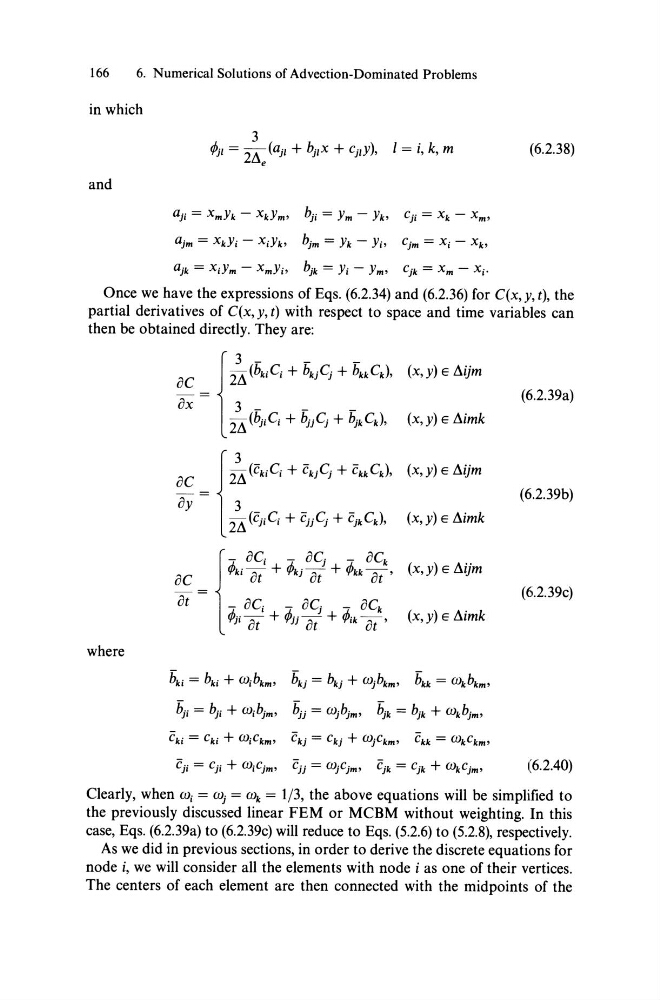
Once we have the expressions of Eqs. (6.2.34) and (6.2.36) for C(x,y, t), the
partial derivatives of C(x, y, t) with respect to space and time variabl,es can
then be obtained directly. They are:
ax
3 _
_
_
2A (bjiCi + bjjCj + bjkCk), (x,y) E Aimk
oC ~ ( 2~ (<'"C, + <"jC j + <, .. C,), (x,y) E Aijm
(6.2.39b)
ay
3
2A (CjiCi + CjjCj + cjkCd, (x,y) E Aimk
r ac - oC - oC, (x,y) E Aijm
ac = cPkiTt + cPkj a/ + cPkk7ft'
(6.2.39c)
at
_ ac. - ac. - aC k
cPji Tt + cPjj a/ + cPik 7ft' (x,y) E Aimk
where
bki = bki + wibkm , bkj = bkj + wjbkm , bkk = Wk b km ,
~i = bji + wibjm , ~j = wjbjm , bjk = bjk + wkbjm ,
Cki = Cki + WiCkm' ckj = ckj + WjCkm , Ckk = WkCkm,
Cji = cji + wicjm , Cjj = WjCjm , Cjk = Cjk + w,.cjm ,
(6.2.40)
Clearly, when W i = wj = Wk = 1/3, the above equations will be simplified to
the previously discussed linear FEM or MCBM without weighting. In this
case, Eqs. (6.2.39a) to (6.2.39c) will reduce to Eqs. (5.2.6) to (5.2.8), respectively.
As we did in previous sections, in order to derive the discrete equations for
node i, we will consider all the elements with node i as one of their vertices.
The centers of each element are then connected with the midpoints of the
6. Numerical Solutions of Advection-Dominated Problems
in which
and
3
cPjl = 2A (ajl + bj1x + cjly), I = i, k, m
e
aji = XmYk - XkYm, bji = Ym - Yk' Cji = Xk - Xm,
ajm = XkYi - XiYk' bjm = Yk - Yi' cjm = Xi - Xk,
ajk = XiYm - XmYi' bjk = Yi - Ym' Cjk = Xm - Xi·
(6.2.38)
Once we have the expressions of Eqs. (6.2.34) and (6.2.36) for C(x,y, t), the
partial derivatives of C(x, y, t) with respect to space and time variabl,es can
then be obtained directly. They are:
ax
3 _
_
_
2A (bjiCi + bjjCj + bjkCk), (x,y) E Aimk
oC ~ ( 2~ (<'"C, + <"jC j + <, .. C,), (x,y) E Aijm
(6.2.39b)
ay
3
2A (CjiCi + CjjCj + cjkCd, (x,y) E Aimk
r ac - oC - oC, (x,y) E Aijm
ac = cPkiTt + cPkj a/ + cPkk7ft'
(6.2.39c)
at
_ ac. - ac. - aC k
cPji Tt + cPjj a/ + cPik 7ft' (x,y) E Aimk
where
bki = bki + wibkm , bkj = bkj + wjbkm , bkk = Wk b km ,
~i = bji + wibjm , ~j = wjbjm , bjk = bjk + wkbjm ,
Cki = Cki + WiCkm' ckj = ckj + WjCkm , Ckk = WkCkm,
Cji = cji + wicjm , Cjj = WjCjm , Cjk = Cjk + w,.cjm ,
(6.2.40)
Clearly, when W i = wj = Wk = 1/3, the above equations will be simplified to
the previously discussed linear FEM or MCBM without weighting. In this
case, Eqs. (6.2.39a) to (6.2.39c) will reduce to Eqs. (5.2.6) to (5.2.8), respectively.
As we did in previous sections, in order to derive the discrete equations for
node i, we will consider all the elements with node i as one of their vertices.
The centers of each element are then connected with the midpoints of the