

5.3. Finite Element Methods for Three-Dimensional Problems
139
For iJ
iJ
iJ
& = - (.1z)
iJ
iJ
& = (.1z) & = (.1z)
Now, let us go back to the integral equation (5.3.20), and rewrite it in the
following form:
ff r (iJiJ C + M)dR = fr Da.PiJiJC na. dS - ff r v,.iJiJC dR. (5.3.38)
JR) t
JS) x p
JR) Xa.
Einstein's summation convention has been used in the above equation, where
(R) is the exc1usive subdomain of the considered node and (S) is its boundary
surface, see Figure 5.22. Note that all integrands in the equation only inc1ude
first-order partial derivatives of the unknown concentration. When the approximate expressions of those partial derivatives given in Eq. (5.3.37) are
substituted into Eq. (5.3.38) and integrated, we can obtain a discretized equati on which connects the unknown concentrations of the node and its surrounding nodes. A system of discrete equations can then be formed by considering all nodes where the concentration is unknown.
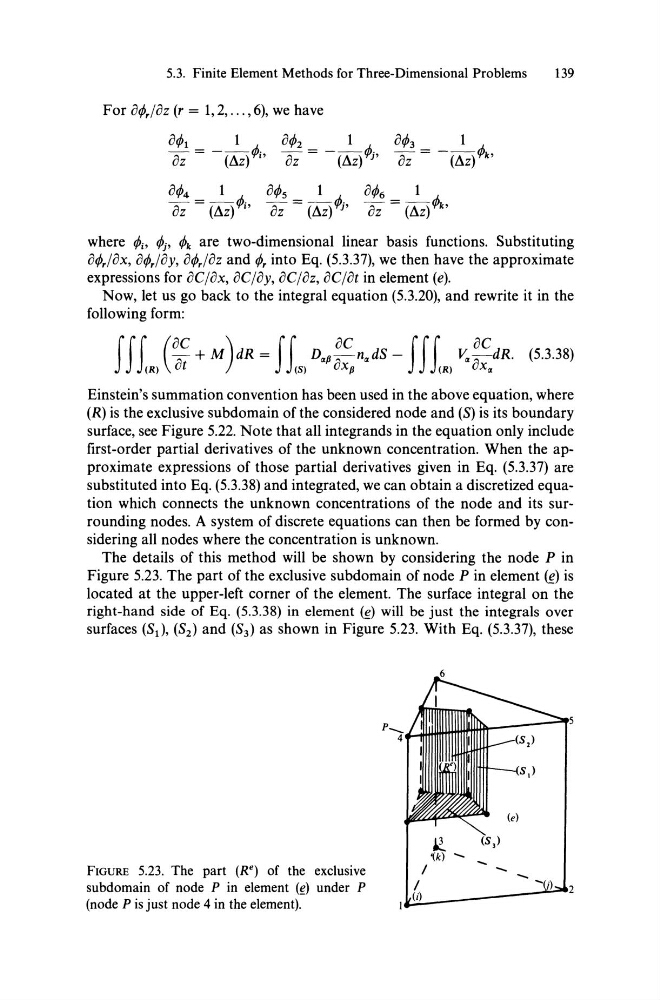
The details of this method will be shown by considering the node P in
Figure 5.23. The part of the exc1usive subdomain of node P in element ~) is
located at the upper-Ieft corner of the element. The surface integral on the
right-hand side of Eq. (5.3.38) in element ~) will be just the integrals over
surfaces (Sd, (S2) and (S3) as shown in Figure 5.23. With Eq. (5.3.37), these
FIGURE 5.23. The part (Re) of the exc1usive
subdomain of node P in element ~) under P
(node P is just node 4 in the element).
139
For iJ
iJ
iJ
& = - (.1z)
iJ
iJ
& = (.1z)
Now, let us go back to the integral equation (5.3.20), and rewrite it in the
following form:
ff r (iJiJ C + M)dR = fr Da.PiJiJC na. dS - ff r v,.iJiJC dR. (5.3.38)
JR) t
JS) x p
JR) Xa.
Einstein's summation convention has been used in the above equation, where
(R) is the exc1usive subdomain of the considered node and (S) is its boundary
surface, see Figure 5.22. Note that all integrands in the equation only inc1ude
first-order partial derivatives of the unknown concentration. When the approximate expressions of those partial derivatives given in Eq. (5.3.37) are
substituted into Eq. (5.3.38) and integrated, we can obtain a discretized equati on which connects the unknown concentrations of the node and its surrounding nodes. A system of discrete equations can then be formed by considering all nodes where the concentration is unknown.
The details of this method will be shown by considering the node P in
Figure 5.23. The part of the exc1usive subdomain of node P in element ~) is
located at the upper-Ieft corner of the element. The surface integral on the
right-hand side of Eq. (5.3.38) in element ~) will be just the integrals over
surfaces (Sd, (S2) and (S3) as shown in Figure 5.23. With Eq. (5.3.37), these
FIGURE 5.23. The part (Re) of the exc1usive
subdomain of node P in element ~) under P
(node P is just node 4 in the element).