

5.3. Finite Element Methods for Three-Dimensional Problems
137
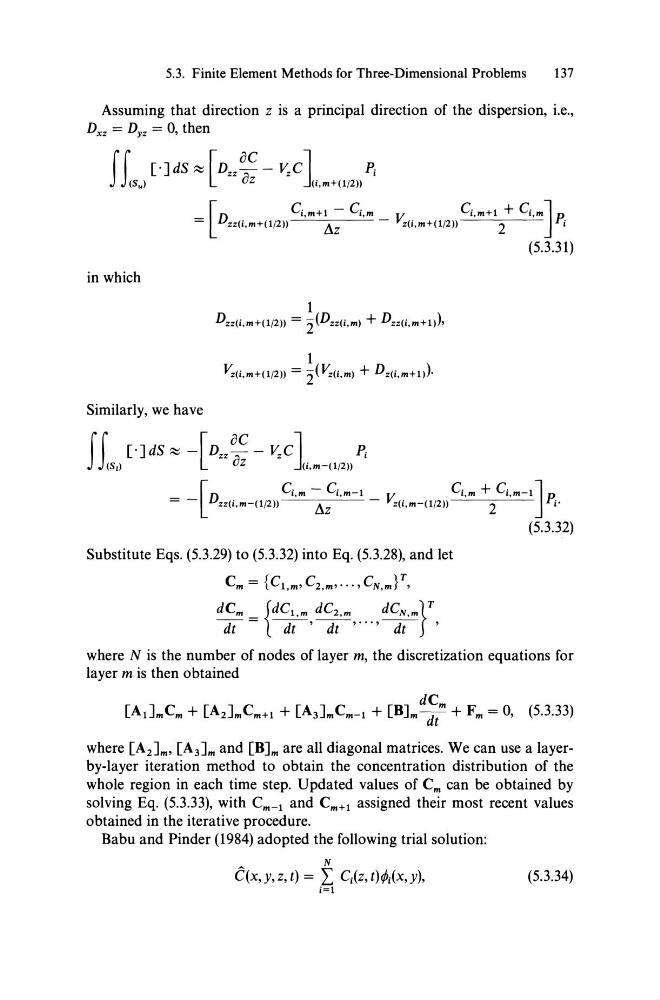
Assuming that direetion z is a prineipal direetion of the dispersion, i.e.,
Dxz = Dyz = 0, then
ff
[ oC ]
['JdS ~ Dzz - - ~C
Pi
(Su)
oz
(i,m+(1/2»
[
Ci,m+1 - Ci,m
C i,m+1 + Ci,m]
= D zz(i,m+(1/2»
tu
- ~(i,m+(1/2»
2
Pi
(5.3.31)
in which
1
D zz(i,m+(1/2» = 2(Dzz(i,m) + Dzz(i,m+1»)'
1
~(i,m+(1/2» = 2(~(i,m) + DZ(i,m+1»)'
Similarly, we have
f r [ . J dS ~ - [D oC - v. c] p.
JSI)
zz oz Z (i,m-(1/2» I
[
Ci,m - Ci,m-1
Ci,m + Ci,m-1]
= - D zz(i,m-(1/2»
Az
- ~(i,m-(1/2»
2
Pi'
(5.3.32)
Substitute Eqs. (5.3.29) to (5.3.32) into Eq. (5.3.28), and let
where N is the number of nodes of layer m, the diseretization equations for
layer m is then obtained
where [A2 Jm' [A3 Jm and [BJm are all diagonal matriees. We ean use a layerby-Iayer iteration method to obtain the eoncentration distribution of the
whole region in eaeh time step. Updated values of C m ean be obtained by
solving Eq. (5.3.33), with C m - 1 and C m + 1 assigned their most recent values
obtained in the iterative proeedure.
Babu and Pinder (1984) adopted the following trial solution:
~
N
C(x, y, z, t) = L Ci(z, t)(/J;(x, y),
(5.3.34)
i=l
137
Assuming that direetion z is a prineipal direetion of the dispersion, i.e.,
Dxz = Dyz = 0, then
ff
[ oC ]
['JdS ~ Dzz - - ~C
Pi
(Su)
oz
(i,m+(1/2»
[
Ci,m+1 - Ci,m
C i,m+1 + Ci,m]
= D zz(i,m+(1/2»
tu
- ~(i,m+(1/2»
2
Pi
(5.3.31)
in which
1
D zz(i,m+(1/2» = 2(Dzz(i,m) + Dzz(i,m+1»)'
1
~(i,m+(1/2» = 2(~(i,m) + DZ(i,m+1»)'
Similarly, we have
f r [ . J dS ~ - [D oC - v. c] p.
JSI)
zz oz Z (i,m-(1/2» I
[
Ci,m - Ci,m-1
Ci,m + Ci,m-1]
= - D zz(i,m-(1/2»
Az
- ~(i,m-(1/2»
2
Pi'
(5.3.32)
Substitute Eqs. (5.3.29) to (5.3.32) into Eq. (5.3.28), and let
where N is the number of nodes of layer m, the diseretization equations for
layer m is then obtained
where [A2 Jm' [A3 Jm and [BJm are all diagonal matriees. We ean use a layerby-Iayer iteration method to obtain the eoncentration distribution of the
whole region in eaeh time step. Updated values of C m ean be obtained by
solving Eq. (5.3.33), with C m - 1 and C m + 1 assigned their most recent values
obtained in the iterative proeedure.
Babu and Pinder (1984) adopted the following trial solution:
~
N
C(x, y, z, t) = L Ci(z, t)(/J;(x, y),
(5.3.34)
i=l