

108
6
7
1' /
2
5. Finite Element Methods for Solving Hydrodynamic Dispersion Equations
3
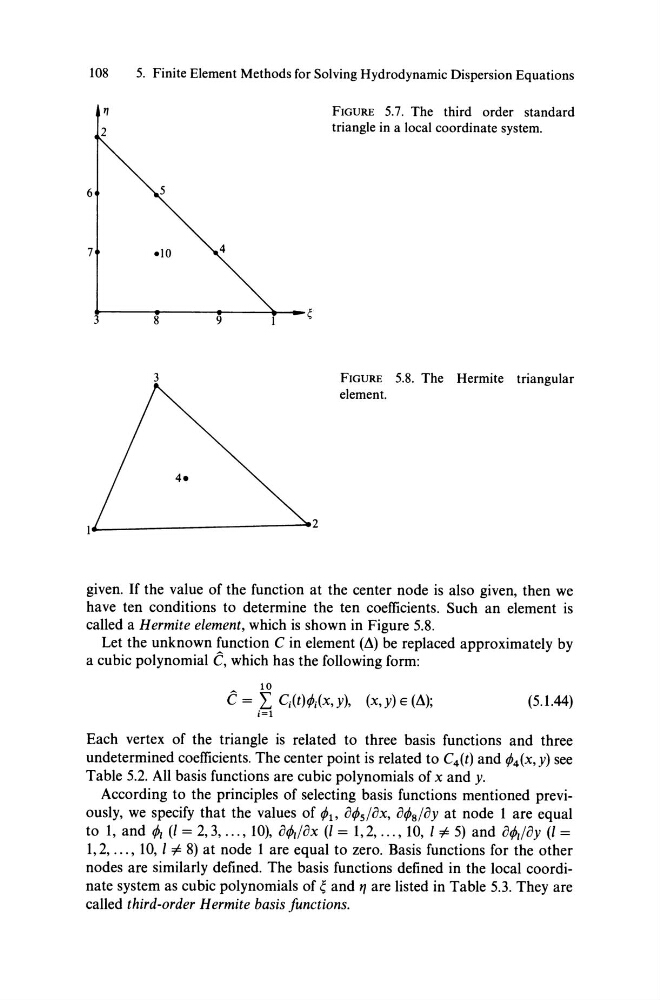
4FIGURE 5.7. The third order standard
triangle in a local coordinate system.
FIGURE 5.8. The Hermite triangular
element.
L-__________________ ~2
given. If the value of the function at the center node is also given, then we
have ten conditions to determine the ten coefficients. Such an element is
called a Hermite element, which is shown in Figure 5.8.
Let the unknown function C in element (A) be replaced approximately by
a cubic polynomial C, which has the following form:
10
C = L Ci (t)(A(x, y), (x, y) E (A);
(5.1.44)
i=l
Each vertex of the triangle is related to three basis functions and three
undetermined coefficients. The center point is related to C 4 (t) and rP4(X, y) see
Table 5.2. All basis functions are cubic polynomials of x and y.
According to the principles of selecting basis functions mentioned previously, we specify that the values of rP1, orPs/ox, orPs/oy at node 1 are equal
to 1, and rPl (l = 2,3, ... , 10), orPz/ox (l = 1,2, ... , 10, 1 # 5) and orPz/oy (I =
1,2, ... , 10, 1 # 8) at node 1 are equal to zero. Basis functions for the other
nodes are similarly defined. The basis functions defined in the local coordina te system as cubic polynomials of ~ and t7 are listed in Table 5.3. They are
called third-order Hermite basis functions.
6
7
1' /
2
5. Finite Element Methods for Solving Hydrodynamic Dispersion Equations
3
4FIGURE 5.7. The third order standard
triangle in a local coordinate system.
FIGURE 5.8. The Hermite triangular
element.
L-__________________ ~2
given. If the value of the function at the center node is also given, then we
have ten conditions to determine the ten coefficients. Such an element is
called a Hermite element, which is shown in Figure 5.8.
Let the unknown function C in element (A) be replaced approximately by
a cubic polynomial C, which has the following form:
10
C = L Ci (t)(A(x, y), (x, y) E (A);
(5.1.44)
i=l
Each vertex of the triangle is related to three basis functions and three
undetermined coefficients. The center point is related to C 4 (t) and rP4(X, y) see
Table 5.2. All basis functions are cubic polynomials of x and y.
According to the principles of selecting basis functions mentioned previously, we specify that the values of rP1, orPs/ox, orPs/oy at node 1 are equal
to 1, and rPl (l = 2,3, ... , 10), orPz/ox (l = 1,2, ... , 10, 1 # 5) and orPz/oy (I =
1,2, ... , 10, 1 # 8) at node 1 are equal to zero. Basis functions for the other
nodes are similarly defined. The basis functions defined in the local coordina te system as cubic polynomials of ~ and t7 are listed in Table 5.3. They are
called third-order Hermite basis functions.