

3 Prediction of the Formation of Water-in-Oil Emulsions
71
Ast3 is the cube of the transformed asphaltene content as calculated in Eq. (3.5),
abbreviated F,
A/Rst3 is the cube of the transformed A/R ratio as calculated in Eq. (3.6), abbreviated G,
lnVst is the natural logarithm (ln) of the transformed viscosity as calculated in
Eq. (3.2), abbreviated H,
lnRst is the natural logarithm (ln) of the transformed resin content as calculated in
Eq. (3.4), abbreviated I,
lnA/Rst is the natural logarithm (ln) of transformed asphaltene/resin ratio as calculated in (3.6), abbreviated J,
Exp(Vst)2 is the exponential of the transformed viscosity and squared—Vst as
calculated in Eq. (3.2), abbreviated K,
Exp(A/Rst)2 is the exponential of the A/R ratio—squared—as calculated in
Eq. (3.6), abbreviated L,
LogDst/Dst2 is the logarithm (base 10) of the exponential of the density—divided
by the square of the transformed density—the transformed density as calculated
in Eq. (3.1), abbreviated M,
LogA/Rst/A/Rst2 is the logarithm (base 10) of the exponential of the A/R ratio—
divided by the square of the A/R ratio—the transformed A/R ratio as calculated
in Eq. (3.6), abbreviated N.
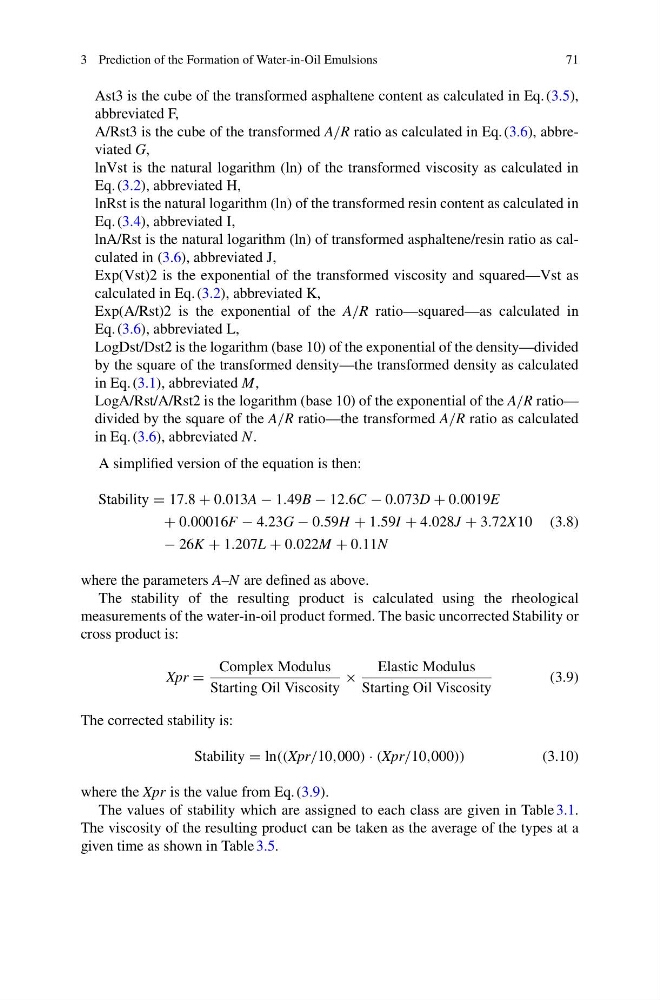
A simplified version of the equation is then:
Stability = 17.8 + 0.013A − 1.49B − 12.6C − 0.073D + 0.0019E
+ 0.00016F − 4.23G − 0.59H + 1.59I + 4.028J + 3.72X10 (3.8)
− 26K + 1.207L + 0.022M + 0.11N
where the parameters A–N are defined as above.
The stability of the resulting product is calculated using the rheological
measurements of the water-in-oil product formed. The basic uncorrected Stability or
cross product is:
Xpr =
Complex Modulus
Starting Oil Viscosity
×
Elastic Modulus
Starting Oil Viscosity
(3.9)
The corrected stability is:
Stability = ln((Xpr/10,000) · (Xpr/10,000))
(3.10)
where the Xpr is the value from Eq. (3.9).
The values of stability which are assigned to each class are given in Table 3.1.
The viscosity of the resulting product can be taken as the average of the types at a
given time as shown in Table 3.5.
71
Ast3 is the cube of the transformed asphaltene content as calculated in Eq. (3.5),
abbreviated F,
A/Rst3 is the cube of the transformed A/R ratio as calculated in Eq. (3.6), abbreviated G,
lnVst is the natural logarithm (ln) of the transformed viscosity as calculated in
Eq. (3.2), abbreviated H,
lnRst is the natural logarithm (ln) of the transformed resin content as calculated in
Eq. (3.4), abbreviated I,
lnA/Rst is the natural logarithm (ln) of transformed asphaltene/resin ratio as calculated in (3.6), abbreviated J,
Exp(Vst)2 is the exponential of the transformed viscosity and squared—Vst as
calculated in Eq. (3.2), abbreviated K,
Exp(A/Rst)2 is the exponential of the A/R ratio—squared—as calculated in
Eq. (3.6), abbreviated L,
LogDst/Dst2 is the logarithm (base 10) of the exponential of the density—divided
by the square of the transformed density—the transformed density as calculated
in Eq. (3.1), abbreviated M,
LogA/Rst/A/Rst2 is the logarithm (base 10) of the exponential of the A/R ratio—
divided by the square of the A/R ratio—the transformed A/R ratio as calculated
in Eq. (3.6), abbreviated N.
A simplified version of the equation is then:
Stability = 17.8 + 0.013A − 1.49B − 12.6C − 0.073D + 0.0019E
+ 0.00016F − 4.23G − 0.59H + 1.59I + 4.028J + 3.72X10 (3.8)
− 26K + 1.207L + 0.022M + 0.11N
where the parameters A–N are defined as above.
The stability of the resulting product is calculated using the rheological
measurements of the water-in-oil product formed. The basic uncorrected Stability or
cross product is:
Xpr =
Complex Modulus
Starting Oil Viscosity
×
Elastic Modulus
Starting Oil Viscosity
(3.9)
The corrected stability is:
Stability = ln((Xpr/10,000) · (Xpr/10,000))
(3.10)
where the Xpr is the value from Eq. (3.9).
The values of stability which are assigned to each class are given in Table 3.1.
The viscosity of the resulting product can be taken as the average of the types at a
given time as shown in Table 3.5.