

144
F. Muttin
7.2 Oil-Spill Booms as a Curvilinear Elastic 2D Domain
7.2.1 Context
Floating booms to combat oil pollution are analysed as a curvilinear domain c moving
in the two-dimensions of the free surface of the sea water. The vertical motion
depending of the buoyancy/gravity forces is not considered here. The horizontal
behaviour depends only on the pressure of a water current. Supplementary waves
and wind forces can be taken into account. The wind generates an aerodynamic
pressure on the aerial part of the boom which remains low considering the wind
gradient leading to a zero value of wind on the water surface.
7.2.2 The Theoretical Model
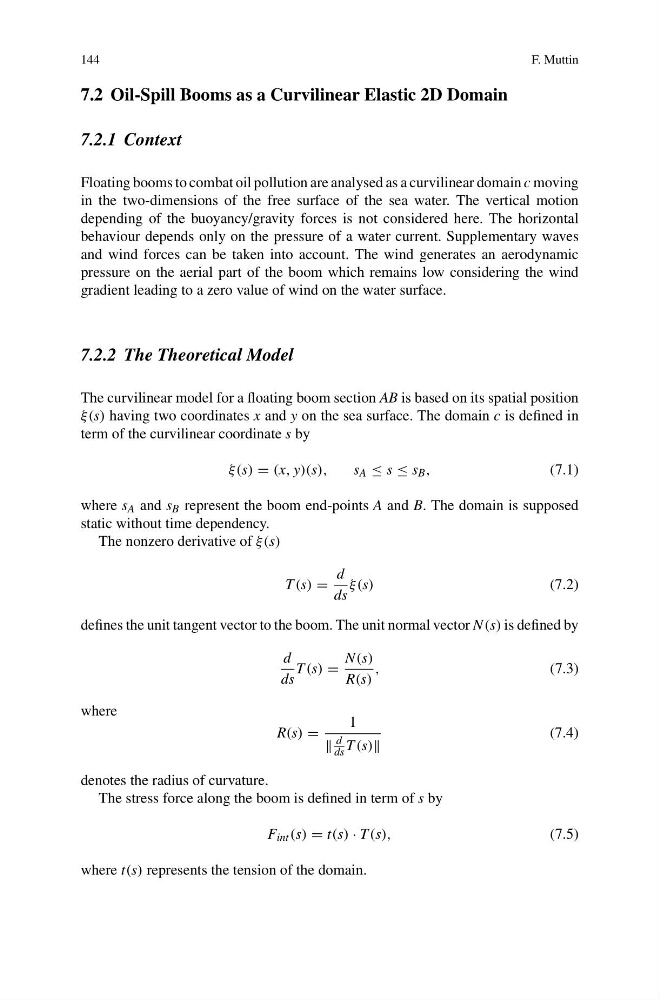
The curvilinear model for a floating boom section AB is based on its spatial position
ξ(s) having two coordinates x and y on the sea surface. The domain c is defined in
term of the curvilinear coordinate s by
ξ(s) = (x, y)(s),
s A ≤ s ≤ s B ,
(7.1)
where s A and s B represent the boom end-points A and B. The domain is supposed
static without time dependency.
The nonzero derivative of ξ(s)
T (s) =
d
ds
ξ(s)
(7.2)
defines the unit tangent vector to the boom. The unit normal vector N(s) is defined by
d
ds
T (s) =
N(s)
R(s)
,
(7.3)
where
R(s) =
1
d
ds T (s)
(7.4)
denotes the radius of curvature.
The stress force along the boom is defined in term of s by
F int (s) = t(s) · T (s),
(7.5)
where t(s) represents the tension of the domain.
F. Muttin
7.2 Oil-Spill Booms as a Curvilinear Elastic 2D Domain
7.2.1 Context
Floating booms to combat oil pollution are analysed as a curvilinear domain c moving
in the two-dimensions of the free surface of the sea water. The vertical motion
depending of the buoyancy/gravity forces is not considered here. The horizontal
behaviour depends only on the pressure of a water current. Supplementary waves
and wind forces can be taken into account. The wind generates an aerodynamic
pressure on the aerial part of the boom which remains low considering the wind
gradient leading to a zero value of wind on the water surface.
7.2.2 The Theoretical Model
The curvilinear model for a floating boom section AB is based on its spatial position
ξ(s) having two coordinates x and y on the sea surface. The domain c is defined in
term of the curvilinear coordinate s by
ξ(s) = (x, y)(s),
s A ≤ s ≤ s B ,
(7.1)
where s A and s B represent the boom end-points A and B. The domain is supposed
static without time dependency.
The nonzero derivative of ξ(s)
T (s) =
d
ds
ξ(s)
(7.2)
defines the unit tangent vector to the boom. The unit normal vector N(s) is defined by
d
ds
T (s) =
N(s)
R(s)
,
(7.3)
where
R(s) =
1
d
ds T (s)
(7.4)
denotes the radius of curvature.
The stress force along the boom is defined in term of s by
F int (s) = t(s) · T (s),
(7.5)
where t(s) represents the tension of the domain.