

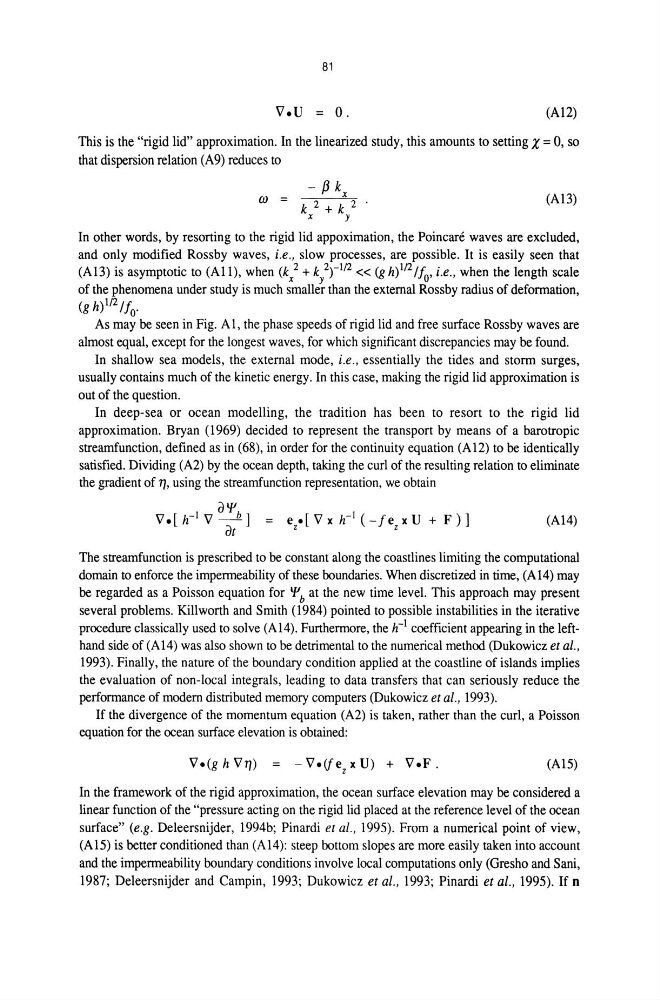
81
V.U = o.
(AI2)
This is the "rigid lid" approximation. In the linearized study, this amounts to setting X = 0, so
that dispersion relation (A9) reduces to
(A 13)
In other words, by resorting to the rigid lid appoximation, the Poincare waves are excluded,
and only modified Rossby waves, i.e., slow processes, are possible. It is easily seen that
(A13) is asymptotic to (All), when (k 2 + k 2r1l2 « (g h)l/2 lio' i.e., when the length scale
of the phenomena under study is much ;malllr than the external Rossby radius of deformation,
(g h)l/2 li o '
As may be seen in Fig. AI, the phase speeds of rigid lid and free surface Rossby waves are
almost equal, except for the longest waves, for which significant discrepancies may be found.
In shallow sea models, the external mode, i.e., essentially the tides and storm surges,
usually contains much of the kinetic energy. In this case, making the rigid lid approximation is
out of the question.
In deep-sea or ocean modelling, the tradition has been to resort to the rigid lid
approximation. Bryan (1969) decided to represent the transport by means of a barotropic
streamfunction, defined as in (68), in order for the continuity equation (A12) to be identically
satisfied. Dividing (A2) by the ocean depth, taking the curl of the resulting relation to eliminate
the gradient of 1], using the streamfunction representation, we obtain
= e.[Vx h- I (-ie xU + F)]
z
z
(A14)
The strearnfunction is prescribed to be constant along the coastlines limiting the computational
domain to enforce the impermeability of these boundaries. When discretized in time, (A 14) may
be regarded as a Poisson equation for If'b at the new time level. This approach may present
several problems. Killworth and Smith (1984) pointed to possible instabilities in the iterative
procedure classically used to solve (AI4). Furthermore, the h- 1 coefficient appearing in the lefthand side of (A14) was also shown to be detrimental to the numerical method (Dukowicz et a!.,
1993). Finally, the nature of the boundary condition applied at the coastline of islands implies
the evaluation of non-local integrals, leading to data transfers that can seriously reduce the
performance of modern distributed memory computers (Dukowicz et ai., 1993).
If the divergence of the momentum equation (A2) is taken, rather than the curl, a Poisson
equation for the ocean surface elevation is obtained:
V.(ghV1]) = -V.(fezxU) + V.F.
(AI5)
In the framework of the rigid approximation, the ocean surface elevation may be considered a
linear function of the "pressure acting on the rigid lid placed at the reference level of the ocean
surface" (e.g. Deleersnijder, 1994b; Pinardi et ai., 1995). From a numerical point of view,
(AI5) is better conditioned than (AI4): steep bottom slopes are more easily taken into account
and the impermeability boundary conditions involve local computations only (Gresho and Sani,
1987; Deleersnijder and Campin, 1993; Dukowicz et ai., 1993; Pinardi et ai., 1995). If n
V.U = o.
(AI2)
This is the "rigid lid" approximation. In the linearized study, this amounts to setting X = 0, so
that dispersion relation (A9) reduces to
(A 13)
In other words, by resorting to the rigid lid appoximation, the Poincare waves are excluded,
and only modified Rossby waves, i.e., slow processes, are possible. It is easily seen that
(A13) is asymptotic to (All), when (k 2 + k 2r1l2 « (g h)l/2 lio' i.e., when the length scale
of the phenomena under study is much ;malllr than the external Rossby radius of deformation,
(g h)l/2 li o '
As may be seen in Fig. AI, the phase speeds of rigid lid and free surface Rossby waves are
almost equal, except for the longest waves, for which significant discrepancies may be found.
In shallow sea models, the external mode, i.e., essentially the tides and storm surges,
usually contains much of the kinetic energy. In this case, making the rigid lid approximation is
out of the question.
In deep-sea or ocean modelling, the tradition has been to resort to the rigid lid
approximation. Bryan (1969) decided to represent the transport by means of a barotropic
streamfunction, defined as in (68), in order for the continuity equation (A12) to be identically
satisfied. Dividing (A2) by the ocean depth, taking the curl of the resulting relation to eliminate
the gradient of 1], using the streamfunction representation, we obtain
= e.[Vx h- I (-ie xU + F)]
z
z
(A14)
The strearnfunction is prescribed to be constant along the coastlines limiting the computational
domain to enforce the impermeability of these boundaries. When discretized in time, (A 14) may
be regarded as a Poisson equation for If'b at the new time level. This approach may present
several problems. Killworth and Smith (1984) pointed to possible instabilities in the iterative
procedure classically used to solve (AI4). Furthermore, the h- 1 coefficient appearing in the lefthand side of (A14) was also shown to be detrimental to the numerical method (Dukowicz et a!.,
1993). Finally, the nature of the boundary condition applied at the coastline of islands implies
the evaluation of non-local integrals, leading to data transfers that can seriously reduce the
performance of modern distributed memory computers (Dukowicz et ai., 1993).
If the divergence of the momentum equation (A2) is taken, rather than the curl, a Poisson
equation for the ocean surface elevation is obtained:
V.(ghV1]) = -V.(fezxU) + V.F.
(AI5)
In the framework of the rigid approximation, the ocean surface elevation may be considered a
linear function of the "pressure acting on the rigid lid placed at the reference level of the ocean
surface" (e.g. Deleersnijder, 1994b; Pinardi et ai., 1995). From a numerical point of view,
(AI5) is better conditioned than (AI4): steep bottom slopes are more easily taken into account
and the impermeability boundary conditions involve local computations only (Gresho and Sani,
1987; Deleersnijder and Campin, 1993; Dukowicz et ai., 1993; Pinardi et ai., 1995). If n