

75
First, we examine the barotropic streamfunction, P b , which is used to represent the
horizontal transport according to
11
f (h u, h v) dz .
y
x
(68)
- h
As may be seen in Fig. 13, the pattern of P b of run I is qualitatively similar to that of the
hopefully more realistic simulation III. It must however be stressed that the Antarctic
Circumpolar Current is almost absent from the wind-only simulation. The eastward flow
through Drake passage is much weaker in I than in II or III (Table 5). Surprinsingly, the Drake
passage transport is probably better when the seasonal cycle of the wind and thermohaline
forcings is not taken into account (Table 5). In I, the large subtropical gyres are present, but
exhibit weaker transports than in the experiment III (Fig. 14). The transport through the
Indonesian passage is probably too small in I, and too large in II and III (Table 5). Overall, it is
clear that the wind-only simulation exhibits large errors - especially in the representation of the
Antarctic Circumpolar Current.
-80
- 40
o
40
80
LaUlude
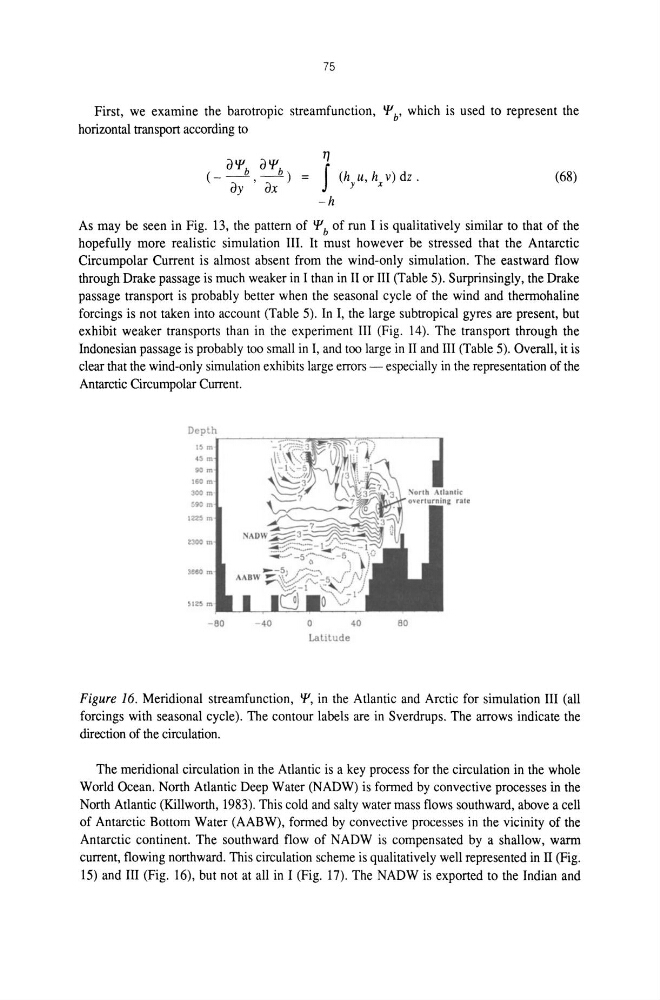
Figure 16. Meridional streamfunction, '1', in the Atlantic and Arctic for simulation III (all
forcings with seasonal cycle). The contour labels are in Sverdrups. The arrows indicate the
direction of the circulation.
The meridional circulation in the Atlantic is a key process for the circulation in the whole
World Ocean. North Atlantic Deep Water (NADW) is formed by convective processes in the
North Atlantic (Killworth, 1983). This cold and salty water mass flows southward, above a cell
of Antarctic Bottom Water (AABW), formed by convective processes in the vicinity of the
Antarctic continent. The southward flow of NADW is compensated by a shallow, warm
current, flowing northward. This circulation scheme is qualitatively well represented in II (Fig.
15) and III (Fig. 16), but not at all in I (Fig. 17). The NADW is exported to the Indian and
First, we examine the barotropic streamfunction, P b , which is used to represent the
horizontal transport according to
11
f (h u, h v) dz .
y
x
(68)
- h
As may be seen in Fig. 13, the pattern of P b of run I is qualitatively similar to that of the
hopefully more realistic simulation III. It must however be stressed that the Antarctic
Circumpolar Current is almost absent from the wind-only simulation. The eastward flow
through Drake passage is much weaker in I than in II or III (Table 5). Surprinsingly, the Drake
passage transport is probably better when the seasonal cycle of the wind and thermohaline
forcings is not taken into account (Table 5). In I, the large subtropical gyres are present, but
exhibit weaker transports than in the experiment III (Fig. 14). The transport through the
Indonesian passage is probably too small in I, and too large in II and III (Table 5). Overall, it is
clear that the wind-only simulation exhibits large errors - especially in the representation of the
Antarctic Circumpolar Current.
-80
- 40
o
40
80
LaUlude
Figure 16. Meridional streamfunction, '1', in the Atlantic and Arctic for simulation III (all
forcings with seasonal cycle). The contour labels are in Sverdrups. The arrows indicate the
direction of the circulation.
The meridional circulation in the Atlantic is a key process for the circulation in the whole
World Ocean. North Atlantic Deep Water (NADW) is formed by convective processes in the
North Atlantic (Killworth, 1983). This cold and salty water mass flows southward, above a cell
of Antarctic Bottom Water (AABW), formed by convective processes in the vicinity of the
Antarctic continent. The southward flow of NADW is compensated by a shallow, warm
current, flowing northward. This circulation scheme is qualitatively well represented in II (Fig.
15) and III (Fig. 16), but not at all in I (Fig. 17). The NADW is exported to the Indian and