

69
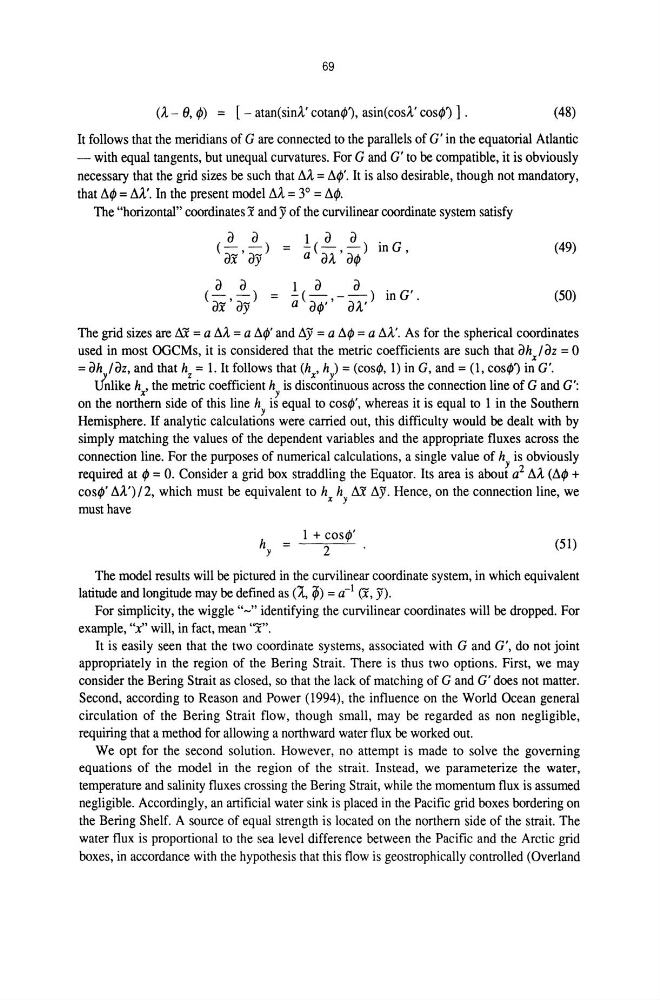
(A - e, tP) = [- atan(sinA' cotantP'), asin(cosA' costP') ] .
(48)
It follows that the meridians of G are connected to the parallels of G' in the equatorial Atlantic
- with equal tangents, but unequal curvatures. For G and G' to be compatible, it is obviously
necessary that the grid sizes be such that 6A = 6tP'. It is also desirable, though not mandatory,
that 6tP = 6A,'. In the present model M = 3° = M.
The "horizontal" coordinates x and y of the curvilinear coordinate system satisfy
a a
1 a a
( ax ' ay ) = a ( aA ' atP) in G ,
(49)
( ~ ~) = .!.(~ -~) inG'
ax' ay
a atP" aA'
.
(50)
The grid sizes are tU = a 6A = a 6tP' and 6y = a 6tP = a 6A'. As for the spherical coordinates
used in most OGCMs, it is considered that the metric coefficients are such that ahxt az = 0
= ah taz, and that h = 1. It follows that (h , h ) = (costP, 1) in G, and = (1, costP') in G'.
Unlike h , the me~c coefficient h is dis~onkuous across the connection line of G and G':
on the northern side of this line h d equal to costP', whereas it is equal to 1 in the Southern
y
Hemisphere. If analytic calculations were carried out, this difficulty would be dealt with by
simply matching the values of the dependent variables and the appropriate fluxes across the
connection line. For the purposes of numerical calculations, a single value of h is obviously
required at tP = O. Consider a grid box straddling the Equator. Its area is aboui a 2 6A (6tP +
costP' 6A')t2, which must be equivalent to h h !ll. 6Y. Hence, on the connection line, we
x y
must have
1 + costP'
2
(51)
The model results will be pictured in the curvilinear coordinate system, in which equivalent
latitude and longitude may be defmed as (A., ~) = a-I (X, y).
For simplicity, the wiggle "-" identifying the curvilinear coordinates will be dropped. For
example, "x" will, in fact, mean ''X''.
It is easily seen that the two coordinate systems, associated with G and G', do not joint
appropriately in the region of the Bering Strait. There is thus two options. First, we may
consider the Bering Strait as closed, so that the lack of matching of G and G' does not matter.
Second, according to Reason and Power (1994), the influence on the World Ocean general
circulation of the Bering Strait flow, though small, may be regarded as non negligible,
requiring that a method for allowing a northward water flux be worked out.
We opt for the second solution. However, no attempt is made to solve the governing
equations of the model in the region of the strait. Instead, we parameterize the water,
temperature and salinity fluxes crossing the Bering Strait, while the momentum flux is assumed
negligible. Accordingly, an artificial water sink is placed in the Pacific grid boxes bordering on
the Bering Shelf. A source of equal strength is located on the northern side of the strait. The
water flux is proportional to the sea level difference between the Pacific and the Arctic grid
boxes, in accordance witlI tlIe hypothesis that this flow is geostrophically controlled (Overland
(A - e, tP) = [- atan(sinA' cotantP'), asin(cosA' costP') ] .
(48)
It follows that the meridians of G are connected to the parallels of G' in the equatorial Atlantic
- with equal tangents, but unequal curvatures. For G and G' to be compatible, it is obviously
necessary that the grid sizes be such that 6A = 6tP'. It is also desirable, though not mandatory,
that 6tP = 6A,'. In the present model M = 3° = M.
The "horizontal" coordinates x and y of the curvilinear coordinate system satisfy
a a
1 a a
( ax ' ay ) = a ( aA ' atP) in G ,
(49)
( ~ ~) = .!.(~ -~) inG'
ax' ay
a atP" aA'
.
(50)
The grid sizes are tU = a 6A = a 6tP' and 6y = a 6tP = a 6A'. As for the spherical coordinates
used in most OGCMs, it is considered that the metric coefficients are such that ahxt az = 0
= ah taz, and that h = 1. It follows that (h , h ) = (costP, 1) in G, and = (1, costP') in G'.
Unlike h , the me~c coefficient h is dis~onkuous across the connection line of G and G':
on the northern side of this line h d equal to costP', whereas it is equal to 1 in the Southern
y
Hemisphere. If analytic calculations were carried out, this difficulty would be dealt with by
simply matching the values of the dependent variables and the appropriate fluxes across the
connection line. For the purposes of numerical calculations, a single value of h is obviously
required at tP = O. Consider a grid box straddling the Equator. Its area is aboui a 2 6A (6tP +
costP' 6A')t2, which must be equivalent to h h !ll. 6Y. Hence, on the connection line, we
x y
must have
1 + costP'
2
(51)
The model results will be pictured in the curvilinear coordinate system, in which equivalent
latitude and longitude may be defmed as (A., ~) = a-I (X, y).
For simplicity, the wiggle "-" identifying the curvilinear coordinates will be dropped. For
example, "x" will, in fact, mean ''X''.
It is easily seen that the two coordinate systems, associated with G and G', do not joint
appropriately in the region of the Bering Strait. There is thus two options. First, we may
consider the Bering Strait as closed, so that the lack of matching of G and G' does not matter.
Second, according to Reason and Power (1994), the influence on the World Ocean general
circulation of the Bering Strait flow, though small, may be regarded as non negligible,
requiring that a method for allowing a northward water flux be worked out.
We opt for the second solution. However, no attempt is made to solve the governing
equations of the model in the region of the strait. Instead, we parameterize the water,
temperature and salinity fluxes crossing the Bering Strait, while the momentum flux is assumed
negligible. Accordingly, an artificial water sink is placed in the Pacific grid boxes bordering on
the Bering Shelf. A source of equal strength is located on the northern side of the strait. The
water flux is proportional to the sea level difference between the Pacific and the Arctic grid
boxes, in accordance witlI tlIe hypothesis that this flow is geostrophically controlled (Overland