

53
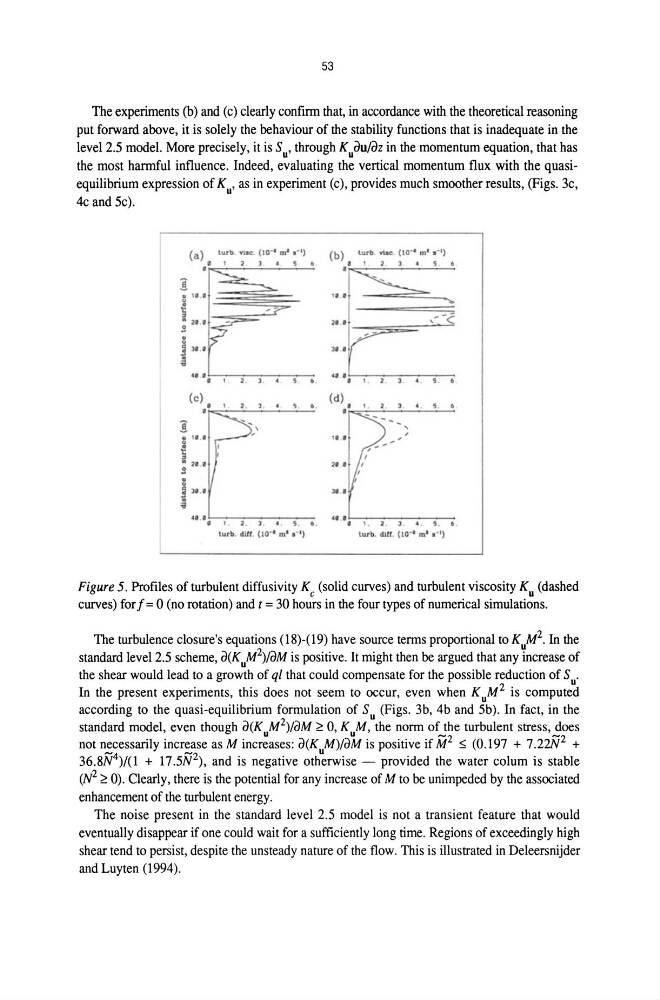
The experiments (b) and (c) clearly confinn that, in accordance with the theoretical reasoning
put forward above, it is solely the behaviour of the stability functions that is inadequate in the
level 2.5 model. More precisely, it is Su' through KiJu/dZ in the momentum equation, that has
the most hannful influence. Indeed, evaluating the vertical momentum flux with the quasiequilibrium expression of K u ' as in experiment (c), provides much smoother results, (Figs. 3c,
4c and 5c).
(a) Lurb. Yl..C. (10·" ma :1 . 1)
(b) turb. "K. (10· .1 ml . ~ l)
.1
I
2
3
•
1Ji..
.;..' ::;:- ' --=.' ---''--'---'--''
""
3
3 31.'
,;
31'
.t '.
,
2
3 , ..
S
..
.II • ,!--, ~,---=,-,-~,. ---".
(el
(d)
.'~_'~'. ~l~ . __ '~'~'.
.'~~'~'~' __ ~' . ~'. ~'
I'.'
. j n ,'
,a
"1
..... • !-""'". ---=,- . -:,'- . --:- •. --:", . ---,.,.
turbo d t. (10· " m' I -a)
"I .• ~. --:- , .--:", . ---=' ' --""' "
'. --:", . ---:" •
turbo dUro (10.1 m' ,-I)
Figure 5. Profiles of turbulent diffusivity Kc (solid curves) and turbulent viscosity Ku (dashed
curves) for f = 0 (no rotation) and t = 30 hours in the four types of numerical simulations.
The turbulence closure's equations (18)-(19) have source tenns proportional to K M2. In the
standard level 2.5 scheme, iJ(K M 2 )/dM is positive. It might then be argued that any increase of
u
the shear would lead to a growth of q/ that could compensate for the possible reduction of S u.
In the present experiments, this does not seem to occur, even when K uM2 is computed
according to the quasi-equilibrium formulation of Su (Figs. 3b, 4b and 5b). In fact, in the
standard model, even though d(K M 2 )/dM ~ 0, K M, the nonn of the turbulent stress, does
u
u
-2
-2
not necessarily increase as M increases: d(K M)/iJM is positive if M ~ (0.197 + 7.22N +
36.8N 4 )/(1 + 17 .5N 2 ), and is negative oth~rwise - provided the water colum is stable
(N 2 ~ 0). Clearly, there is the potential for any increase of M to be unimpeded by the associated
enhancement of the turbulent energy.
The noise present in the standard level 2.5 model is not a transient feature that would
eventually disappear if one could wait for a sufficiently long time. Regions of exceedingly high
shear tend to persist, despite the unsteady nature of the flow. This is illustrated in Deleersnijder
and Luyten (1994) .
The experiments (b) and (c) clearly confinn that, in accordance with the theoretical reasoning
put forward above, it is solely the behaviour of the stability functions that is inadequate in the
level 2.5 model. More precisely, it is Su' through KiJu/dZ in the momentum equation, that has
the most hannful influence. Indeed, evaluating the vertical momentum flux with the quasiequilibrium expression of K u ' as in experiment (c), provides much smoother results, (Figs. 3c,
4c and 5c).
(a) Lurb. Yl..C. (10·" ma :1 . 1)
(b) turb. "K. (10· .1 ml . ~ l)
.1
I
2
3
•
1Ji..
.;..' ::;:- ' --=.' ---''--'---'--''
""
3
3 31.'
,;
31'
.t '.
,
2
3 , ..
S
..
.II • ,!--, ~,---=,-,-~,. ---".
(el
(d)
.'~_'~'. ~l~ . __ '~'~'.
.'~~'~'~' __ ~' . ~'. ~'
I'.'
. j n ,'
,a
"1
..... • !-""'". ---=,- . -:,'- . --:- •. --:", . ---,.,.
turbo d t. (10· " m' I -a)
"I .• ~. --:- , .--:", . ---=' ' --""' "
'. --:", . ---:" •
turbo dUro (10.1 m' ,-I)
Figure 5. Profiles of turbulent diffusivity Kc (solid curves) and turbulent viscosity Ku (dashed
curves) for f = 0 (no rotation) and t = 30 hours in the four types of numerical simulations.
The turbulence closure's equations (18)-(19) have source tenns proportional to K M2. In the
standard level 2.5 scheme, iJ(K M 2 )/dM is positive. It might then be argued that any increase of
u
the shear would lead to a growth of q/ that could compensate for the possible reduction of S u.
In the present experiments, this does not seem to occur, even when K uM2 is computed
according to the quasi-equilibrium formulation of Su (Figs. 3b, 4b and 5b). In fact, in the
standard model, even though d(K M 2 )/dM ~ 0, K M, the nonn of the turbulent stress, does
u
u
-2
-2
not necessarily increase as M increases: d(K M)/iJM is positive if M ~ (0.197 + 7.22N +
36.8N 4 )/(1 + 17 .5N 2 ), and is negative oth~rwise - provided the water colum is stable
(N 2 ~ 0). Clearly, there is the potential for any increase of M to be unimpeded by the associated
enhancement of the turbulent energy.
The noise present in the standard level 2.5 model is not a transient feature that would
eventually disappear if one could wait for a sufficiently long time. Regions of exceedingly high
shear tend to persist, despite the unsteady nature of the flow. This is illustrated in Deleersnijder
and Luyten (1994) .