

466
Flos and TintoH), 1990). The WMCE experiment (1985-87) established the importance
of the frontal boundary regions between Mediterranean waters and waters of Atlantic
origin for the increase of biomass in the Western Mediterranean (Lhorenz et a!., 1988).
The ALMOFRONT-l interdisciplinary experiment (1991) later focused on the AlmeriaOran front and assessed the effect of the frontal circulation on the ecosystem (Prieur and
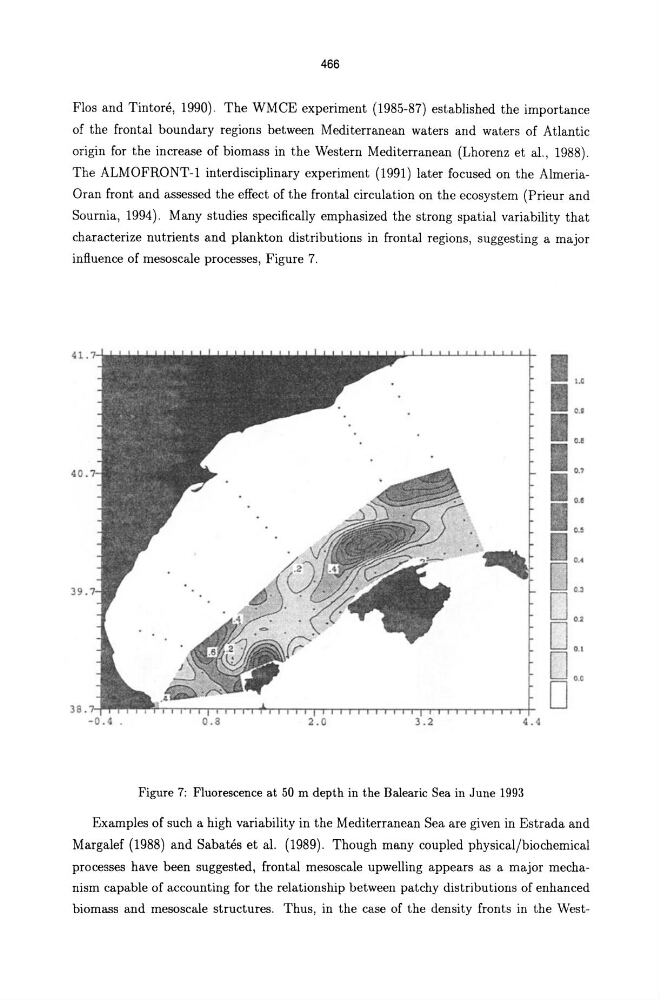
Sournia, 1994). Many studies specifically emphasized the strong spatial variability that
characterize nutrients and plankton distributions in frontal regions, suggesting a major
influence of mesoscale processes, Figure 7.
4l.
I:' :
O.!
40.
0. 7
0 . 1
0 .5
39.
D :. :
002
0 0 .,
38.
B··
.4
Figure 7: Fluorescence at 50 m depth in the Balearic Sea in June 1993
Examples of such a high variability in the Mediterranean Sea are given in Estrada and
Margalef (1988) and Sabates et al. (1989). Though many coupled physical/biochemical
processes have been suggested, frontal mesoscale upwelling appears as a major mechanism capable of accounting for the relationship between patchy distributions of enhanced
biomass and mesoscale structures. Thus, in the case of the density fronts in the West-
Flos and TintoH), 1990). The WMCE experiment (1985-87) established the importance
of the frontal boundary regions between Mediterranean waters and waters of Atlantic
origin for the increase of biomass in the Western Mediterranean (Lhorenz et a!., 1988).
The ALMOFRONT-l interdisciplinary experiment (1991) later focused on the AlmeriaOran front and assessed the effect of the frontal circulation on the ecosystem (Prieur and
Sournia, 1994). Many studies specifically emphasized the strong spatial variability that
characterize nutrients and plankton distributions in frontal regions, suggesting a major
influence of mesoscale processes, Figure 7.
4l.
I:' :
O.!
40.
0. 7
0 . 1
0 .5
39.
D :. :
002
0 0 .,
38.
B··
.4
Figure 7: Fluorescence at 50 m depth in the Balearic Sea in June 1993
Examples of such a high variability in the Mediterranean Sea are given in Estrada and
Margalef (1988) and Sabates et al. (1989). Though many coupled physical/biochemical
processes have been suggested, frontal mesoscale upwelling appears as a major mechanism capable of accounting for the relationship between patchy distributions of enhanced
biomass and mesoscale structures. Thus, in the case of the density fronts in the West-