

458
(Candela et al., 1992; Foreman and Freeland, 1991; Allen, 1995). Also, the combination of SeaSoar high resolution hydrographic data with shipboard ADCP data has shown
to avoid the influence of inertial currents (Pollard and Regier, 1992; Allen and Smeed,
1995). However, the direct use of ADCP data for computation of vertical motions is not
recomended and indirect diagnostic methods need to be used.
b - The omega equation
Since vertical velocity in the ocean is difficult to measure, indirect techniques are
required for its estimation. Several methods can be used, depending on the nature of
the data set (Lindstrom and Watts, 1994). Some early estimation of vertical motion was
carried out by Chew et al. (1985) who used a temperature conservation equation to show
that significant vertical motions could occur within frontal Gulf Stream meanders.
In the case of extensive high resolution ship surveys, the now most widely used tool
is the omega equation (Hoskins et al., 1978). This equation is a diagnostic equation for
estimating vertical motion that can be obtained in the frame of quasi-geostrophic (QG)
theory (without any stationarity assumption) and that has proved to be a useful tool for
mapping the atmospheric vertical velocity field.
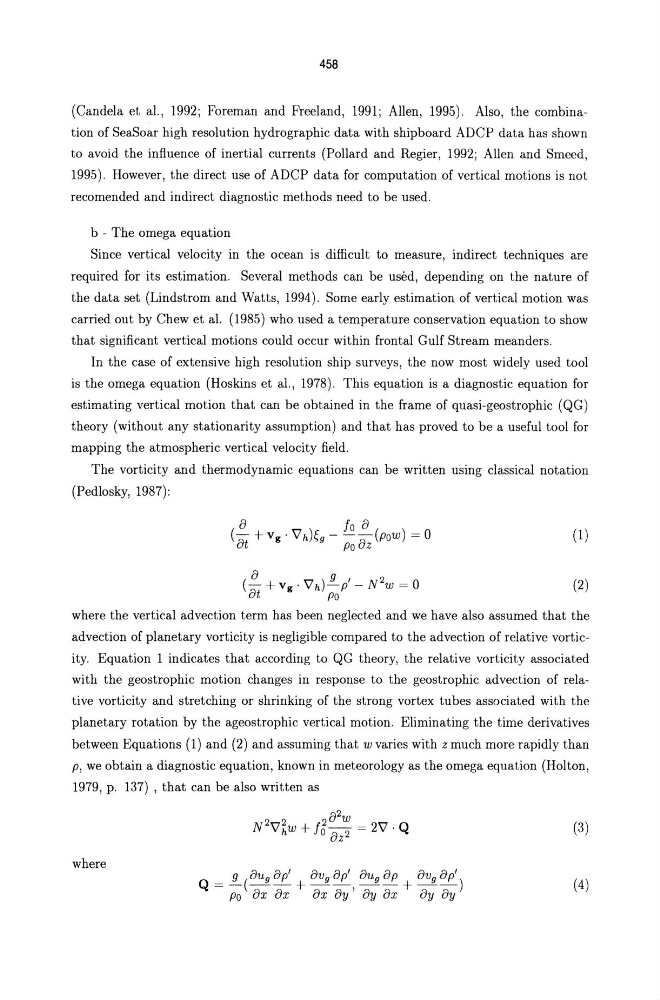
The vorticity and thermodynamic equations can be written using classical notation
(Pedlosky, 1987):
a
fo a
(- + v . ~\)~ - --(Pow) = 0
at g
9
Po az
(1)
( a
)g I
2
-+v ·"ih -p -N w=O
at g
po
(2)
where the vertical advection term has been neglected and we have also assumed that the
advection of planetary vorticity is negligible compared to the advection of relative vorticity. Equation 1 indicates that according to QG theory, the relative vorticity associated
with the geostrophic motion changes in response to the geostrophic advection of relative vorticity and stretching or shrinking of the strong vortex tubes associated with the
planetary rotation by the ageostrophic vertical motion. Eliminating the time derivatives
between Equations (1) and (2) and assuming that w varies with z much more rapidly than
p, we obtain a diagnostic equation, known in meteorology as the omega equation (Holton,
1979, p. 137) , that can be also written as
(3)
where
Q _ ~(aUg ap' + aVg ap' aUg ap + aVg a pl )
- Po ax ax ax ay' ay ax ay ay
(4)
(Candela et al., 1992; Foreman and Freeland, 1991; Allen, 1995). Also, the combination of SeaSoar high resolution hydrographic data with shipboard ADCP data has shown
to avoid the influence of inertial currents (Pollard and Regier, 1992; Allen and Smeed,
1995). However, the direct use of ADCP data for computation of vertical motions is not
recomended and indirect diagnostic methods need to be used.
b - The omega equation
Since vertical velocity in the ocean is difficult to measure, indirect techniques are
required for its estimation. Several methods can be used, depending on the nature of
the data set (Lindstrom and Watts, 1994). Some early estimation of vertical motion was
carried out by Chew et al. (1985) who used a temperature conservation equation to show
that significant vertical motions could occur within frontal Gulf Stream meanders.
In the case of extensive high resolution ship surveys, the now most widely used tool
is the omega equation (Hoskins et al., 1978). This equation is a diagnostic equation for
estimating vertical motion that can be obtained in the frame of quasi-geostrophic (QG)
theory (without any stationarity assumption) and that has proved to be a useful tool for
mapping the atmospheric vertical velocity field.
The vorticity and thermodynamic equations can be written using classical notation
(Pedlosky, 1987):
a
fo a
(- + v . ~\)~ - --(Pow) = 0
at g
9
Po az
(1)
( a
)g I
2
-+v ·"ih -p -N w=O
at g
po
(2)
where the vertical advection term has been neglected and we have also assumed that the
advection of planetary vorticity is negligible compared to the advection of relative vorticity. Equation 1 indicates that according to QG theory, the relative vorticity associated
with the geostrophic motion changes in response to the geostrophic advection of relative vorticity and stretching or shrinking of the strong vortex tubes associated with the
planetary rotation by the ageostrophic vertical motion. Eliminating the time derivatives
between Equations (1) and (2) and assuming that w varies with z much more rapidly than
p, we obtain a diagnostic equation, known in meteorology as the omega equation (Holton,
1979, p. 137) , that can be also written as
(3)
where
Q _ ~(aUg ap' + aVg ap' aUg ap + aVg a pl )
- Po ax ax ax ay' ay ax ay ay
(4)