

431
but this should be expected because Martel and Wunsch's (1993) model has only a 1°
resolution . Considering all archipelagos in the region we may guess the simultaneous
existence of some ten cyclonic vortices; assuming each to have R = 2. 5 km and We = 10- 5
mis, we obtain an upward transport \IV ~ 0.2 Sv.
/12
a
® v--.J!
u,
'
I ~
---;=.s
b
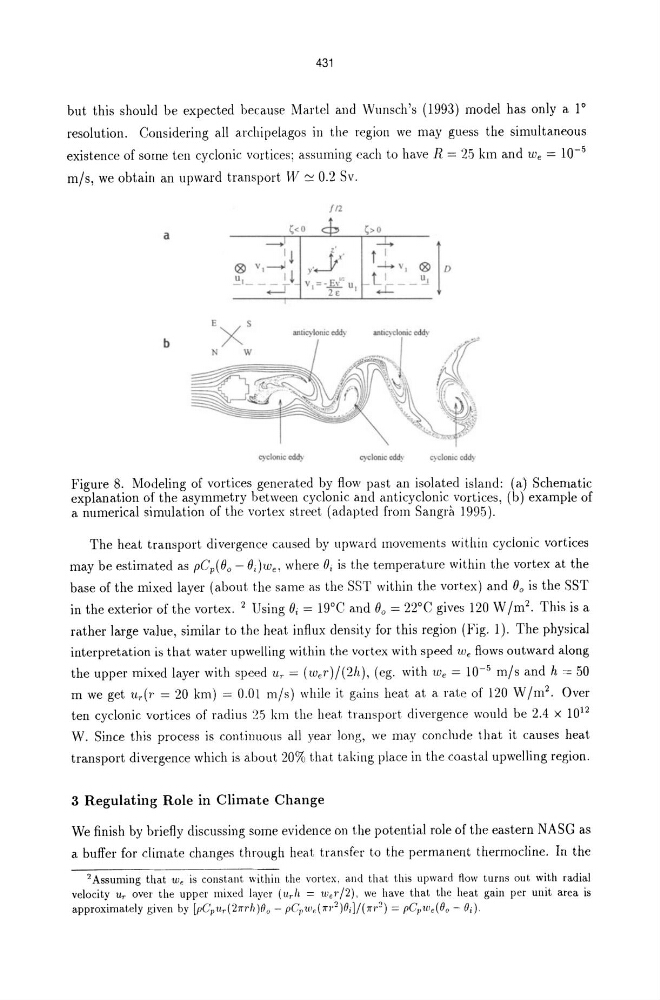
Figure 8. Modeling of vo rtices generated by flow past an isolated island: (a) Schematic
explanation of the asymmetry between cyclonic and anticyclonic vorti ces, (b) example of
a numerical simulation of the vortex street (adapted from Sangra 1995).
The heat transport divergence caused by upward mo vements within cyclonic vortices
may be estimated as pCp( Bo - B,)w" where Bi is the temperature within the vortex at the
base of the mixed layer (about the same as the SST within the vortex) and Bo is the SST
in the exterior of the vortex. 2 Using Bi = 19°C and Bo = 22°C gives 120 W /m2. This is a
rather large value, similar to the heat influx density for this region (Fig. 1). The physical
interpretat ion is that water upwelling within the vortex with speed We flows outward along
the upper mixed layer with speed u,· = (wer)/(2h), (eg. with We = 10- 5 m/s and h = 50
m we get ur(r = 20 km) = om m/s) while it gains heat at a rate of 120 W /m2. Over
ten cyclonic vortices of radius 2.5 km the heat t ransport divergence would be 2.4 x lO12
W. Since this process is continuous all year long, we may conclude that it causes heat
transport divergence which is about 20% that taking place in t he coastal upwelling region.
3 Regulating Role in Climate Change
We finish by briefly discussing some evidence on the potentiaJ role of the eastern NASG as
a buffer for climate changes through heat transfer to the permanent thermocline. In the
2 Assuming that We is constant within t.he vortex, a nd t.hat t.his upw ard flow turns out with radial
velocity Ur over the upp er mixed layer (urI! = w e"/2), we have that t he heat gain per unit area is
approximately given by [pCp1l.r(2rrrh)Oo - pCp we(Jf1"2)Oil!(rrr') = pCpWe(Oo - OJ).
but this should be expected because Martel and Wunsch's (1993) model has only a 1°
resolution . Considering all archipelagos in the region we may guess the simultaneous
existence of some ten cyclonic vortices; assuming each to have R = 2. 5 km and We = 10- 5
mis, we obtain an upward transport \IV ~ 0.2 Sv.
/12
a
® v--.J!
u,
'
I ~
---;=.s
b
Figure 8. Modeling of vo rtices generated by flow past an isolated island: (a) Schematic
explanation of the asymmetry between cyclonic and anticyclonic vorti ces, (b) example of
a numerical simulation of the vortex street (adapted from Sangra 1995).
The heat transport divergence caused by upward mo vements within cyclonic vortices
may be estimated as pCp( Bo - B,)w" where Bi is the temperature within the vortex at the
base of the mixed layer (about the same as the SST within the vortex) and Bo is the SST
in the exterior of the vortex. 2 Using Bi = 19°C and Bo = 22°C gives 120 W /m2. This is a
rather large value, similar to the heat influx density for this region (Fig. 1). The physical
interpretat ion is that water upwelling within the vortex with speed We flows outward along
the upper mixed layer with speed u,· = (wer)/(2h), (eg. with We = 10- 5 m/s and h = 50
m we get ur(r = 20 km) = om m/s) while it gains heat at a rate of 120 W /m2. Over
ten cyclonic vortices of radius 2.5 km the heat t ransport divergence would be 2.4 x lO12
W. Since this process is continuous all year long, we may conclude that it causes heat
transport divergence which is about 20% that taking place in t he coastal upwelling region.
3 Regulating Role in Climate Change
We finish by briefly discussing some evidence on the potentiaJ role of the eastern NASG as
a buffer for climate changes through heat transfer to the permanent thermocline. In the
2 Assuming that We is constant within t.he vortex, a nd t.hat t.his upw ard flow turns out with radial
velocity Ur over the upp er mixed layer (urI! = w e"/2), we have that t he heat gain per unit area is
approximately given by [pCp1l.r(2rrrh)Oo - pCp we(Jf1"2)Oil!(rrr') = pCpWe(Oo - OJ).