

429
Island Generated Eddies
The shedding of oceanic vortices downstream of islands is a common phenomenon (Wolanskyet al. 1984, Pattiaratchi et al. 1986, Boyer et al. 1987). One excellent source of oceanic
vortices is the island of Gran Canaria, located in the path of the CC, because of its near
circular shape and considerable diameter (54 km) (Molina and Laatzen 1989, Arfstegui
et al. 1994, Sangra 1995). Fig. 7, shows two examples of SST distribution in the Canary
Archipelago during summer and early spring. The isopycnals in the cyclonic vortices
approach the sea surface, causing their central surface water to be relatively cold. These
events resemble the classical Fluid Mechanics problem of flow past an obstacle, also called
Von Karman vortex street, which has been modeled both numerically and in the laboratory (for reviews see Berger and White 1972, Bearman 1984). The vortices observed in
nature, however, correspond to rapidly rotating (geophysical) and strat.ified fluids, which
have not yet received as much attention. One characteristic of these flows is that for low
Rossby numbers the vortices are assymmetric, with the cyclonic ones being more intense
and better defined (Boyer 1970, Merkine and Solan 1979, Boyer and Davies 1982, Chabert
d'Hieres et al. 1989, Arfstegui et al. 1994). SangI'll, (1995) has shown that the vortices'
asymmetry is due to the joint effect of diffusion and advection of vorticity in the boundary region close to the obstacle (Fig. 8a, SangI'll, 1995). The advective flux of vorticity is
outward (inward) in the cyclonic (anticyclonic) side of the obstacle, and takes place due
to mass conservation of Ekman transport in the bottom boundary layer. Fig. 8b shows
the numerical simulation for Reynolds and Rossby numbers of 250 and 0.1, respectively.
The predominance of cyclonic vortices in the region has important consequences for
WWM formation because it produces upward transport of relatively cold waters (SangI'll,
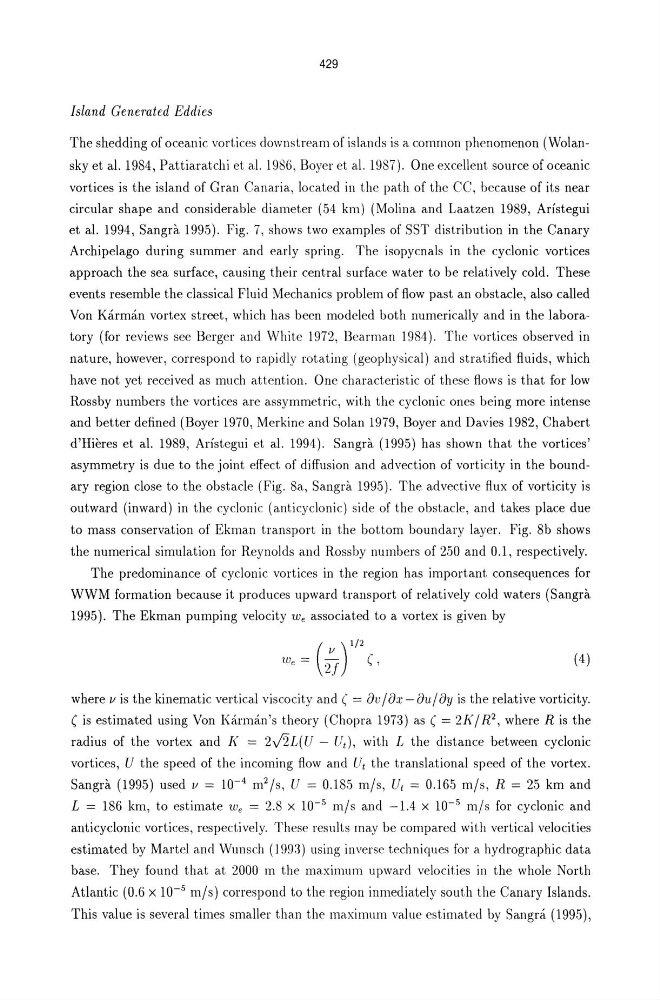
1995). The Ekman pumping velocity We associated to a vortex is given by
(
)
1/2
We = ;1 (,
(4)
where v is the kinematic vertical viscocity and ( = ov I ax - oul oy is the relative vorticity.
(is estimated using Von IGrman's theory (Chopra 1973) as (= 2I
vortices, U the speed of the incoming flow and Ut the translational speed of the vortex.
SangI'll, (1995) used v = 10- 4 m 2 Is, U = 0.185 mis, Ut = 0.165 mis, R = 25 km and
L = 186 km, to estimate We = 2.8 X 10- 5 mls and -1.4 x 10- 5 mls for cyclonic and
anticyclonic vortices, respectively. These results may be compared with vertical velocities
estimated by Martel and Wunsch (1993) using inverse techniques for a hydrographic data
base. They found that at 2000 m the maximum upward velocities in the whole North
Atlantic (0.6 x 10- 5 m/s) correspond to the region inmediately south the Canary Islands.
This value is several times smaller than the maximum value estimated by Sangni (1995),
Island Generated Eddies
The shedding of oceanic vortices downstream of islands is a common phenomenon (Wolanskyet al. 1984, Pattiaratchi et al. 1986, Boyer et al. 1987). One excellent source of oceanic
vortices is the island of Gran Canaria, located in the path of the CC, because of its near
circular shape and considerable diameter (54 km) (Molina and Laatzen 1989, Arfstegui
et al. 1994, Sangra 1995). Fig. 7, shows two examples of SST distribution in the Canary
Archipelago during summer and early spring. The isopycnals in the cyclonic vortices
approach the sea surface, causing their central surface water to be relatively cold. These
events resemble the classical Fluid Mechanics problem of flow past an obstacle, also called
Von Karman vortex street, which has been modeled both numerically and in the laboratory (for reviews see Berger and White 1972, Bearman 1984). The vortices observed in
nature, however, correspond to rapidly rotating (geophysical) and strat.ified fluids, which
have not yet received as much attention. One characteristic of these flows is that for low
Rossby numbers the vortices are assymmetric, with the cyclonic ones being more intense
and better defined (Boyer 1970, Merkine and Solan 1979, Boyer and Davies 1982, Chabert
d'Hieres et al. 1989, Arfstegui et al. 1994). SangI'll, (1995) has shown that the vortices'
asymmetry is due to the joint effect of diffusion and advection of vorticity in the boundary region close to the obstacle (Fig. 8a, SangI'll, 1995). The advective flux of vorticity is
outward (inward) in the cyclonic (anticyclonic) side of the obstacle, and takes place due
to mass conservation of Ekman transport in the bottom boundary layer. Fig. 8b shows
the numerical simulation for Reynolds and Rossby numbers of 250 and 0.1, respectively.
The predominance of cyclonic vortices in the region has important consequences for
WWM formation because it produces upward transport of relatively cold waters (SangI'll,
1995). The Ekman pumping velocity We associated to a vortex is given by
(
)
1/2
We = ;1 (,
(4)
where v is the kinematic vertical viscocity and ( = ov I ax - oul oy is the relative vorticity.
(is estimated using Von IGrman's theory (Chopra 1973) as (= 2I
vortices, U the speed of the incoming flow and Ut the translational speed of the vortex.
SangI'll, (1995) used v = 10- 4 m 2 Is, U = 0.185 mis, Ut = 0.165 mis, R = 25 km and
L = 186 km, to estimate We = 2.8 X 10- 5 mls and -1.4 x 10- 5 mls for cyclonic and
anticyclonic vortices, respectively. These results may be compared with vertical velocities
estimated by Martel and Wunsch (1993) using inverse techniques for a hydrographic data
base. They found that at 2000 m the maximum upward velocities in the whole North
Atlantic (0.6 x 10- 5 m/s) correspond to the region inmediately south the Canary Islands.
This value is several times smaller than the maximum value estimated by Sangni (1995),