

425
Despite our improved understanding of the region , the above efforts have not tackled
the behaviour of the eastern boundary-coastal upwelling coupled problem. A number of
theoretical studies have shown that the coastal bou ndary condition can control the interior
flow (Pedlosky 1983, Janowitz 1986, Huang 1989b, Cessi 1992, Csanady and Pelegri 1995).
This is supported by two considerations: First, about 2-3 Sv of geostrophic flow enter the
coastal region between the Iberian Peninsula and the Canary Archipelago (Stramma 1984,
Stramma and Siedler 1988, Fiekas et al. 1992), out of which about only 1 Sv flows into the
Mediterranean (Bryden and Pillsbury 1990), indicating that the difference (1-2 Sv) must
flow to the south along the upwelling region (Fig. 2). And second , the anticyclonic eastern
loop formed by the AC-CC-NEC shows a latitudinal contraction during summer; during
winter coastal upwelling is displaced to the south and the final separation of the CC from
the coast (at the Cape Vert frontal zone) appears to follow it (Stramma and Siedler 1988).
This may be interpreted as if coastal upwelling, through the associated inshore flux along
the permanent thermocline, helps to maintain the CC close to the coast .
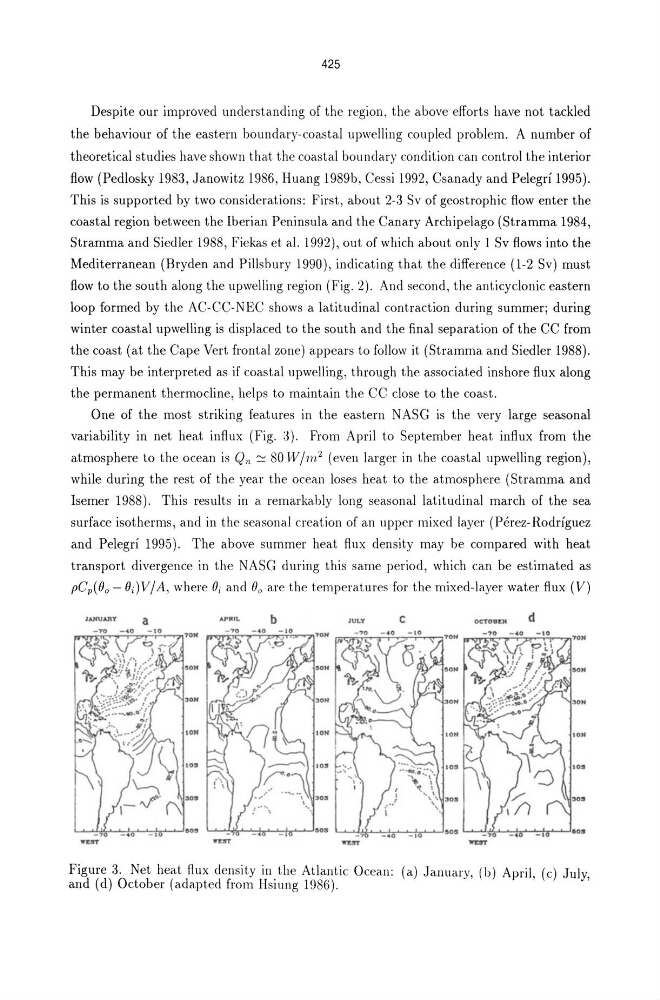
One of the most striking features in the eastern N ASG is the very large seasonal
variability in net heat influx (Fig. 3) . From April to September heat influx from the
atmosphere to the ocean is Qn ~ 80 W/m 2 (even larger in the coastal upwelling region),
while during the rest of the year the ocean loses heat to the atmosphere (Stramma and
Isemer 1988) . This results in a remarkably long seasonal latitudin al march of the sea
surface isotherms, and in the season a.] creation of an upper mixed layer (Perez- Rodriguez
and Pelegri 1995). The above summer heat flux density may be compared with heat
transport divergence in the NASG during this same period, which can be estimated as
pCp ( ()o - Oi) V / A, where Oi and ()o are the temperatures for the mixed-layer water flux (V)
Figure 3. Net heat flux density in the Atlantic Ocean: (a) January, (b) April, (c) July,
and (d) October (adapted from Hsiung 1986).
Despite our improved understanding of the region , the above efforts have not tackled
the behaviour of the eastern boundary-coastal upwelling coupled problem. A number of
theoretical studies have shown that the coastal bou ndary condition can control the interior
flow (Pedlosky 1983, Janowitz 1986, Huang 1989b, Cessi 1992, Csanady and Pelegri 1995).
This is supported by two considerations: First, about 2-3 Sv of geostrophic flow enter the
coastal region between the Iberian Peninsula and the Canary Archipelago (Stramma 1984,
Stramma and Siedler 1988, Fiekas et al. 1992), out of which about only 1 Sv flows into the
Mediterranean (Bryden and Pillsbury 1990), indicating that the difference (1-2 Sv) must
flow to the south along the upwelling region (Fig. 2). And second , the anticyclonic eastern
loop formed by the AC-CC-NEC shows a latitudinal contraction during summer; during
winter coastal upwelling is displaced to the south and the final separation of the CC from
the coast (at the Cape Vert frontal zone) appears to follow it (Stramma and Siedler 1988).
This may be interpreted as if coastal upwelling, through the associated inshore flux along
the permanent thermocline, helps to maintain the CC close to the coast .
One of the most striking features in the eastern N ASG is the very large seasonal
variability in net heat influx (Fig. 3) . From April to September heat influx from the
atmosphere to the ocean is Qn ~ 80 W/m 2 (even larger in the coastal upwelling region),
while during the rest of the year the ocean loses heat to the atmosphere (Stramma and
Isemer 1988) . This results in a remarkably long seasonal latitudin al march of the sea
surface isotherms, and in the season a.] creation of an upper mixed layer (Perez- Rodriguez
and Pelegri 1995). The above summer heat flux density may be compared with heat
transport divergence in the NASG during this same period, which can be estimated as
pCp ( ()o - Oi) V / A, where Oi and ()o are the temperatures for the mixed-layer water flux (V)
Figure 3. Net heat flux density in the Atlantic Ocean: (a) January, (b) April, (c) July,
and (d) October (adapted from Hsiung 1986).