

28
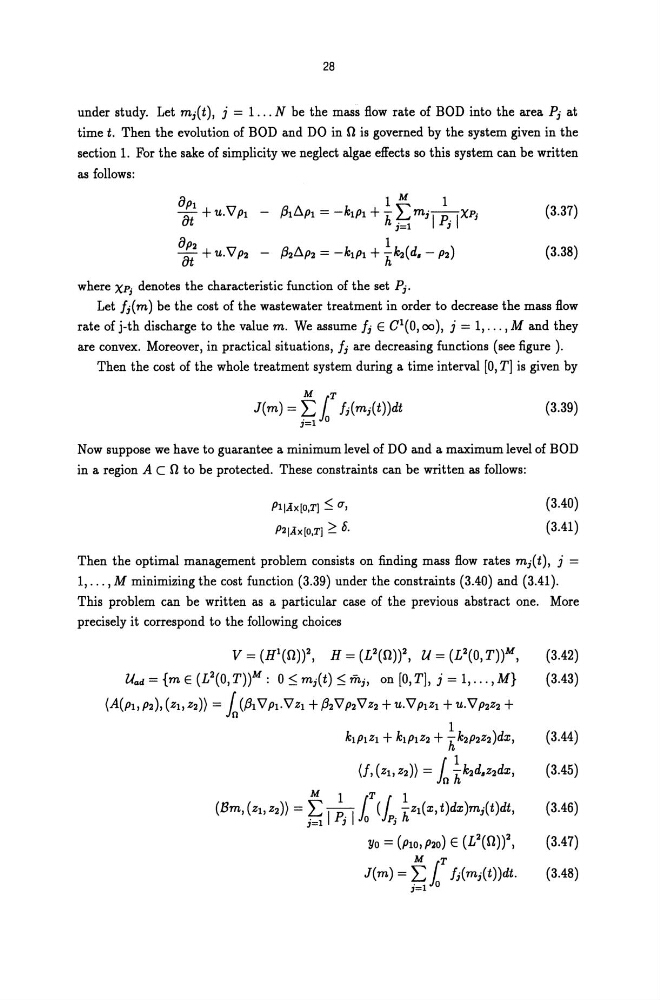
under study. Let m;(t), j = 1 ... N be the mass flow rate of BOD into the area P; at
time t. Then the evolution of BOD and DO in 0 is governed by the system given in the
section 1. For the sake of simplicity we neglect algae effects so this system can be written
as follows:
1 M
1
fhllp1 = -k1P1 +"h, ~mj-I p.I XPj
,=1
,
(3.37)
1
(hllpa = -k1P1 + "h,ka(d. - Pa)
(3.38)
where XP; denotes the characteristic function of the set Pj •
Let I;( m) be the cost of the wastewater treatment in order to decrease the mass flow
rate of j-th discharge to the value m. We assume 1; E C1(0, 00), j = 1, ... , M and they
are convex. Moreover, in practical situations, I; are decreasing functions (see figure ).
Then the cost of the whole treatment system during a time interval [0, T) is given by
M
T
J(m) = L L Ij(mj(t))dt
j=l 0
(3.39)
Now suppose we have to guarantee a minimum level of DO and a maximum level of BOD
in a region A C 0 to be protected. These constraints can be written as follows:
P1IAx [o,T] :0:::; (J,
PaIAx[O,Tj ~ o.
(3.40)
(3.41)
Then the optimal management problem consists on finding mass flow rates mj(t), j =
1, ... , M minimizing the cost function (3.39) under the constraints (3.40) and (3.41).
This problem can be written as a particular case of the previous abstract one. More
precisely it correspond to the following choices
v = (H1(O)?, H = (L2(O))2, U = (L2(0,T))M, (3.42)
U"d = {m E (L2(0, T))M: 0:0:::; mj(t) :0:::; mj, on [0, T), j = 1, ... , M}
(3.43)
(A(P1' pal, (Zl, za)) = 10 «(:i1 "il P1."ilZ1 + (:i2 "il P2 "ilz2 + u."il P1Z1 + u."il P2Z2 +
1
k1P1Z1 + k1P1 Z2 + "h,kaP2z2)dx,
(3.44)
{J, (Zl, Z2)) = 10 ~k2d.Z2dx, (3.45)
M
1 f { 1
(8m, (Zl, Z2)) = ~ - I
p. 1 10 (J,. -hZ1(x, t)dx )mj(t)dt,
(3.46)
,=1
,
0
P,
Yo = (PlO, P20) E (L2(O))a,
(3.47)
M T
J(m) = L L I;(mj(t))dt. (3.48)
j=l 0
under study. Let m;(t), j = 1 ... N be the mass flow rate of BOD into the area P; at
time t. Then the evolution of BOD and DO in 0 is governed by the system given in the
section 1. For the sake of simplicity we neglect algae effects so this system can be written
as follows:
1 M
1
fhllp1 = -k1P1 +"h, ~mj-I p.I XPj
,=1
,
(3.37)
1
(hllpa = -k1P1 + "h,ka(d. - Pa)
(3.38)
where XP; denotes the characteristic function of the set Pj •
Let I;( m) be the cost of the wastewater treatment in order to decrease the mass flow
rate of j-th discharge to the value m. We assume 1; E C1(0, 00), j = 1, ... , M and they
are convex. Moreover, in practical situations, I; are decreasing functions (see figure ).
Then the cost of the whole treatment system during a time interval [0, T) is given by
M
T
J(m) = L L Ij(mj(t))dt
j=l 0
(3.39)
Now suppose we have to guarantee a minimum level of DO and a maximum level of BOD
in a region A C 0 to be protected. These constraints can be written as follows:
P1IAx [o,T] :0:::; (J,
PaIAx[O,Tj ~ o.
(3.40)
(3.41)
Then the optimal management problem consists on finding mass flow rates mj(t), j =
1, ... , M minimizing the cost function (3.39) under the constraints (3.40) and (3.41).
This problem can be written as a particular case of the previous abstract one. More
precisely it correspond to the following choices
v = (H1(O)?, H = (L2(O))2, U = (L2(0,T))M, (3.42)
U"d = {m E (L2(0, T))M: 0:0:::; mj(t) :0:::; mj, on [0, T), j = 1, ... , M}
(3.43)
(A(P1' pal, (Zl, za)) = 10 «(:i1 "il P1."ilZ1 + (:i2 "il P2 "ilz2 + u."il P1Z1 + u."il P2Z2 +
1
k1P1Z1 + k1P1 Z2 + "h,kaP2z2)dx,
(3.44)
{J, (Zl, Z2)) = 10 ~k2d.Z2dx, (3.45)
M
1 f { 1
(8m, (Zl, Z2)) = ~ - I
p. 1 10 (J,. -hZ1(x, t)dx )mj(t)dt,
(3.46)
,=1
,
0
P,
Yo = (PlO, P20) E (L2(O))a,
(3.47)
M T
J(m) = L L I;(mj(t))dt. (3.48)
j=l 0