

401
3.2 Heat Flux Forcing.
An adequate parametrization of the total heat flux must include its dependence on the surface
temperature. In the 33-year forced experiment, the formulation designed by Oberhuber (1988)
for the total heat flux will be used:
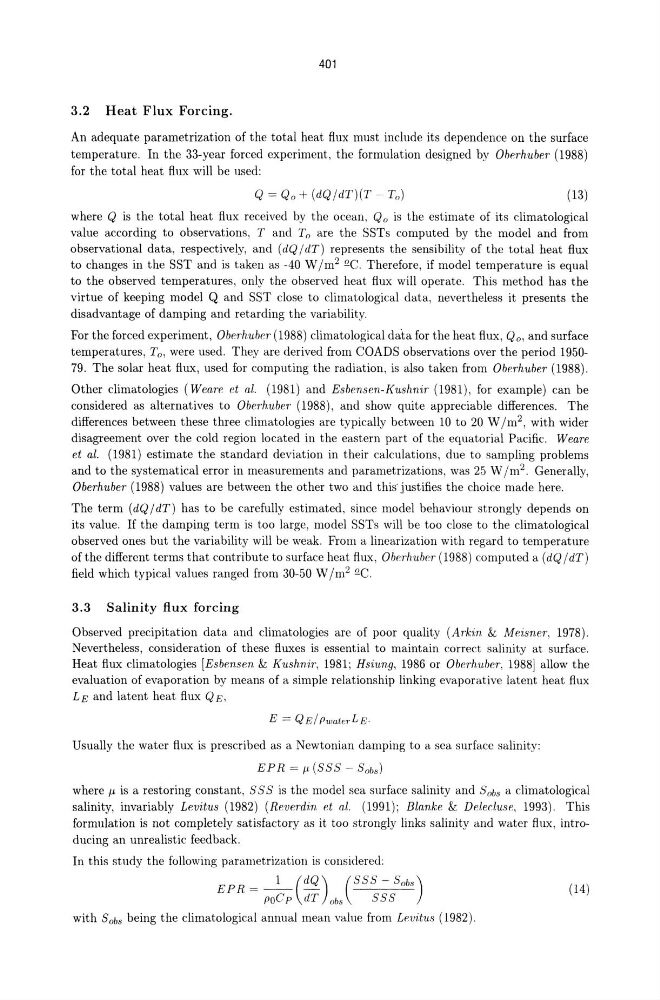
Q = Qo + (dQldT)(T - To)
(13)
where Q is the total heat flux received by the ocean, Qo is the estimate of its climatological
value according to observations, T and To are the SSTs computed by the model and from
observational data, respectively, and (dQldT) represents the sensibility of the total heat flux
to changes in the SST and is taken as -40 W 1m 2 QC. Therefore, if model temperature is equal
to the observed temperatures, only the observed heat flux will operate. This method has the
virtue of keeping model Q and SST close to climatological data, nevertheless it presents the
disadvantage of damping and retarding the variability.
For the forced experiment, Oberhuber (1988) climatological data for the heat flux, Q 0, and surface
temperatures, To, were used. They are derived from COADS observations over the period 195079. The solar heat flux, used for computing the radiation, is also taken from Oberhuber (1988).
Other climatologies (Weare et aL (1981) and Esbensen-Kushnir (1981), for example) can be
considered as alternatives to Oberhuber (1988), and show quite appreciable differences. The
differences between these three climatologies are typically between 10 to 20 W 1m 2 , with wider
disagreement over the cold region located in the eastern part of the equatorial Pacific. Weare
et al. (1981) estimate the standard deviation in their calculations, due to sampling problems
and to the systematical error in measurements and parametrizations, was 25 W 1m2. Generally,
Oberhuber (1988) values are between the other two and this· justifies the choice made here.
The term (dQldT) has to be carefully estimated, since model behaviour strongly depends on
its value. If the damping term is too large, model SSTs will be too close to the climatological
observed ones but the variability will be weak. From a linearization with regard to temperature
ofthe different terms that contribute to surface heat flux, Oberhuber (1988) computed a (dQ I dT)
field which typical values ranged from 30-50 W 1m 2 QC.
3.3 Salinity flux forcing
Observed precipitation data and climatologies are of poor quality (Arkin & Meisner, 1978).
Nevertheless, consideration of these fluxes is essential to maintain correct salinity at surface.
Heat flux climatologies [Esbensen & Kushnir, 1981; Hsiung, 1986 or Oberhuber, 1988] allow the
evaluation of evaporation by means of a simple relationship linking evaporative latent heat flux
L E and latent heat flux Q E,
Usually the water flux is prescribed as a Newtonian damping to a sea surface salinity:
EP R = J.L (SSS - Sobs)
where J.L is a restoring constant, SSS is the model sea surface salinity and Sobs a climatological
salinity, invariably Levitus (1982) (Reverdin et a.l. (1991); Bla.nke & Deleduse, 1993). This
formulation is not completely satisfactory as it too strongly links salinity and water flux, introducing an unrealistic feedback.
In this study the following parametrization is considered:
EPR _ _ 1_(d Q )
(SSS - SObS)
poep dT obs
SSS
(14)
with Sobs being the climatological annual mean value from Levitus (1982).
3.2 Heat Flux Forcing.
An adequate parametrization of the total heat flux must include its dependence on the surface
temperature. In the 33-year forced experiment, the formulation designed by Oberhuber (1988)
for the total heat flux will be used:
Q = Qo + (dQldT)(T - To)
(13)
where Q is the total heat flux received by the ocean, Qo is the estimate of its climatological
value according to observations, T and To are the SSTs computed by the model and from
observational data, respectively, and (dQldT) represents the sensibility of the total heat flux
to changes in the SST and is taken as -40 W 1m 2 QC. Therefore, if model temperature is equal
to the observed temperatures, only the observed heat flux will operate. This method has the
virtue of keeping model Q and SST close to climatological data, nevertheless it presents the
disadvantage of damping and retarding the variability.
For the forced experiment, Oberhuber (1988) climatological data for the heat flux, Q 0, and surface
temperatures, To, were used. They are derived from COADS observations over the period 195079. The solar heat flux, used for computing the radiation, is also taken from Oberhuber (1988).
Other climatologies (Weare et aL (1981) and Esbensen-Kushnir (1981), for example) can be
considered as alternatives to Oberhuber (1988), and show quite appreciable differences. The
differences between these three climatologies are typically between 10 to 20 W 1m 2 , with wider
disagreement over the cold region located in the eastern part of the equatorial Pacific. Weare
et al. (1981) estimate the standard deviation in their calculations, due to sampling problems
and to the systematical error in measurements and parametrizations, was 25 W 1m2. Generally,
Oberhuber (1988) values are between the other two and this· justifies the choice made here.
The term (dQldT) has to be carefully estimated, since model behaviour strongly depends on
its value. If the damping term is too large, model SSTs will be too close to the climatological
observed ones but the variability will be weak. From a linearization with regard to temperature
ofthe different terms that contribute to surface heat flux, Oberhuber (1988) computed a (dQ I dT)
field which typical values ranged from 30-50 W 1m 2 QC.
3.3 Salinity flux forcing
Observed precipitation data and climatologies are of poor quality (Arkin & Meisner, 1978).
Nevertheless, consideration of these fluxes is essential to maintain correct salinity at surface.
Heat flux climatologies [Esbensen & Kushnir, 1981; Hsiung, 1986 or Oberhuber, 1988] allow the
evaluation of evaporation by means of a simple relationship linking evaporative latent heat flux
L E and latent heat flux Q E,
Usually the water flux is prescribed as a Newtonian damping to a sea surface salinity:
EP R = J.L (SSS - Sobs)
where J.L is a restoring constant, SSS is the model sea surface salinity and Sobs a climatological
salinity, invariably Levitus (1982) (Reverdin et a.l. (1991); Bla.nke & Deleduse, 1993). This
formulation is not completely satisfactory as it too strongly links salinity and water flux, introducing an unrealistic feedback.
In this study the following parametrization is considered:
EPR _ _ 1_(d Q )
(SSS - SObS)
poep dT obs
SSS
(14)
with Sobs being the climatological annual mean value from Levitus (1982).