

380
s • .,
hI
s,
h,
b
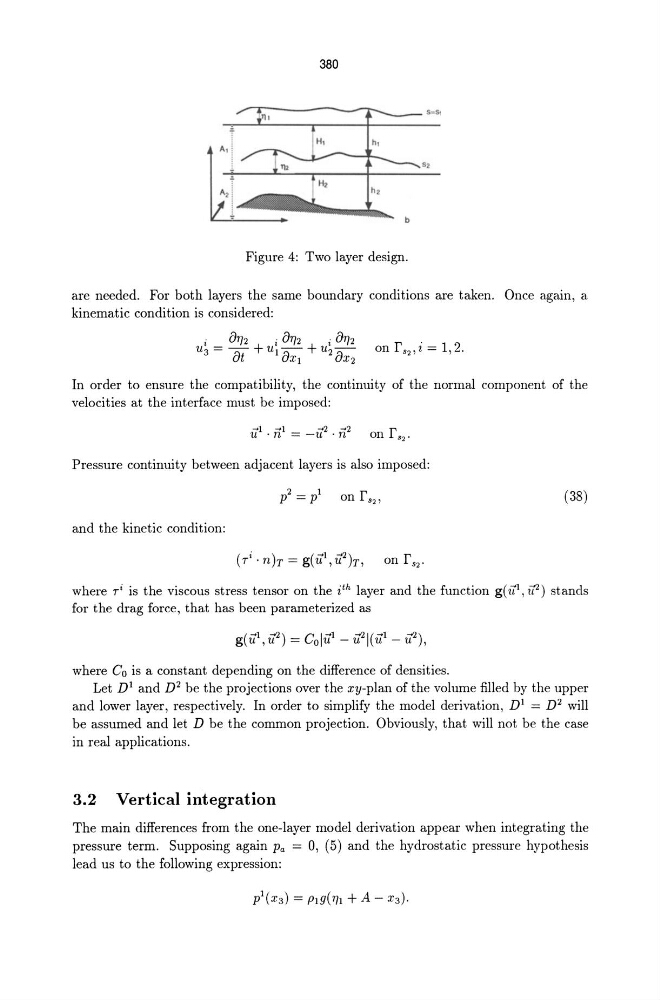
Figure 4: Two layer design.
are needed. For both layers the same boundary conditions are taken. Once again, a
kinematic condition is considered:
In order to ensure the compatibility, the continuity of the normal component of the
velocities at the interface must be imposed:
Pressure continuity between adjacent layers is also imposed:
(38)
and the kinetic condition:
( i )
(-1 -2)
T . n T = g U , U T,
where T i is the viscous stress tensor on the ith layer and the function g( ttl, tP) stands
for the drag force, that has been parameterized as
where Co is a constant depending on the difference of densities.
Let Dl and D2 be the projections over the xy-plan of the volume filled by the upper
and lower layer, respectively. In order to simplify the model derivation, DI = D2 will
be assumed and let D be the common projection. Obviously, that will not be the case
in real applications.
3.2 Vertical integration
The main differences from the one-layer model derivation appear when integrating the
pressure term. Supposing again Pa = 0, (5) and the hydrostatic pressure hypothesis
lead us to the following expression:
s • .,
hI
s,
h,
b
Figure 4: Two layer design.
are needed. For both layers the same boundary conditions are taken. Once again, a
kinematic condition is considered:
In order to ensure the compatibility, the continuity of the normal component of the
velocities at the interface must be imposed:
Pressure continuity between adjacent layers is also imposed:
(38)
and the kinetic condition:
( i )
(-1 -2)
T . n T = g U , U T,
where T i is the viscous stress tensor on the ith layer and the function g( ttl, tP) stands
for the drag force, that has been parameterized as
where Co is a constant depending on the difference of densities.
Let Dl and D2 be the projections over the xy-plan of the volume filled by the upper
and lower layer, respectively. In order to simplify the model derivation, DI = D2 will
be assumed and let D be the common projection. Obviously, that will not be the case
in real applications.
3.2 Vertical integration
The main differences from the one-layer model derivation appear when integrating the
pressure term. Supposing again Pa = 0, (5) and the hydrostatic pressure hypothesis
lead us to the following expression: