

377
-
; '
-
h'~
x=c(t)
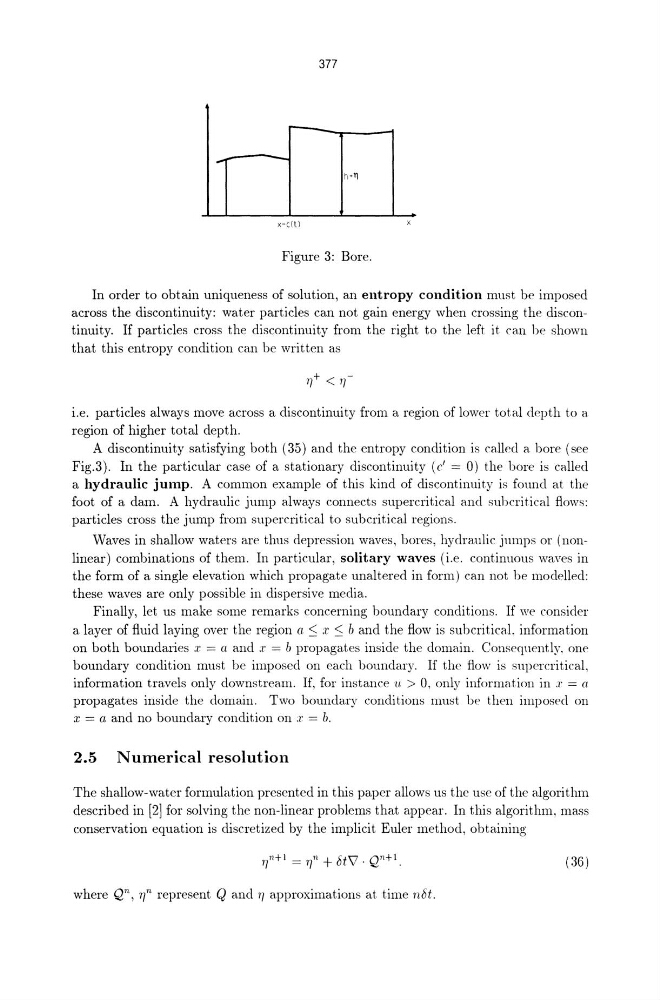
Figure 3: Bore.
In order to obtain uniqueness of solution, an entropy condition must be imposed
across the discontinuity: water particles can not gain energy when crossing the discontinuity. If particles cross the discontinuity from the right to the left it can be shown
that this entropy condition can be written as
i.e. particles always move across a discontinuity from a region of lower tot.al depth to a
region of higher total depth.
A discontinuity satisfying both (35) and the entropy condition is called a bore (see
Fig.3). In the particular case of a stationary discontinuity (c' = 0) the bore is called
a hydraulic jump. A common example of this kind of discontinuity is found at the
foot of a dam. A hydraulic jump always connects supercritical and sub critical flows:
particles cross the jump from supercritical to sub critical regions.
Waves in shallow waters are thus depression waves, bores, hydraulic jumps or (nonlinear) combinations of them. In particular, solitary waves (i.e. continuous waves in
the form of a single elevation which propagate unaltered in form) can not be modelled:
these waves are only possible in dispersive media.
Finally, let us make some remarks concerning boundary conditions. If we consider
a layer of fluid laying over the region a :::; x :::; b and the flow is subcritical, information
on both boundaries x = a and x = b propagates inside the domain. Consequently, one
boundary condition must be imposed on each boundary. If the flow is supercritical,
information travels only downstream. If, for instance 1l > 0, only information in x = a
propagates inside the domain. Two boundary conditions must be then imposed on
x = a and no boundary condition on x = b.
2.5 Numerical resolution
The shallow-water formulation presented in this paper allows us the use of the algorithm
described in [2] for solving the non-linear problems that appear. In this algorithm, mass
conservation equation is discretized by the implicit Euler method, obtaining
(36)
where Qn, TJn represent Q and TJ approximations at time nbt.
-
; '
-
h'~
x=c(t)
Figure 3: Bore.
In order to obtain uniqueness of solution, an entropy condition must be imposed
across the discontinuity: water particles can not gain energy when crossing the discontinuity. If particles cross the discontinuity from the right to the left it can be shown
that this entropy condition can be written as
i.e. particles always move across a discontinuity from a region of lower tot.al depth to a
region of higher total depth.
A discontinuity satisfying both (35) and the entropy condition is called a bore (see
Fig.3). In the particular case of a stationary discontinuity (c' = 0) the bore is called
a hydraulic jump. A common example of this kind of discontinuity is found at the
foot of a dam. A hydraulic jump always connects supercritical and sub critical flows:
particles cross the jump from supercritical to sub critical regions.
Waves in shallow waters are thus depression waves, bores, hydraulic jumps or (nonlinear) combinations of them. In particular, solitary waves (i.e. continuous waves in
the form of a single elevation which propagate unaltered in form) can not be modelled:
these waves are only possible in dispersive media.
Finally, let us make some remarks concerning boundary conditions. If we consider
a layer of fluid laying over the region a :::; x :::; b and the flow is subcritical, information
on both boundaries x = a and x = b propagates inside the domain. Consequently, one
boundary condition must be imposed on each boundary. If the flow is supercritical,
information travels only downstream. If, for instance 1l > 0, only information in x = a
propagates inside the domain. Two boundary conditions must be then imposed on
x = a and no boundary condition on x = b.
2.5 Numerical resolution
The shallow-water formulation presented in this paper allows us the use of the algorithm
described in [2] for solving the non-linear problems that appear. In this algorithm, mass
conservation equation is discretized by the implicit Euler method, obtaining
(36)
where Qn, TJn represent Q and TJ approximations at time nbt.