

23
3 Optimal control of distributed systems with state
constraints
In this section we consider two examples of optimal control problems arising from the
design and management of a wastewater treatment system. In order to analyze and
numerically solve these problems we begin with an introduction to optimal control theory
in an abstract framework. Further information can be found in references Lions[1968] and
[1985].
3.1 Statement of the problem
In an optimal control problem we have three main elements:
• the control, which belongs to a functional space U,
• the state, which can be obtained as the solution of the "state equation"; a partial
differential equation in our context.
• and the cost function which is a function of the control and the state to be minimized.
In addition, we can have some state constraints, i.e. conditions to be satisfied by the
state. In many practical situations this corresponds to the fact that it has to belong to a
certain subset of a functional space.
Optimal control theory deals with the following problems:
1. Existence of solution
2. Optimality conditions
3. Numerical methods, including discretization and iterative algorithms for solving the
discretized problem.
In this presentation we consider the case where the state equation is a partial differential
equation of parabolic type. Let V and H be two Hilbert spaces such that V is densely
included in H. By identifying H to its topological dual we have V c H c V'.
Let A be a bounded linear operator from V into its topological dual V'. We suppose
A is coercive, i.e.
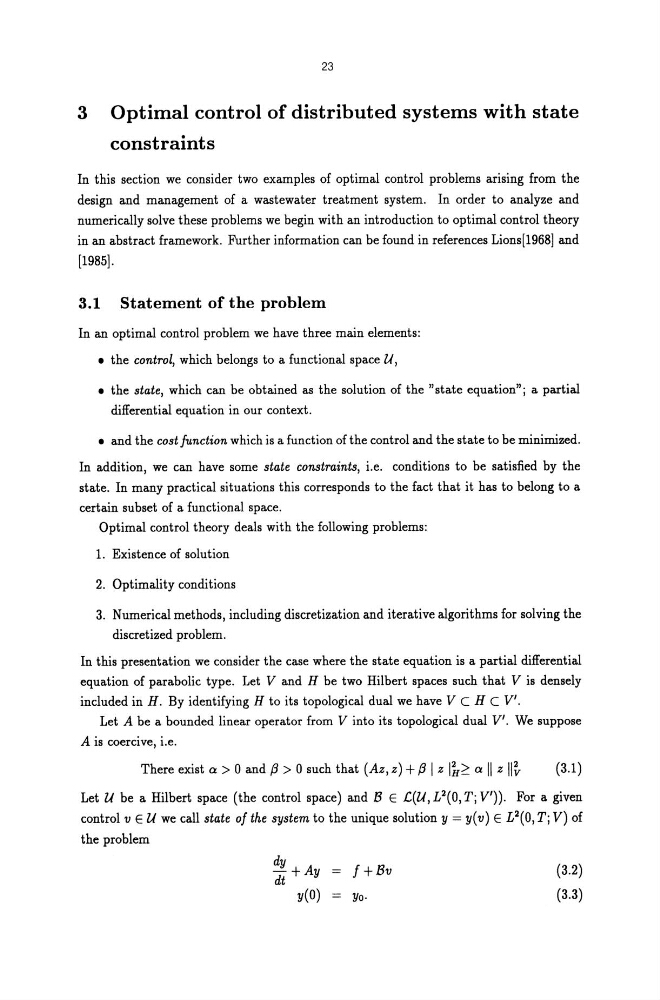
There exist Q; > 0 and (3 > 0 such that (Az, z) + (31 z It-~ Q; I I z II~
(3.1)
Let U be a Hilbert space (the control space) and BE £(U,L2(0,T;V')). For a given
control v E U we call state of the system to the unique solution y = y( v) E L2(0, Tj V) of
the problem
dy
-+Ay
dt
y(O)
f +Bv
Yo·
(3.2)
(3.3)
3 Optimal control of distributed systems with state
constraints
In this section we consider two examples of optimal control problems arising from the
design and management of a wastewater treatment system. In order to analyze and
numerically solve these problems we begin with an introduction to optimal control theory
in an abstract framework. Further information can be found in references Lions[1968] and
[1985].
3.1 Statement of the problem
In an optimal control problem we have three main elements:
• the control, which belongs to a functional space U,
• the state, which can be obtained as the solution of the "state equation"; a partial
differential equation in our context.
• and the cost function which is a function of the control and the state to be minimized.
In addition, we can have some state constraints, i.e. conditions to be satisfied by the
state. In many practical situations this corresponds to the fact that it has to belong to a
certain subset of a functional space.
Optimal control theory deals with the following problems:
1. Existence of solution
2. Optimality conditions
3. Numerical methods, including discretization and iterative algorithms for solving the
discretized problem.
In this presentation we consider the case where the state equation is a partial differential
equation of parabolic type. Let V and H be two Hilbert spaces such that V is densely
included in H. By identifying H to its topological dual we have V c H c V'.
Let A be a bounded linear operator from V into its topological dual V'. We suppose
A is coercive, i.e.
There exist Q; > 0 and (3 > 0 such that (Az, z) + (31 z It-~ Q; I I z II~
(3.1)
Let U be a Hilbert space (the control space) and BE £(U,L2(0,T;V')). For a given
control v E U we call state of the system to the unique solution y = y( v) E L2(0, Tj V) of
the problem
dy
-+Ay
dt
y(O)
f +Bv
Yo·
(3.2)
(3.3)