

356
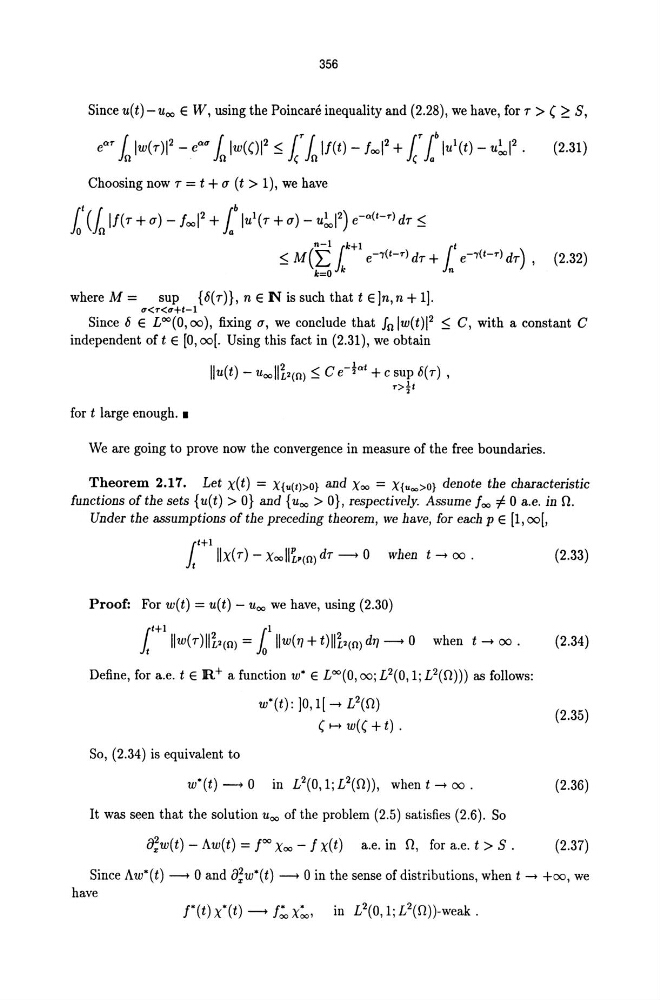
Since u(t) - Uoo E W, using the Poincare inequality and (2.28), we have, for r > ( ~ S,
ear In Iw(r)1 2 - e au In Iw((W :::; [In If(t) - fool2 + [llul(t) - u~12 . (2.31)
Choosing now r = t + (J (t > 1), we have
l (In If(r + (J) - fool2 + llul(r + (J) - U~12) e-a(t-r) dr:::;
n-I
1
k+l
it
: : : ; M(:L
e-')'(t-r) dr + e-')'(t-r) dr) ,
k=O k
n
(2.32)
whereM=
sup {c5(r)},nENissuchthattE]n,n+l].
u
independent of t E [0,00[. Using this fact in (2.31), we obtain
lIu(t) - uoo Il12({}) :::; C e- tat + c sup c5(r) ,
r>tt
for t large enough. I
We are going to prove now the convergence in measure of the free boundaries.
Theorem 2.17. Let X(t) = X{u(t»O} and Xoo = X{uoo>O} denote the characteristic
functions of the sets {u( t) > O} and {uoo > O}, respectively. Assume f 00 =f. 0 a.e. in O.
Under the assumptions of the preceding theorem, we have, for each p E [1,00[,
t+l
it II X( r) - Xoo lI~p({}) dr ----- 0 when t ---> 00 .
(2.33)
Proof: For w(t) = u(t) - Uoo we have, using (2.30)
t+l
2
r l
it IIw(r)II£2({}) = io IIw(1J + t)1112({})d1J ----- 0 when t --+ 00 .
(2.34)
Define, for a.e. t E R+ a function w* E LOO(O, 00; L2(0, 1; L2(0))) as follows:
w*(t): ]0, I[ --+ L2(0)
( f--+ w( ( + t) .
(2.35)
So, (2.34) is equivalent to
w*(t) ----- 0 in L2(0, 1; L2(0)), when t ---> 00 .
(2.36)
It was seen that the solution U oo of the problem (2.5) satisfies (2.6). So
8;w(t) - Aw(t) = foo Xoo - f x(t) a.e. in 0, for a.e. t > S .
(2.37)
Since Aw*(t) ----- 0 and 8;w*(t) ----- 0 in the sense of distributions, when t --+ +00, we
have
!*(t) X*(t) ----- f~ X::."
in L2(0, 1; L2(0))-weak .
Since u(t) - Uoo E W, using the Poincare inequality and (2.28), we have, for r > ( ~ S,
ear In Iw(r)1 2 - e au In Iw((W :::; [In If(t) - fool2 + [llul(t) - u~12 . (2.31)
Choosing now r = t + (J (t > 1), we have
l (In If(r + (J) - fool2 + llul(r + (J) - U~12) e-a(t-r) dr:::;
n-I
1
k+l
it
: : : ; M(:L
e-')'(t-r) dr + e-')'(t-r) dr) ,
k=O k
n
(2.32)
whereM=
sup {c5(r)},nENissuchthattE]n,n+l].
u
independent of t E [0,00[. Using this fact in (2.31), we obtain
lIu(t) - uoo Il12({}) :::; C e- tat + c sup c5(r) ,
r>tt
for t large enough. I
We are going to prove now the convergence in measure of the free boundaries.
Theorem 2.17. Let X(t) = X{u(t»O} and Xoo = X{uoo>O} denote the characteristic
functions of the sets {u( t) > O} and {uoo > O}, respectively. Assume f 00 =f. 0 a.e. in O.
Under the assumptions of the preceding theorem, we have, for each p E [1,00[,
t+l
it II X( r) - Xoo lI~p({}) dr ----- 0 when t ---> 00 .
(2.33)
Proof: For w(t) = u(t) - Uoo we have, using (2.30)
t+l
2
r l
it IIw(r)II£2({}) = io IIw(1J + t)1112({})d1J ----- 0 when t --+ 00 .
(2.34)
Define, for a.e. t E R+ a function w* E LOO(O, 00; L2(0, 1; L2(0))) as follows:
w*(t): ]0, I[ --+ L2(0)
( f--+ w( ( + t) .
(2.35)
So, (2.34) is equivalent to
w*(t) ----- 0 in L2(0, 1; L2(0)), when t ---> 00 .
(2.36)
It was seen that the solution U oo of the problem (2.5) satisfies (2.6). So
8;w(t) - Aw(t) = foo Xoo - f x(t) a.e. in 0, for a.e. t > S .
(2.37)
Since Aw*(t) ----- 0 and 8;w*(t) ----- 0 in the sense of distributions, when t --+ +00, we
have
!*(t) X*(t) ----- f~ X::."
in L2(0, 1; L2(0))-weak .