

326
Q
s
H
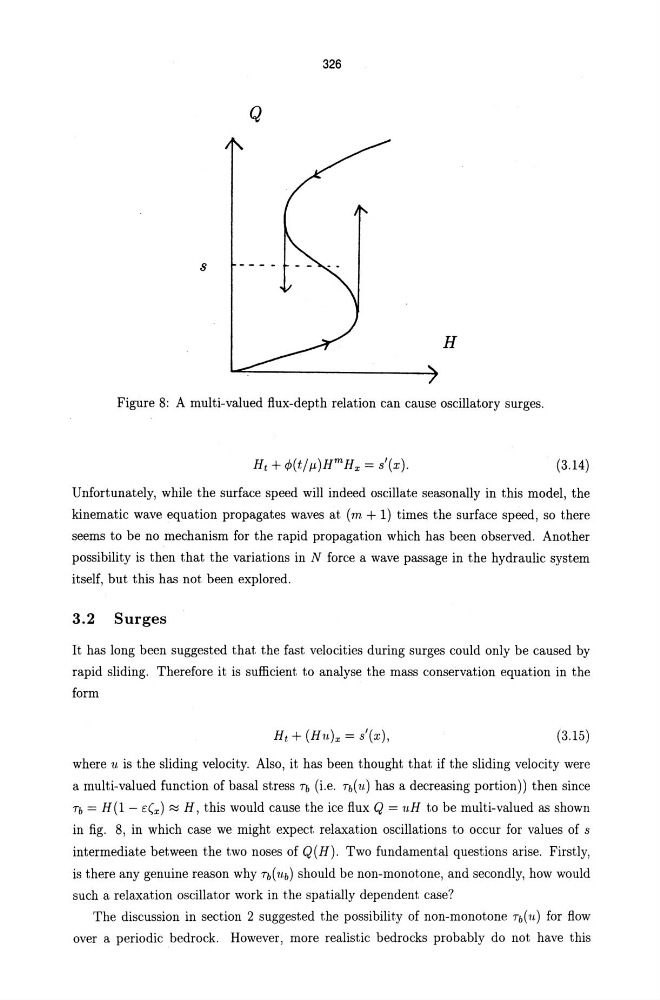
Figure 8: A multi-valued flux-depth relation can cause oscillatory surges.
(3.14)
Unfortunately, while the surface speed will indeed oscillate seasonally in this model, the
kinematic wave equation propagates waves at (m + 1) times the surface speed, so there
seems to be no mechanism for the rapid propagation which has been observed. Another
possibility is then that the variations in N force a wave passage in the hydraulic system
itself, but this has not been explored.
3.2 Surges
It has long been suggested that the fast velocities during surges could only be caused by
rapid sliding. Therefore it is sufficient to analyse the mass conservation equation in the
form
Ht + (Hu.)x = SI(X),
(3.15)
where u. is the sliding velocity. Also, it has been thought that if the sliding velocity were
a multi-valued function of basal stress Tb (i.e. Tb(U.) has a decreasing portion)) then since
Tb = H(l- e(x) ~ H, this would cause the ice flux Q = uH to be multi"valued as shown
in fig. 8, in which case we might expect relaxation oscillations to occur for values of s
intermediate between the two noses of Q(H). Two fundamental questions arise. Firstly,
is there any genuine reason why Tb(1/.b) should be non-monotone, and secondly, how would
such a relaxation oscillator work in the spatially dependent case?
The discussion in section 2 suggested the possibility of non-monotone Tb(U.) for flow
over a periodic bedrock. However, more realistic bedrocks probably do not have this
Q
s
H
Figure 8: A multi-valued flux-depth relation can cause oscillatory surges.
(3.14)
Unfortunately, while the surface speed will indeed oscillate seasonally in this model, the
kinematic wave equation propagates waves at (m + 1) times the surface speed, so there
seems to be no mechanism for the rapid propagation which has been observed. Another
possibility is then that the variations in N force a wave passage in the hydraulic system
itself, but this has not been explored.
3.2 Surges
It has long been suggested that the fast velocities during surges could only be caused by
rapid sliding. Therefore it is sufficient to analyse the mass conservation equation in the
form
Ht + (Hu.)x = SI(X),
(3.15)
where u. is the sliding velocity. Also, it has been thought that if the sliding velocity were
a multi-valued function of basal stress Tb (i.e. Tb(U.) has a decreasing portion)) then since
Tb = H(l- e(x) ~ H, this would cause the ice flux Q = uH to be multi"valued as shown
in fig. 8, in which case we might expect relaxation oscillations to occur for values of s
intermediate between the two noses of Q(H). Two fundamental questions arise. Firstly,
is there any genuine reason why Tb(1/.b) should be non-monotone, and secondly, how would
such a relaxation oscillator work in the spatially dependent case?
The discussion in section 2 suggested the possibility of non-monotone Tb(U.) for flow
over a periodic bedrock. However, more realistic bedrocks probably do not have this