

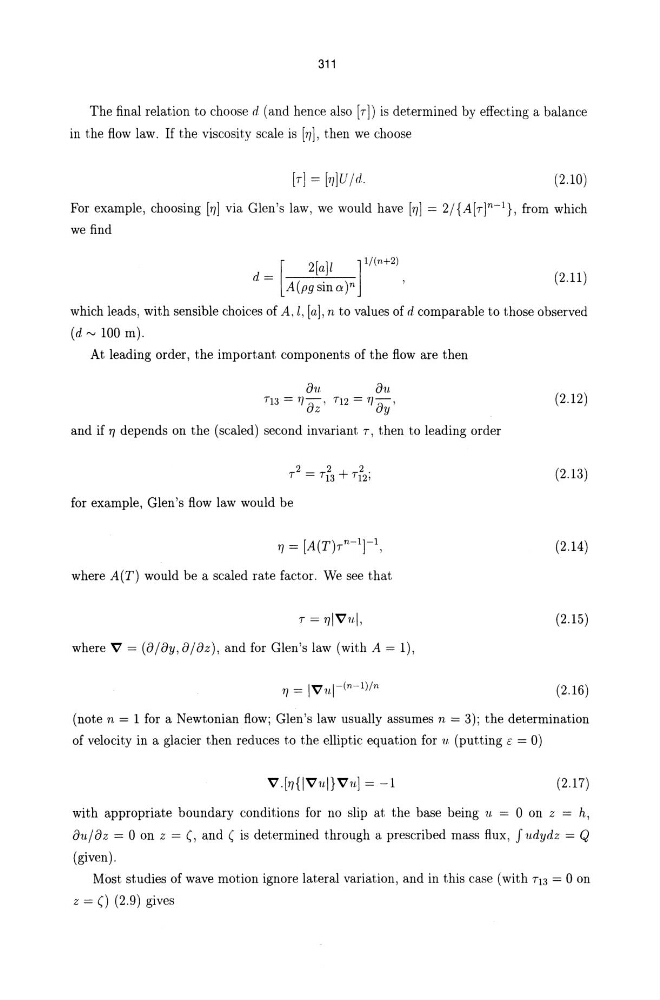
311
The final relation to choose d (and hence also [7]) is determined by effecting a balance
in the flow law. If the viscosity scale is [1)], then we choose
[7] = [1)]Uld.
(2.10)
For example, choosing [1)] via Glen's law, we would have [1)] = 2/{A[7r- 1 }, from which
we find
d = [ 2[aJI ] 1/(n+2)
A(pg sin a)n
'
(2.11)
which leads, with sensible choices of A, I, [aJ, n to values of d comparable to those observed
(d'" 100 m).
At leading order, the important components of the flow are then
on
ou.
713 = 1) oz' 712 = 1) oy'
(2.12)
and if 1) depends on the (scaled) second invariant 7, then to leading order
for example, Glen's flow law would be
(2.14)
where A(T) would be a scaled rate factor. We see that
7 = 1)IVnl,
(2.15)
where V = (oloy,oloz), and for Glen's law (with A = 1),
1) = IV11.1-(n-l)/n
(2.16)
(note n = 1 for a Newtonian flow; Glen's law usually assumes n = 3); the determination
of velocity in a glacier then reduces to the elliptic equation for 71, (putting E = 0)
V.[1){IV11.1}V11.] = -1
(2,17)
with appropriate boundary conditions for no slip at the base being 11. = 0 on z = h,
onloz = 0 on z = (, and ( is determined through a prescribed mass flux, J u.dydz = Q
(given).
Most studies of wave motion ignore lateral variation, and in this case (with 713 = 0 on
z = () (2.9) gives
The final relation to choose d (and hence also [7]) is determined by effecting a balance
in the flow law. If the viscosity scale is [1)], then we choose
[7] = [1)]Uld.
(2.10)
For example, choosing [1)] via Glen's law, we would have [1)] = 2/{A[7r- 1 }, from which
we find
d = [ 2[aJI ] 1/(n+2)
A(pg sin a)n
'
(2.11)
which leads, with sensible choices of A, I, [aJ, n to values of d comparable to those observed
(d'" 100 m).
At leading order, the important components of the flow are then
on
ou.
713 = 1) oz' 712 = 1) oy'
(2.12)
and if 1) depends on the (scaled) second invariant 7, then to leading order
for example, Glen's flow law would be
(2.14)
where A(T) would be a scaled rate factor. We see that
7 = 1)IVnl,
(2.15)
where V = (oloy,oloz), and for Glen's law (with A = 1),
1) = IV11.1-(n-l)/n
(2.16)
(note n = 1 for a Newtonian flow; Glen's law usually assumes n = 3); the determination
of velocity in a glacier then reduces to the elliptic equation for 71, (putting E = 0)
V.[1){IV11.1}V11.] = -1
(2,17)
with appropriate boundary conditions for no slip at the base being 11. = 0 on z = h,
onloz = 0 on z = (, and ( is determined through a prescribed mass flux, J u.dydz = Q
(given).
Most studies of wave motion ignore lateral variation, and in this case (with 713 = 0 on
z = () (2.9) gives