

285
Structural Hypotheses.
(A4) ~>. > ° for every eigenvalue>. unless ~>. = >'0(/1,19);
(A5) ((/1,19) E 1iJ: >'0(/1,19) = o} is finite.
Of course, we can then again use the implicit function theorem and establish that
IiJ is locally a one-dimensional sub manifold of (0,00) x C([-T, O] x M,(O, 00)) near
(/1,19) E ~ \ {(O, O)} with >'0(/1,19) =1= 0, but Amann's result employed before to handle
>'0(/1,19) = ° must be modified due to the fact that D2II is lacking compactness. In
skipping the question of uniqueness of fixed points of II(/1, .), in case that /1 is close to
zero or infinity, we obtain:
Theorem 4. (cf. [Hetzer (1995)]) Let (Al) - (A5) be fulfilled. Then
a) IiJ is the trace of a Jordan curve in R+ x C+([-T, 0] x M): there exists a homeomorphism,: R+ -; ~ (onto), which is C 2 from (0,00) onto ~ \ {(O,O)} with
,'(p) =1= (0,0) for all p E (0,00).
b) ~ is "S-shaped": prl 0 ,(p) -; 00, inf pr2 0 ,(p) --+ 00 as p --+ 00, and prl 0 ,
has an even number of strict local extrema (turning points) in (0,00).
c) Given (/1,19) E 1iJ, u("'; /1,19) is an orbitally asymptotically stable (unstable)
periodic solution of (22) provided that ,'(,-1(/1, 19)) > ° « 0).
Finally, let us indicate how to determine sgn(>'o(/1,19)) without solving an eigenvalue
problem that involves a nonlinear eigenparameter. A way of approaching this question
is to decouple the two terms on the right hand side of (24) by introducing a second
parameter, say K E R. This leads to
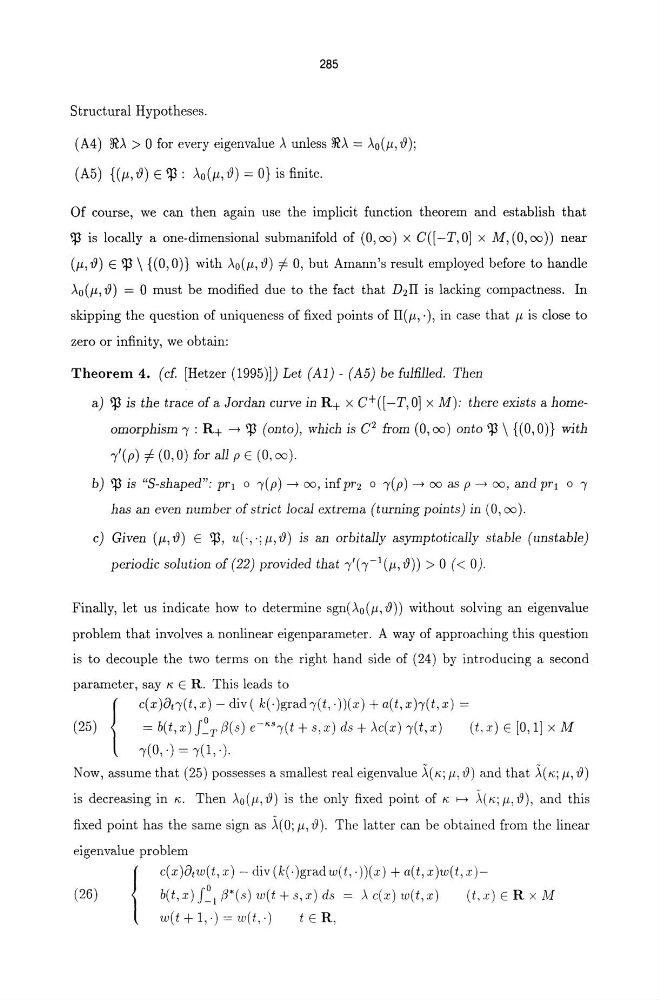
{
c(x )on(t, x) - div ( k(·)grad ,(t, ·))(x) + a(t, x h(t, x) =
(25)
= b(t,x)J~T(3(s) e-I
Now, assume that (25) possesses a smallest real eigenvalue ~(K; /1, 19) and that ~(K; J-l, 19)
is decreasing in K. Then AO(J-l,19) is the only fixed point of K t--> ~(K; J-l, 19), and this
fixed point has the same sign as ~(O; J-l, 19). The latter can be obtained from the linear
eigenvalue problem
{
c(x)Otw(t,x) - div(k(·)gradw(t, .))(x) + a(t,x)w(t,x)(26)
b(t,x)J~l (3*(s) w(t + s,x) ds = A c(x) w(t,x) (t,x) E R x M
w(t+1,.)=w(t,·)
tER,
Structural Hypotheses.
(A4) ~>. > ° for every eigenvalue>. unless ~>. = >'0(/1,19);
(A5) ((/1,19) E 1iJ: >'0(/1,19) = o} is finite.
Of course, we can then again use the implicit function theorem and establish that
IiJ is locally a one-dimensional sub manifold of (0,00) x C([-T, O] x M,(O, 00)) near
(/1,19) E ~ \ {(O, O)} with >'0(/1,19) =1= 0, but Amann's result employed before to handle
>'0(/1,19) = ° must be modified due to the fact that D2II is lacking compactness. In
skipping the question of uniqueness of fixed points of II(/1, .), in case that /1 is close to
zero or infinity, we obtain:
Theorem 4. (cf. [Hetzer (1995)]) Let (Al) - (A5) be fulfilled. Then
a) IiJ is the trace of a Jordan curve in R+ x C+([-T, 0] x M): there exists a homeomorphism,: R+ -; ~ (onto), which is C 2 from (0,00) onto ~ \ {(O,O)} with
,'(p) =1= (0,0) for all p E (0,00).
b) ~ is "S-shaped": prl 0 ,(p) -; 00, inf pr2 0 ,(p) --+ 00 as p --+ 00, and prl 0 ,
has an even number of strict local extrema (turning points) in (0,00).
c) Given (/1,19) E 1iJ, u("'; /1,19) is an orbitally asymptotically stable (unstable)
periodic solution of (22) provided that ,'(,-1(/1, 19)) > ° « 0).
Finally, let us indicate how to determine sgn(>'o(/1,19)) without solving an eigenvalue
problem that involves a nonlinear eigenparameter. A way of approaching this question
is to decouple the two terms on the right hand side of (24) by introducing a second
parameter, say K E R. This leads to
{
c(x )on(t, x) - div ( k(·)grad ,(t, ·))(x) + a(t, x h(t, x) =
(25)
= b(t,x)J~T(3(s) e-I
Now, assume that (25) possesses a smallest real eigenvalue ~(K; /1, 19) and that ~(K; J-l, 19)
is decreasing in K. Then AO(J-l,19) is the only fixed point of K t--> ~(K; J-l, 19), and this
fixed point has the same sign as ~(O; J-l, 19). The latter can be obtained from the linear
eigenvalue problem
{
c(x)Otw(t,x) - div(k(·)gradw(t, .))(x) + a(t,x)w(t,x)(26)
b(t,x)J~l (3*(s) w(t + s,x) ds = A c(x) w(t,x) (t,x) E R x M
w(t+1,.)=w(t,·)
tER,