

280
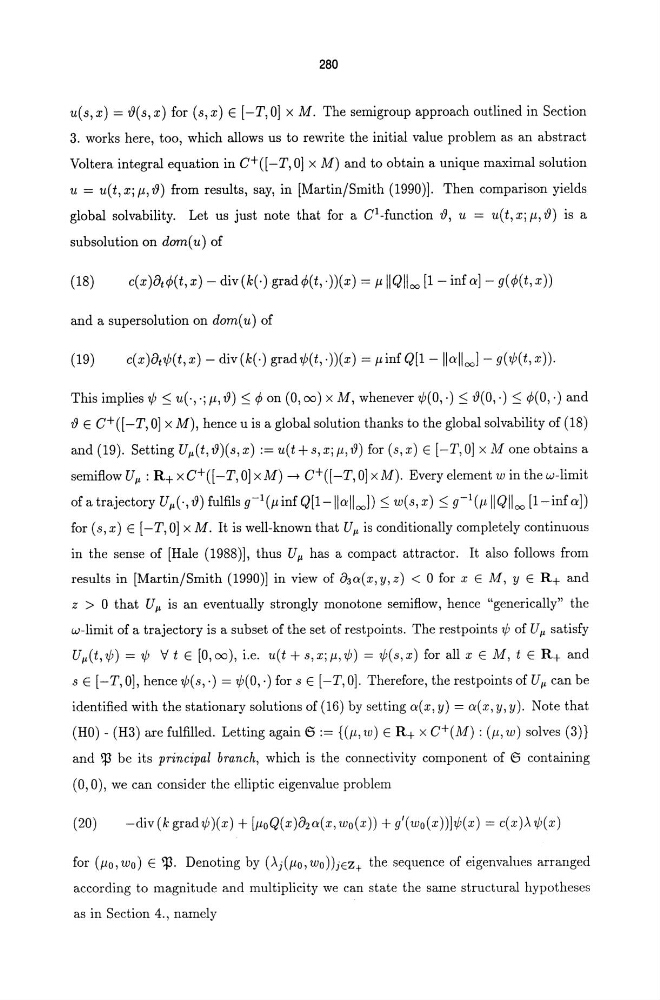
u(s,x) = ti(s,x) for (s,x) E [-T,O] x M. The semi group approach outlined in Section
3. works here, too, which allows us to rewrite the initial value problem as an abstract
Volt era integral equation in C+([-T, 0] x M) and to obtain a unique maximal solution
u = u(t, Xj fl, ti) from results, say, in [Martin/Smith (1990)]. Then comparison yields
global solvability. Let us just note that for a CI-function ti, u = u(t,Xjfl,ti) is a
subsolution on dom( u) of
(18)
c( x )8t and a supersolution on dom( u) of
(19)
c(x)8t1/;(t,x) - div(k(·) grad1/;(t,·))(x) = flinfQ[I-llalloo]- g(1/;(t, x)).
This implies 1/; ::; u(·,·j fl, ti) ::; 19 E C+([ - T, 0] x M), hence u is a global solution thanks to the global solvability of (18)
and (19). Setting Up.(t,19)(s,x) := u(t+S,Xjfl,ti) for (s,x) E [-T, 0] x M one obtains a
semiflow Up. : R+ xC+([-T, 0] xM) --4 C+([-T, 0] xM). Every element w in the w-limit
of a trajectory Up.(·, ti) fulfils 9-I(fl inf Q[I-llallool) ::; w( s, x) ::; 9-I(flll Qlloo [1-inf al)
for (s, x) E [-T,O] x M. It is well-known that Up. is conditionally completely continuous
in the sense of [Hale (1988)]' thus Up. has a compact attractor. It also follows from
results in [Martin/Smith (1990)] in view of 83 a(x,y,z) < ° for x E M, y E R+ and
z > ° that Up. is an eventually strongly monotone semiflow, hence "generically" the
w-limit of a trajectory is a subset of the set of restpoints. The restpoints 1/; of Up. satisfy
Up.(t,1/;) = 1/; If t E [0,00), i.e. u(t + S,Xjfl,1/;) = 1/;(s,x) for all x E M, t E R+ and
S E [-T, 0], hence 1/;( s,·) = 1/;(0,,) for s E [-T, 0]. Therefore, the restpoints of Up. can be
identified with the stationary solutions of (16) by setting a(x, y) = a(x, y, y). Note that
(HO) - (H3) are fulfilled. Letting again 6 := {(fl, w) E R+ x C+(M) : (/1, w) solves (3)}
and \13 be its principal branch, which is the connectivity component of 6 containing
(0,0), we can consider the elliptic eigenvalue problem
(20)
-div (k grad 1/; )(x) + [/1oQ(x )82 a(x, wo(x)) + g'( wo(x ))]1/;(x) = C(X)A 1/;(x)
for (flo,Wo) E \13. Denoting by (Aj(flo,wO))jEZ+ the sequence of eigenvalues arranged
according to magnitude and multiplicity we can state the same structural hypotheses
as in Section 4., namely
u(s,x) = ti(s,x) for (s,x) E [-T,O] x M. The semi group approach outlined in Section
3. works here, too, which allows us to rewrite the initial value problem as an abstract
Volt era integral equation in C+([-T, 0] x M) and to obtain a unique maximal solution
u = u(t, Xj fl, ti) from results, say, in [Martin/Smith (1990)]. Then comparison yields
global solvability. Let us just note that for a CI-function ti, u = u(t,Xjfl,ti) is a
subsolution on dom( u) of
(18)
c( x )8t and a supersolution on dom( u) of
(19)
c(x)8t1/;(t,x) - div(k(·) grad1/;(t,·))(x) = flinfQ[I-llalloo]- g(1/;(t, x)).
This implies 1/; ::; u(·,·j fl, ti) ::; 19 E C+([ - T, 0] x M), hence u is a global solution thanks to the global solvability of (18)
and (19). Setting Up.(t,19)(s,x) := u(t+S,Xjfl,ti) for (s,x) E [-T, 0] x M one obtains a
semiflow Up. : R+ xC+([-T, 0] xM) --4 C+([-T, 0] xM). Every element w in the w-limit
of a trajectory Up.(·, ti) fulfils 9-I(fl inf Q[I-llallool) ::; w( s, x) ::; 9-I(flll Qlloo [1-inf al)
for (s, x) E [-T,O] x M. It is well-known that Up. is conditionally completely continuous
in the sense of [Hale (1988)]' thus Up. has a compact attractor. It also follows from
results in [Martin/Smith (1990)] in view of 83 a(x,y,z) < ° for x E M, y E R+ and
z > ° that Up. is an eventually strongly monotone semiflow, hence "generically" the
w-limit of a trajectory is a subset of the set of restpoints. The restpoints 1/; of Up. satisfy
Up.(t,1/;) = 1/; If t E [0,00), i.e. u(t + S,Xjfl,1/;) = 1/;(s,x) for all x E M, t E R+ and
S E [-T, 0], hence 1/;( s,·) = 1/;(0,,) for s E [-T, 0]. Therefore, the restpoints of Up. can be
identified with the stationary solutions of (16) by setting a(x, y) = a(x, y, y). Note that
(HO) - (H3) are fulfilled. Letting again 6 := {(fl, w) E R+ x C+(M) : (/1, w) solves (3)}
and \13 be its principal branch, which is the connectivity component of 6 containing
(0,0), we can consider the elliptic eigenvalue problem
(20)
-div (k grad 1/; )(x) + [/1oQ(x )82 a(x, wo(x)) + g'( wo(x ))]1/;(x) = C(X)A 1/;(x)
for (flo,Wo) E \13. Denoting by (Aj(flo,wO))jEZ+ the sequence of eigenvalues arranged
according to magnitude and multiplicity we can state the same structural hypotheses
as in Section 4., namely