

278
by (16). Of course, as before one should consider the principal branch of the fixed
point set and investigate the questions, which led to the concept of S-shapedness. It
is presently unknown though whether S-shapedness persists in this framework, and before, we have even to look out for an appropriate basic dynamical theory (existence,
uniqueness, continuous dependence) for (16). It seems that Amann's approach to parabolic evolution equations (cf. the survey article [Amann (1993)] for references and a
forthcoming monograph) could provide an appropriate setting.
A few papers [Bhattacharya et al. (1982), Hetzer/Schmidt (1995), Hetzer (1995)]
have been devoted to special cases of (16), and they all have in common that the
inertia term c is independent of temperature, i.e. c = c( x). Thereby one arrives at a
standard semilinear functional parabolic equation, a fact, which constitutes a significant
mathematical simplification. As we will see, S-shapedness then persists under structural
hypotheses completely analogous to those utilized before.
It is instructive to begin with a brief look at a model without seasonal cycle. In that
case one has, roughly speaking, the same stationary solutions as for the model without
memory term, but of course it is not at all obvious that the stability properties of these
stationary solutions do not change, when a delay term is introduced. Our main result
addresses a situation that includes the seasonal variation.
12. Persistence of S-shapedness for a Model without Seasonal Resolution.
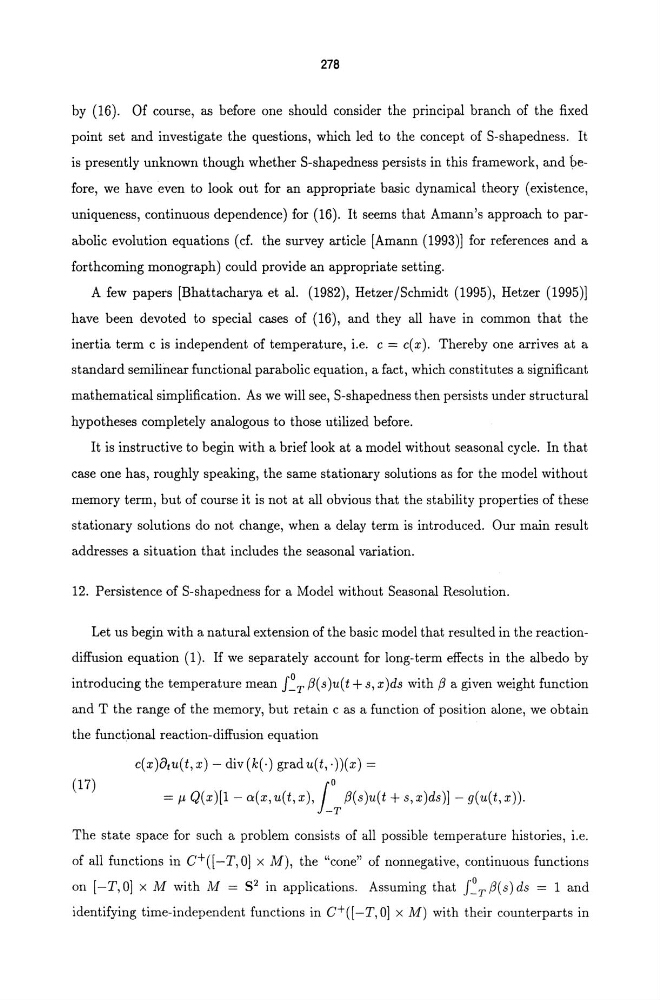
Let us begin with a natural extension of the basic model that resulted in the reactiondiffusion equation (1). If we separately account for long-term effects in the albedo by
introducing the temperature mean J~T {3( s )u( t + s, x )ds with (3 a given weight function
and T the range of the memory, but retain c as a function of position alone, we obtain
the functional reaction-diffusion equation
c(x )8t u(t, x) - div (k(·) grad u(t,· ))(x) =
(17)
= J.t Q(x)[l- a(x,u(t,x), lOT {3(s)u(t + s,x)ds)]- g(u(t,x)).
The state space for such a problem consists of all possible temperature histories, i.e.
of all functions in C+([-T,O] X M), the "cone" of nonnegative, continuous functions
on [-T,O] X M with M = 8 2 in applications. Assuming that J~T{3(s)ds = 1 and
identifying time-independent functions in C+([-T, O] X M) with their counterparts in
by (16). Of course, as before one should consider the principal branch of the fixed
point set and investigate the questions, which led to the concept of S-shapedness. It
is presently unknown though whether S-shapedness persists in this framework, and before, we have even to look out for an appropriate basic dynamical theory (existence,
uniqueness, continuous dependence) for (16). It seems that Amann's approach to parabolic evolution equations (cf. the survey article [Amann (1993)] for references and a
forthcoming monograph) could provide an appropriate setting.
A few papers [Bhattacharya et al. (1982), Hetzer/Schmidt (1995), Hetzer (1995)]
have been devoted to special cases of (16), and they all have in common that the
inertia term c is independent of temperature, i.e. c = c( x). Thereby one arrives at a
standard semilinear functional parabolic equation, a fact, which constitutes a significant
mathematical simplification. As we will see, S-shapedness then persists under structural
hypotheses completely analogous to those utilized before.
It is instructive to begin with a brief look at a model without seasonal cycle. In that
case one has, roughly speaking, the same stationary solutions as for the model without
memory term, but of course it is not at all obvious that the stability properties of these
stationary solutions do not change, when a delay term is introduced. Our main result
addresses a situation that includes the seasonal variation.
12. Persistence of S-shapedness for a Model without Seasonal Resolution.
Let us begin with a natural extension of the basic model that resulted in the reactiondiffusion equation (1). If we separately account for long-term effects in the albedo by
introducing the temperature mean J~T {3( s )u( t + s, x )ds with (3 a given weight function
and T the range of the memory, but retain c as a function of position alone, we obtain
the functional reaction-diffusion equation
c(x )8t u(t, x) - div (k(·) grad u(t,· ))(x) =
(17)
= J.t Q(x)[l- a(x,u(t,x), lOT {3(s)u(t + s,x)ds)]- g(u(t,x)).
The state space for such a problem consists of all possible temperature histories, i.e.
of all functions in C+([-T,O] X M), the "cone" of nonnegative, continuous functions
on [-T,O] X M with M = 8 2 in applications. Assuming that J~T{3(s)ds = 1 and
identifying time-independent functions in C+([-T, O] X M) with their counterparts in