

276
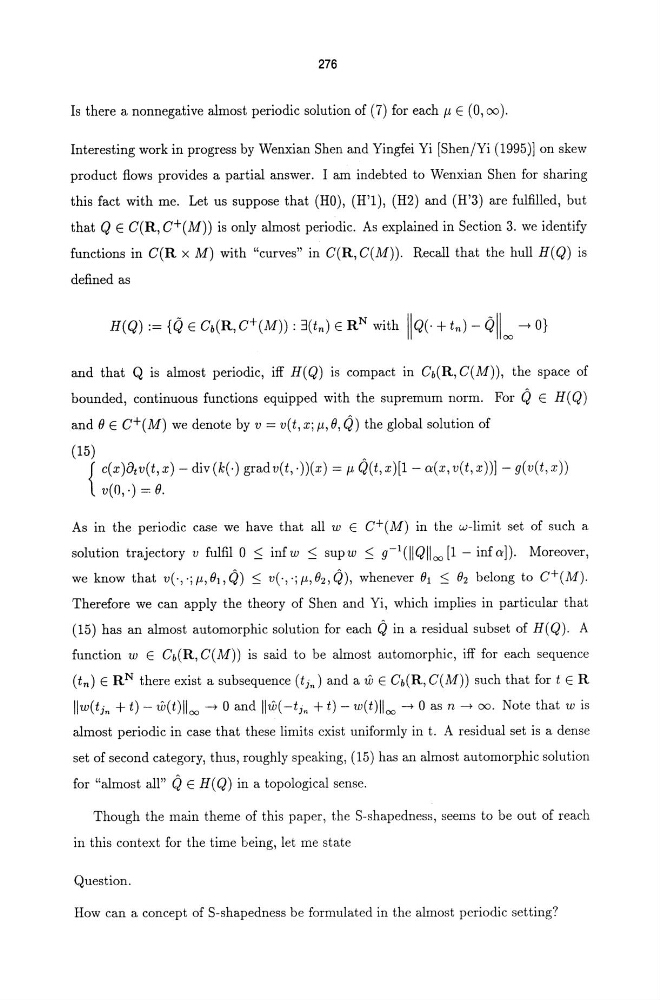
Is there a nonnegative almost periodic solution of (7) for each fl E (0,00).
Interesting work in progress by Wenxian Shen and Yingfei Yi [ShenjYi (1995)] on skew
product flows provides a partial answer. I am indebted to Wenxian Shen for sharing
this fact with me. Let us suppose that (HO), (H'l), (H2) and (H'3) are fulfilled, but
that Q E C(R, C+(M)) is only almost periodic. As explained in Section 3. we identify
functions in C(R x M) with "curves" in C(R, C(M)). Recall that the hull H(Q) is
defined as
and that Q is almost periodic, iff H(Q) is compact in Cb(R, C(M)), the space of
bounded, continuous functions equipped with the supremum norm. For Q E H(Q)
and B E C+(M) we denote by v = v(t,x;/1,B,Q) the global solution of
(15)
{
c(x)Otv(t,x) - div(k(-) gradv(t,·))(x) = /1 Q(t,x)[l- a(x,v(t,x))]- g(v(t,x))
v(O,') = B.
As in the periodic case we have that all w E C+(M) in the w-limit set of such a
solution trajectory v fulfil 0 :::; infw :::; supw :::; g-I(IIQlloo[l- infa]). Moreover,
we know that v(.,·; /1Jh, Q) :::; v(-,.; /1, 82 , Q), whenever 81 :::; 82 belong to C+(M).
Therefore we can apply the theory of Shen and Yi, which implies in particular that
(15) has an almost automorphic solution for each Q in a residual subset of H(Q). A
function w E Cb(R, C(M)) is said to be almost automorphic, iff for each sequence
(t n) E RN there exist a subsequence (tjJ and awE Cb(R,C(M)) such that for t E R
Ilw(tjn + t) - w(t)lloo -+ 0 and Ilw( -tjn + t) - w(t)lloo -+ 0 as n -+ 00. Note that w is
almost periodic in case that these limits exist uniformly in t. A residual set is a dense
set of second category, thus, roughly speaking, (15) has an almost automorphic solution
for "almost all" Q E H( Q) in a topological sense.
Though the main theme of this paper, the S-shapedness, seems to be out of reach
in this context for the time being, let me state
Question.
How can a concept of S-shapedness be formulated in the almost periodic setting?
Is there a nonnegative almost periodic solution of (7) for each fl E (0,00).
Interesting work in progress by Wenxian Shen and Yingfei Yi [ShenjYi (1995)] on skew
product flows provides a partial answer. I am indebted to Wenxian Shen for sharing
this fact with me. Let us suppose that (HO), (H'l), (H2) and (H'3) are fulfilled, but
that Q E C(R, C+(M)) is only almost periodic. As explained in Section 3. we identify
functions in C(R x M) with "curves" in C(R, C(M)). Recall that the hull H(Q) is
defined as
and that Q is almost periodic, iff H(Q) is compact in Cb(R, C(M)), the space of
bounded, continuous functions equipped with the supremum norm. For Q E H(Q)
and B E C+(M) we denote by v = v(t,x;/1,B,Q) the global solution of
(15)
{
c(x)Otv(t,x) - div(k(-) gradv(t,·))(x) = /1 Q(t,x)[l- a(x,v(t,x))]- g(v(t,x))
v(O,') = B.
As in the periodic case we have that all w E C+(M) in the w-limit set of such a
solution trajectory v fulfil 0 :::; infw :::; supw :::; g-I(IIQlloo[l- infa]). Moreover,
we know that v(.,·; /1Jh, Q) :::; v(-,.; /1, 82 , Q), whenever 81 :::; 82 belong to C+(M).
Therefore we can apply the theory of Shen and Yi, which implies in particular that
(15) has an almost automorphic solution for each Q in a residual subset of H(Q). A
function w E Cb(R, C(M)) is said to be almost automorphic, iff for each sequence
(t n) E RN there exist a subsequence (tjJ and awE Cb(R,C(M)) such that for t E R
Ilw(tjn + t) - w(t)lloo -+ 0 and Ilw( -tjn + t) - w(t)lloo -+ 0 as n -+ 00. Note that w is
almost periodic in case that these limits exist uniformly in t. A residual set is a dense
set of second category, thus, roughly speaking, (15) has an almost automorphic solution
for "almost all" Q E H( Q) in a topological sense.
Though the main theme of this paper, the S-shapedness, seems to be out of reach
in this context for the time being, let me state
Question.
How can a concept of S-shapedness be formulated in the almost periodic setting?