

271
The same techniques that were briefly indicated at the beginning of section 3, I.e.
semigroup approach and comparison, yield here:
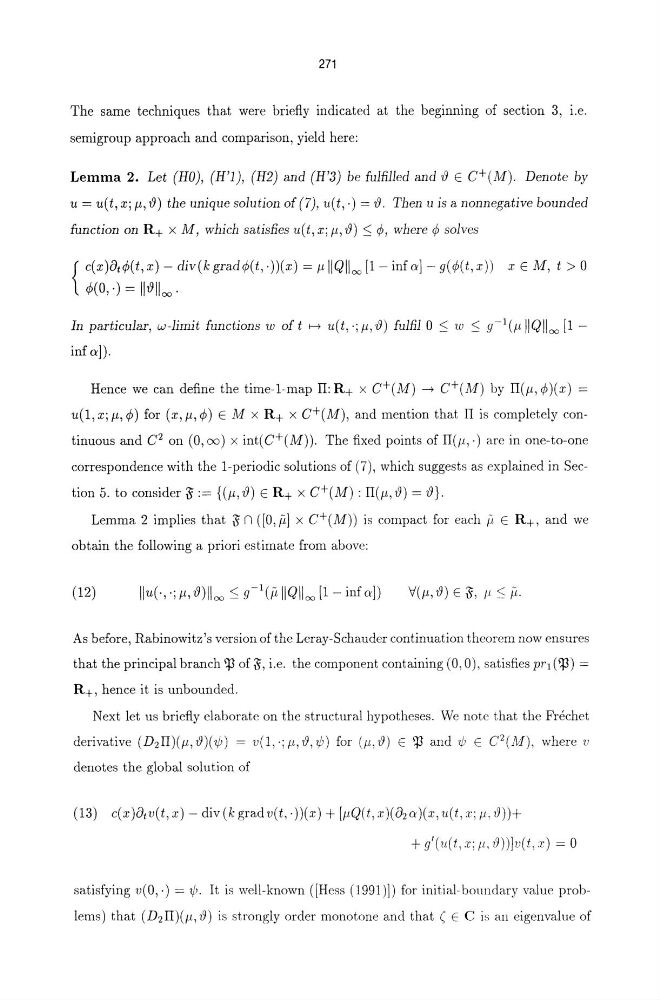
Lemma 2. Let (HD), (H'l), (H2) and (H'3) be fulfilled and {} E C+(M). Denote by
u = u( t, Xi fl., {}) the unique solution of (7), u( t, .) = {}. Then u is a nonnegative bounded
function on R+ x M, which satisfies u(t, X; fl., {}) ::; {
c(x )8t x E M, t > 0
In particular, w-limit functions w of t 1-+ u(t,·; fl., {}) fulfil 0 ::; w ::; 9-l(flIIQlioo [1 -
inf 0:]).
Hence we can define the time-I-map II:R+ x C+(M) --+ C+(M) by II(fl, u(l,x;fl., correspondence with the I-periodic solutions of (7), which suggests as explained in Section 5. to consider ~:= {(fl,{}) E R+ x C+(M): II(fl.,{}) = {}}.
Lemma 2 implies that ~ n ([0, jL] x C+(M)) is compact for each jL E R+, and we
obtain the following a priori estimate from above:
(12)
V(fl., {}) E~, fl. ::; jL.
As before, Rabinowitz's version of the Leray-Schauder continuation theorem now ensures
that the principal branch \P of~, i.e. the component containing (0,0), satisfies prl (\P) =
R+, hence it is unbounded.
Next let us briefly elaborate on the structural hypotheses. We note that the Frechet
derivative (D2 II)(fl,{})(lj;) = v(1,';fl,{},lj;) for (fl,{}) E \P and lj; E C2(M), where v
denotes the global solution of
(13) c(x )8t v(t, x) - div (k grad vet, . ))( x) + [IlQ( t, x)( 82 0: )(x, u(t, x; fl, {}))+
+ g'(u(t,:!:; fl, {}))]v(t, x) = 0
satisfying v(O,·) = lj;. It is well-known ([Hess (1991)]) for initial-boundary value problems) that (D2 II)(fl.,{}) is strongly order monotone and that (E C is an eigenvalue of
The same techniques that were briefly indicated at the beginning of section 3, I.e.
semigroup approach and comparison, yield here:
Lemma 2. Let (HD), (H'l), (H2) and (H'3) be fulfilled and {} E C+(M). Denote by
u = u( t, Xi fl., {}) the unique solution of (7), u( t, .) = {}. Then u is a nonnegative bounded
function on R+ x M, which satisfies u(t, X; fl., {}) ::; {
c(x )8t x E M, t > 0
In particular, w-limit functions w of t 1-+ u(t,·; fl., {}) fulfil 0 ::; w ::; 9-l(flIIQlioo [1 -
inf 0:]).
Hence we can define the time-I-map II:R+ x C+(M) --+ C+(M) by II(fl, u(l,x;fl., correspondence with the I-periodic solutions of (7), which suggests as explained in Section 5. to consider ~:= {(fl,{}) E R+ x C+(M): II(fl.,{}) = {}}.
Lemma 2 implies that ~ n ([0, jL] x C+(M)) is compact for each jL E R+, and we
obtain the following a priori estimate from above:
(12)
V(fl., {}) E~, fl. ::; jL.
As before, Rabinowitz's version of the Leray-Schauder continuation theorem now ensures
that the principal branch \P of~, i.e. the component containing (0,0), satisfies prl (\P) =
R+, hence it is unbounded.
Next let us briefly elaborate on the structural hypotheses. We note that the Frechet
derivative (D2 II)(fl,{})(lj;) = v(1,';fl,{},lj;) for (fl,{}) E \P and lj; E C2(M), where v
denotes the global solution of
(13) c(x )8t v(t, x) - div (k grad vet, . ))( x) + [IlQ( t, x)( 82 0: )(x, u(t, x; fl, {}))+
+ g'(u(t,:!:; fl, {}))]v(t, x) = 0
satisfying v(O,·) = lj;. It is well-known ([Hess (1991)]) for initial-boundary value problems) that (D2 II)(fl.,{}) is strongly order monotone and that (E C is an eigenvalue of